Idea gallery · 8 ideas
Bedroom desk ideas: 8 ways to fit work into a sleeping room
Idea gallery 0 sources
A desk fits into a small bedroom when it is shallow, can close or hide, and leaves the walkway beside the bed free. A wall-mounted desk with a flap, a desk inside a wardrobe or a corner behind a curtain lets work disappear at night. Check that the chair has room to pull out, and keep chargers and cables away from the bedding.
-
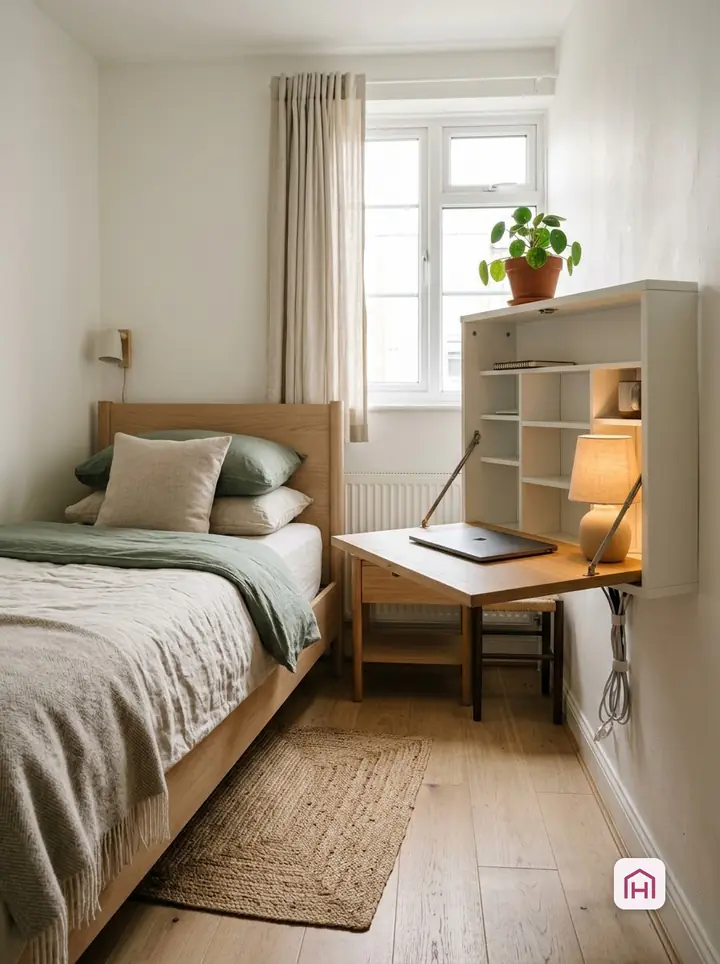
A wall-mounted desk that closes
Open for work, closed for sleep.
Why it works
A wall-mounted desk with a flap that closes over the work surface takes little depth when shut and hides the laptop at night. Pigeonholes inside hold the small things.
Materials and furniture
- Wall-mounted fold-down desk
- Fixings for the wall and load
Check first
- Fix into solid wall or studs with suitable fixings; the picture does not show the fixings or test the flap.
- Clear the flap before closing it, and do not lean on it when open.
- Here the desk sits in front of a radiator: keep the stool and the closed flap from blocking its warmth.
-
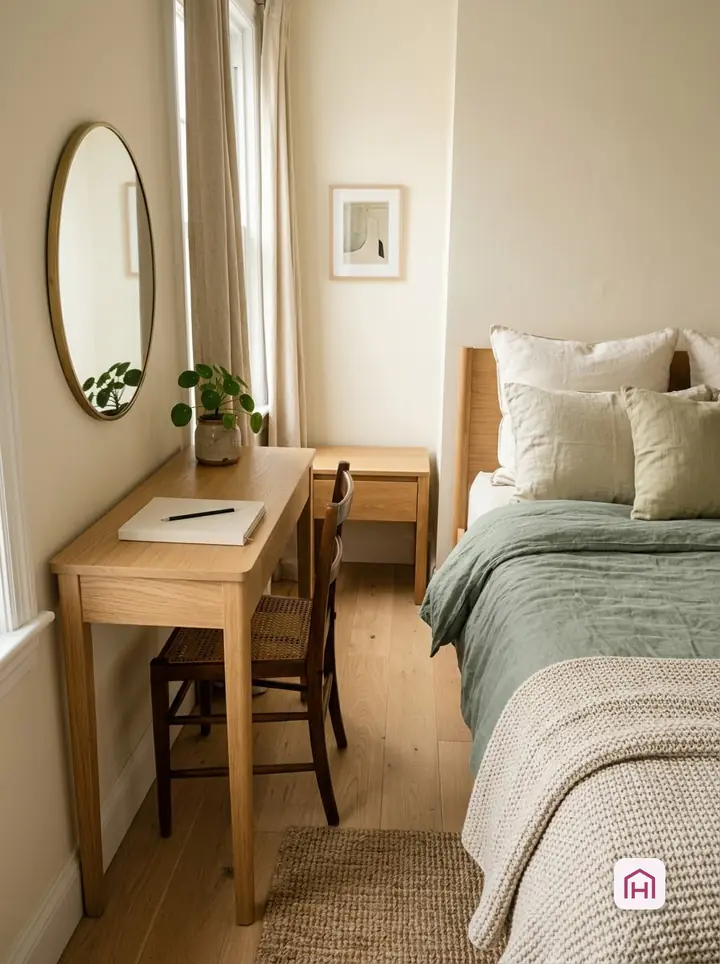
A dressing table that doubles as a desk
Mirror in the morning, notebook in the afternoon.
Why it works
A slim dressing table takes make-up in the morning and a notebook or laptop in the afternoon; one piece of furniture, two jobs.
Materials and furniture
- Slim dressing table with drawer
- Chair that tucks under
Check first
- Choose one deep enough for a laptop if you need one; the picture shows only a notebook.
- Clear the top between uses.
- Check the strip between table and bed is wide enough to pass when the chair is out.
-
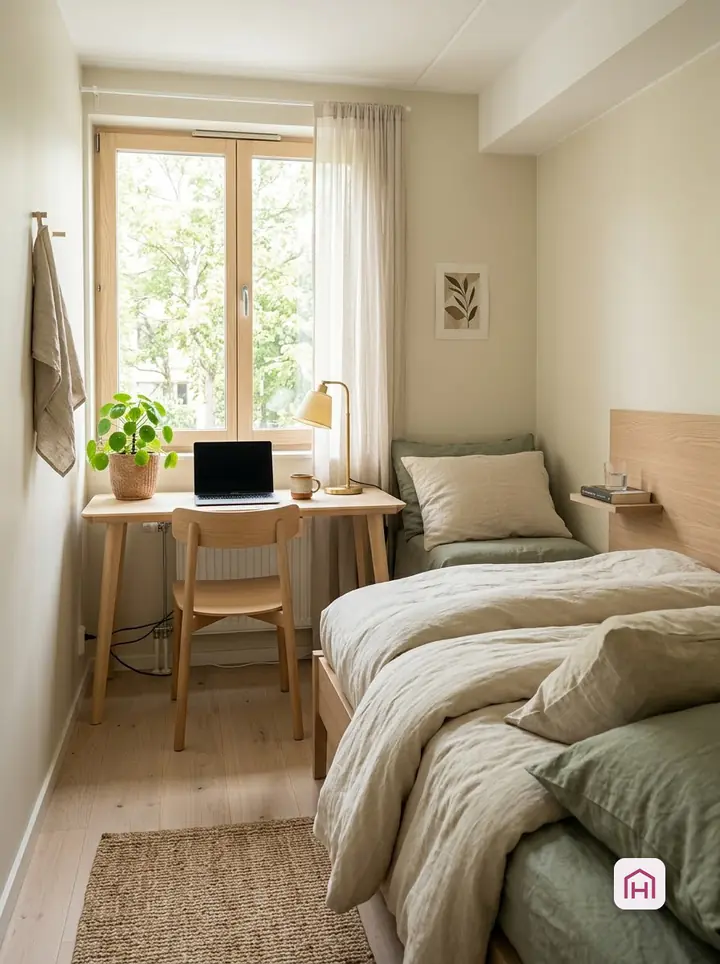
A desk under the window, beside the bed
Daylight on the desk, the bed just behind you.
Why it works
A small desk under the window gets the best light. Here it stands beside the head of the bed; with the chair turned to the window, the bed stays out of sight while you work.
Materials and furniture
- Narrow desk
- Chair
Check first
- Keep room to walk between the chair and the bed.
- Bundle the cords; in the picture a power strip and loose cables sit under the desk.
- The window must still open, and the radiator behind the desk needs space for warm air.
-
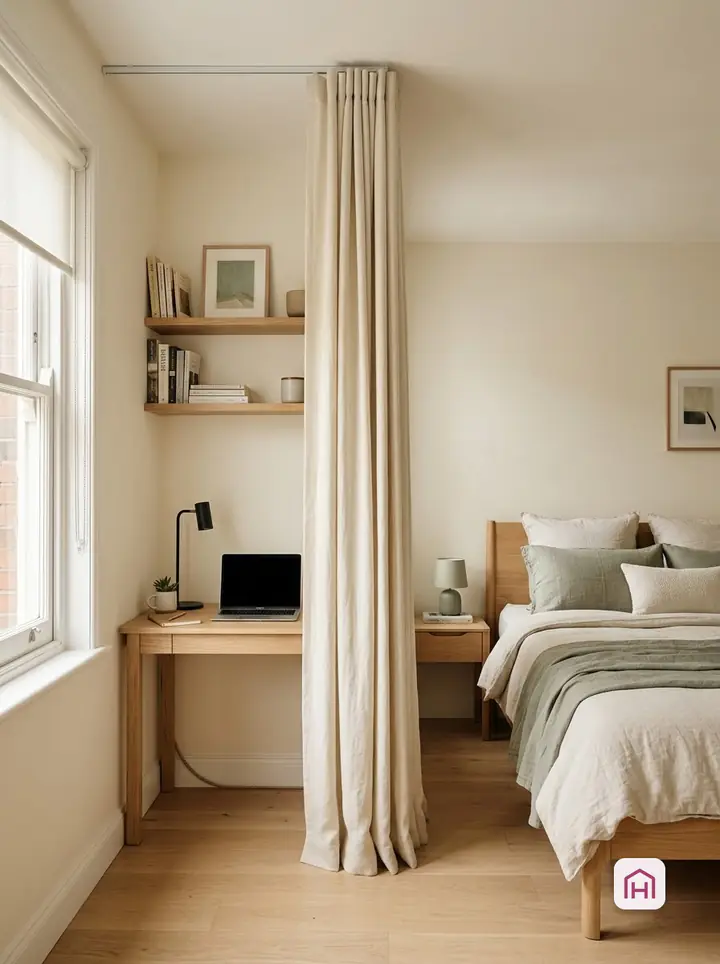
A corner desk behind a curtain
Draw the curtain and the office is out of sight.
Why it works
A desk in a corner with a ceiling-track curtain beside it can be hidden at night, so the bedroom stays calm. The picture shows the curtain gathered; drawn, it closes off the corner.
Materials and furniture
- Corner desk
- Ceiling track
- Curtain
Check first
- Curtain clear of lamps and heaters.
- Track fixed securely; the picture does not show the curtain fully drawn.
- Plan a chair that fits in the corner; none is shown.
-
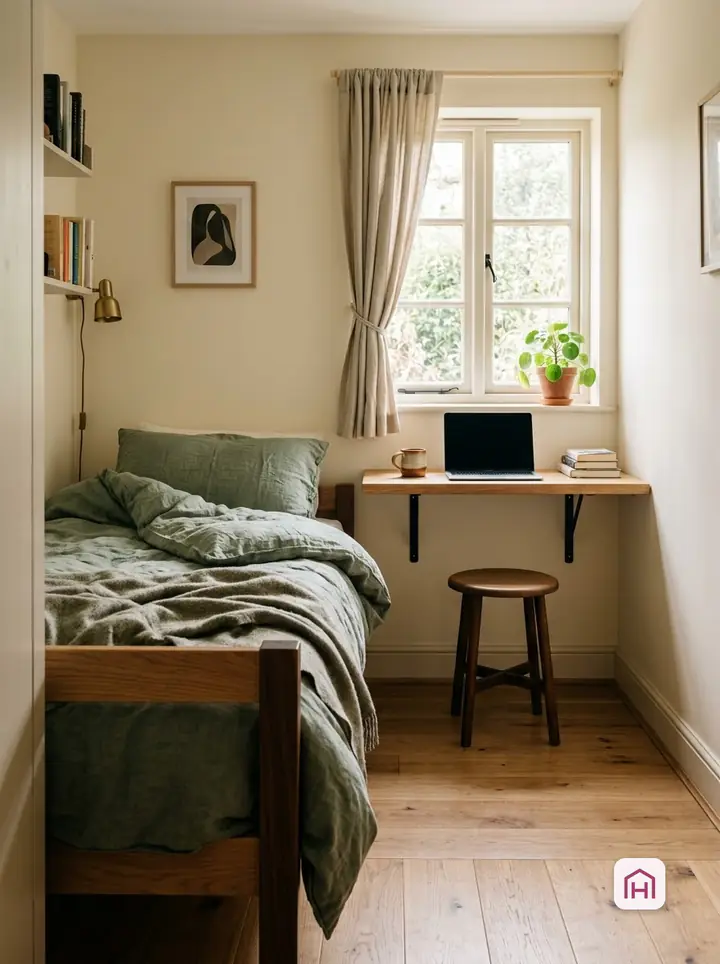
A wall-board desk under the window
A board on two brackets becomes a desk.
Why it works
A wide board fixed to the wall below the window sill turns the space under a window into a desk for a laptop, with a stool tucked partly under it.
Materials and furniture
- Wide board
- Brackets
- Stool
Check first
- Brackets and fixings rated for leaning on; the picture shows two brackets, not their rating.
- The window must still open; the picture does not show it opening.
- Not over a radiator.
-
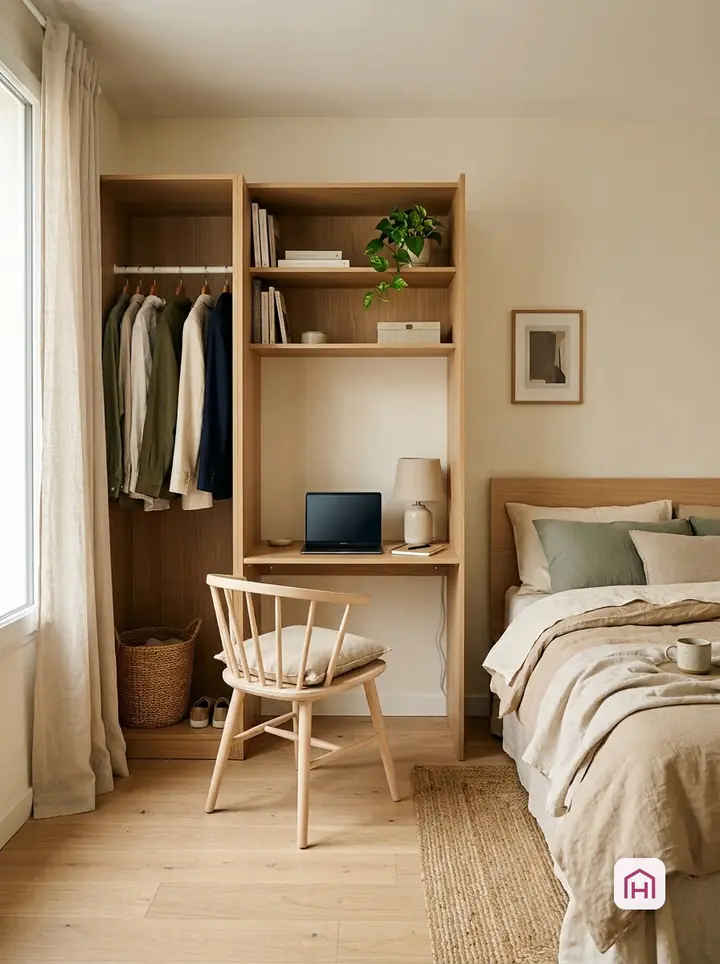
A desk bay in an open wardrobe unit
Clothes on one side, a small desk on the other.
Why it works
One bay of a wardrobe unit fitted with a desk surface and shelves becomes a tiny office next to the clothes. With doors or a curtain in front it can disappear at night; the unit in the picture is open.
Materials and furniture
- Wardrobe section
- Desk board
- Small lamp
- Power with a cable path
Check first
- Anchor the wardrobe unit to the wall.
- Run the lamp and charger cables tidily; do not trap them in doors if you add them.
- Keep cups and liquids off the bed and the bedding.
-
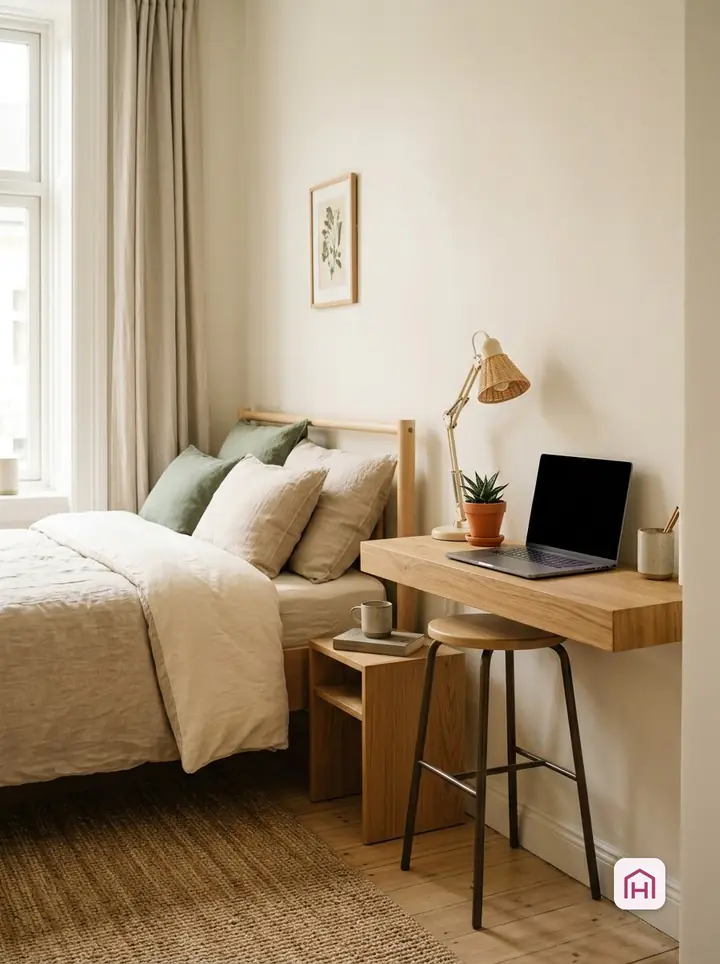
A floating shelf desk with a stool
A deep shelf and a stool: a desk for short tasks.
Why it works
A deep floating shelf at desk height is the slimmest possible desk. With a stool it makes a compact perch for emails and short work; it is not an all-day workstation.
Materials and furniture
- Deep floating shelf
- Heavy-duty fixings
- Stool
Check first
- Fixings rated for leaning and the load; the concealed fixing in the picture is not proven.
- Measure the height for the stool; in the picture it only partly fits under the shelf.
- Check for cables before drilling.
-
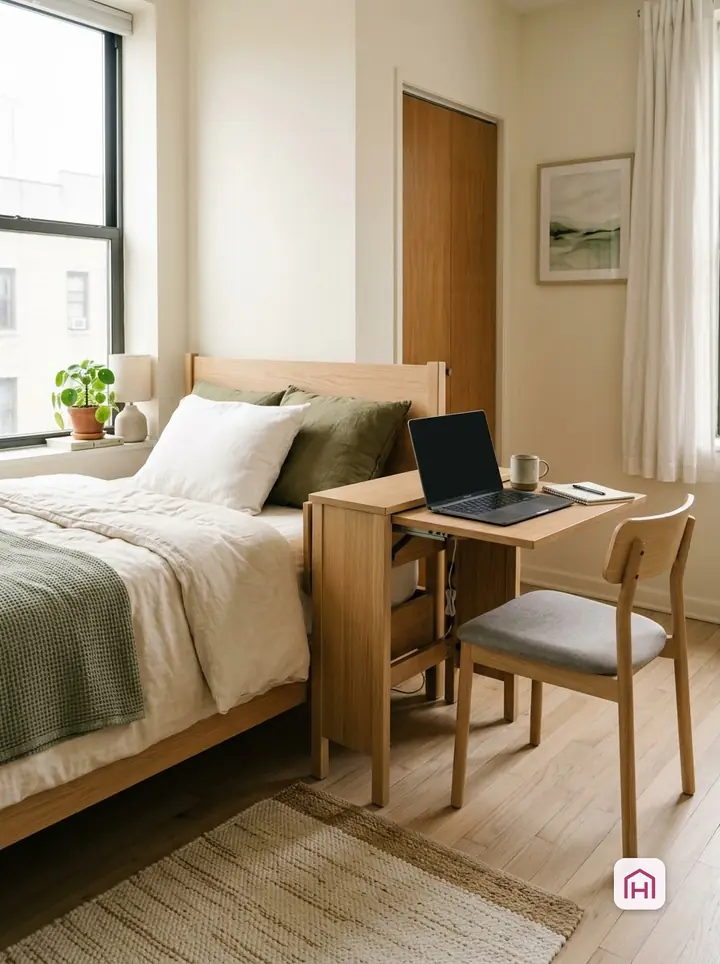
A bedside table that extends
Bedside table by night, laptop table by day.
Why it works
A bedside cabinet with a top that extends becomes a small work surface for a laptop and slides back at night.
Materials and furniture
- Bedside table with extending top
- Chair
Check first
- Extended, the top and chair take the side passage: slide it back before you need the route.
- Check the extended top is stable; the picture illustrates the idea, not a tested mechanism.
- Keep chargers off the bed.
Work that can disappear
A bedroom office works best when work can be put away at night. A desk that folds shut, a curtain that closes over a corner or wardrobe doors that close on a laptop make the room a bedroom again. A calm room at night is the point.
Room for the chair
A desk is only usable with room to pull the chair out and sit. Measure from the desk edge to the bed or wardrobe and check that you can still walk past when the chair is out. A stool that slides fully under the desk saves space in the narrowest rooms.
Cables and chargers
Laptop chargers and phone chargers get warm. Keep them on a hard surface, not in the bed, and run cables along the wall so nobody trips over them at night.