Calculators
TV viewing distance calculator
Runs in your browser · does not check building standards
How far to sit from a TV, or what size TV suits your seat, in feet and inches, using the 30° mixed-use and 40° cinema viewing angles.
Result
–
How it was calculated
How to use
- Enter the TV size: The diagonal in inches, as the TV is sold.
- Measure your seat: Optionally, the distance from your eyes in the usual seat to the screen, in feet.
- Read the range: The 40° distance is the closest, the 30° distance the farthest of the two guidelines.
- Check the height: Mount the screen so its center is near your seated eye height.
How to measure your viewing distance
Sit in the seat you use most and measure from your eyes to the wall or stand where the screen will be. Subtract the depth of the TV stand only if the screen will sit at its front edge. If several seats face the TV, check the nearest and the farthest.
Viewing angles explained
The calculator works with the horizontal angle the screen fills in your view. What Hi-Fi? reports that the Society of Motion Picture and Television Engineers (SMPTE) recommends about 30° for mixed use, and that both SMPTE and THX recommend about 40° for a room used mainly for movies.
The distance for an angle is plain geometry: half the screen width divided by the tangent of half the angle. For a 16:9 screen that is about 1.63 times the diagonal at 30° and 1.2 times at 40°. The angles describe comfort and immersion, not health limits; sitting closer or farther does not harm your eyes.
Mounting height
A screen at seated eye height needs no tilt of the head. Measure your own eye height on the sofa; 42 in is a starting value. The calculator places the screen center there and gives the height of the bottom edge.
How it is calculated
- Screen width = diagonal × 16 ÷ √(16² + 9²) ≈ diagonal × 0.872 (16:9 screen)
- Distance = (screen width ÷ 2) ÷ tan(viewing angle ÷ 2)
- 40° (cinema) ≈ diagonal × 1.2; 30° (mixed use) ≈ diagonal × 1.63, both in the same unit
- TV size for a seat = 2 × distance × tan(angle ÷ 2) ÷ 0.872
Examples
65 in TV
The screen is 56.7 in wide. For 40° sit 77.9 in (6.5 ft) away; for 30°, 105.7 in (8.8 ft). A seat between about 6.5 and 9 ft suits this TV.
Sofa 9 ft from the wall
From 9 ft (108 in) a TV of 66 in fills 30° of your view and one of 90 in fills 40°, so a 65 to 75 in set is the usual choice for mixed viewing.
Frequently asked questions
How far should I sit from a 65 inch TV?
About 6.5 to 9 ft. At 6.5 ft the screen fills 40° of your view, the angle given for movie viewing; at 8.8 ft it fills 30°, the figure for mixed use.
What size TV should I get for my room?
Measure from your seat to the wall the TV will hang on, then enter the distance. From 8 ft, 59 to 80 in covers the 30° to 40° range; from 10 ft, 74 to 100 in.
What are the SMPTE and THX viewing angles?
What Hi-Fi? reports that SMPTE recommends a screen filling about 30° of your field of vision for mixed use, and that SMPTE and THX recommend about 40° for a room used mainly for movies. The calculator shows both distances.
Is a quick rule like 1.5 times the screen size right?
It is close to the 30° angle: 30° works out to about 1.63 times the diagonal and 40° to about 1.2 times. Multiply the TV size in inches and divide by 12 for feet.
How high should I mount the TV?
Put the center of the screen near your eye height when seated, often about 42 in from the floor. Higher mounting, for example over a fireplace, means tilting your head back.
Does 4K let me sit closer?
Higher resolution shows less visible pixel structure up close, so a closer seat can look sharper than on an older set. The angle guidelines above still describe how much of your view the screen fills.
Sources
Keep planning with your measurements
Related ideas
-
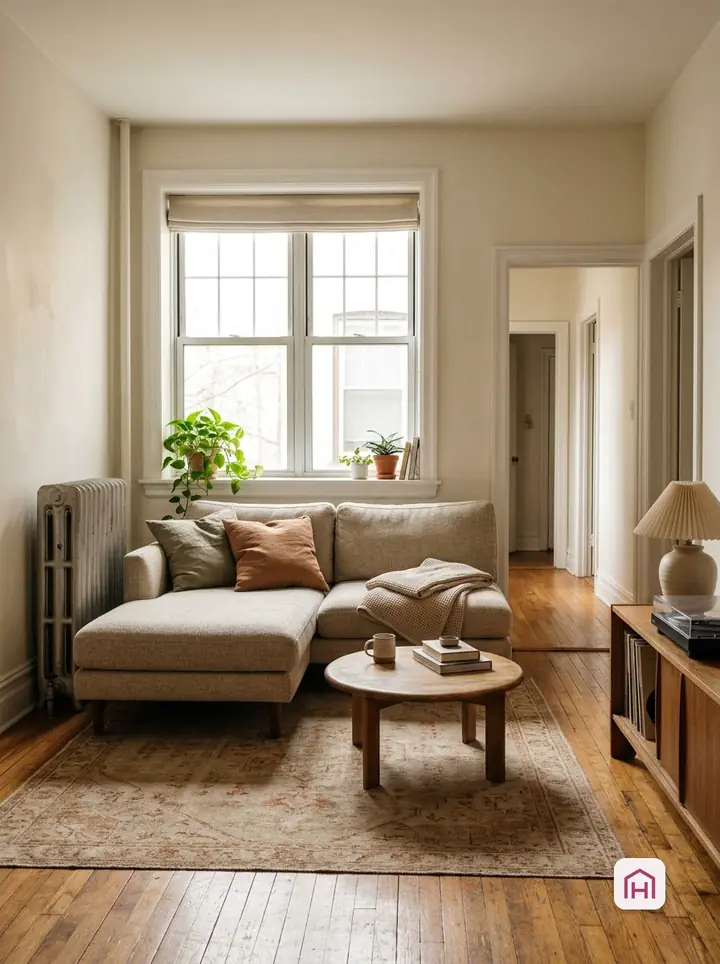
Corner sofa in a small living room: 8 layouts that still flow
Eight corner-sofa layouts for small living rooms: the chaise towards the window, a compact two-seater corner, a floating corner sofa with a console, modular pieces split in two, a corner against the TV wall, a round coffee table, a low back for sightlines and a storage chaise.
-
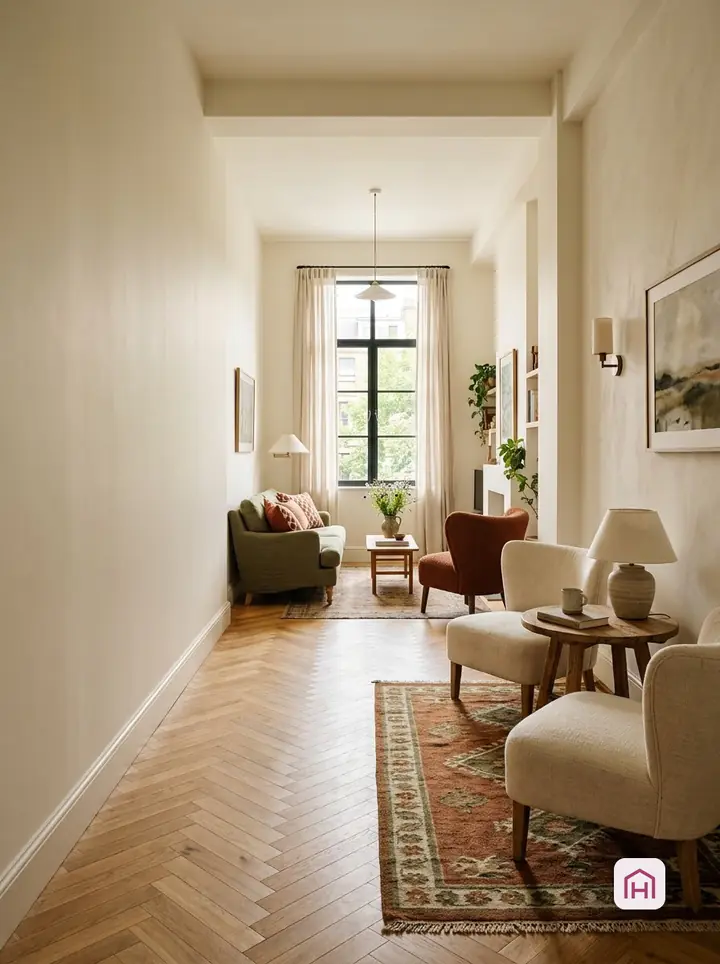
Long, narrow living room ideas: 10 layouts that stop the bowling-alley look
Ten ideas for a living room that is much longer than it is wide: split the length into zones, float furniture across the width, give the far end a purpose, and keep one continuous walkway along one side.
-
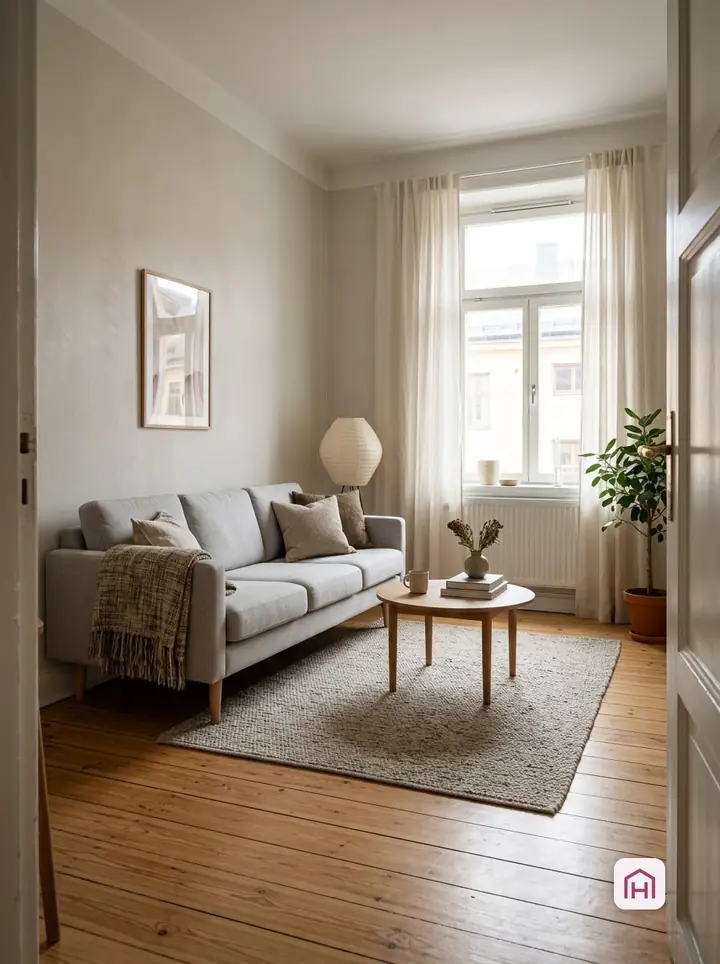
Small living room ideas: 8 layouts that make space
Eight small living room ideas that start with the layout: the sofa on the longest wall, a loveseat with two chairs, a floating sofa that creates an entry, a round coffee table, nesting tables, a wall-mounted TV, one large rug and a mirror opposite the window.