Encyclopedia
Wallpaper pattern repeat: match types, drop length and waste
In short
The pattern repeat is the distance after which the design repeats vertically. For the drop length, divide the wall height by the repeat and round up: with a 2.50 m wall and a 53 cm repeat that is 5 repeats, so 2.65 m per drop. With an offset match, if you cut drop after drop from one roll, you can lose up to another half repeat at each change.
Contents
Pattern repeat and offset
On a patterned wallpaper the motif repeats at a fixed interval along the roll. That interval is the pattern repeat. The offset tells you by how many centimetres the pattern appears shifted on the next drop [3].
Both decide how you cut the drops. A design with a large repeat looks calmer and more generous, but uses more paper because every drop has to be aligned to the pattern. A small repeat is more forgiving – especially in rooms with lots of corners, windows or sloping ceilings.
The match types
The symbols on the label follow the European standard EN 235. For pattern matching there are four variants [1]:
- Free match: the pattern lines up at any height, as with textures or irregular stripes. You can cut drops without regard to the motif.
- Straight match: the motif sits at the same height on every drop. All drops start at the same point in the pattern.
- Offset (half-drop) match: the motif steps down by half the pattern height from one drop to the next. Every second drop starts at a different point in the pattern.
- Reverse hanging: every second drop is hung upside down.
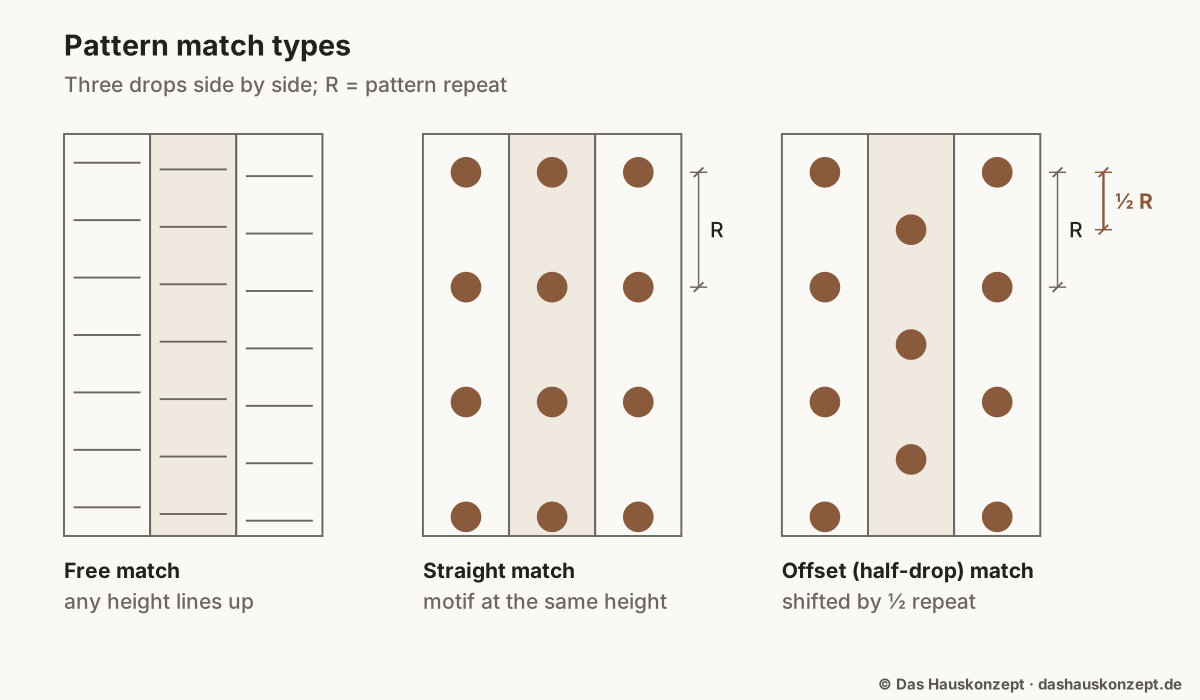 (Open the diagram full size)
Which match applies, and how large the repeat and offset are, is printed on the roll or its insert [2]. Note these values before you cut – every calculation depends on them.
Drop length: round up to the next full repeat
With a straight match, one simple rule applies: each drop must consist of whole repeats and cover the wall height. Every subsequent drop cut from the same roll then automatically starts at the same point in the pattern.
Worked example: wall height 2.50 m, repeat 53 cm.
- 250 cm ÷ 53 cm = 4.72 repeats.
- Round up to 5 repeats.
- 5 × 53 cm = 265 cm drop length.
Split the 15 cm surplus between top and bottom – around 7.5 cm each for trimming at the ceiling and skirting board.
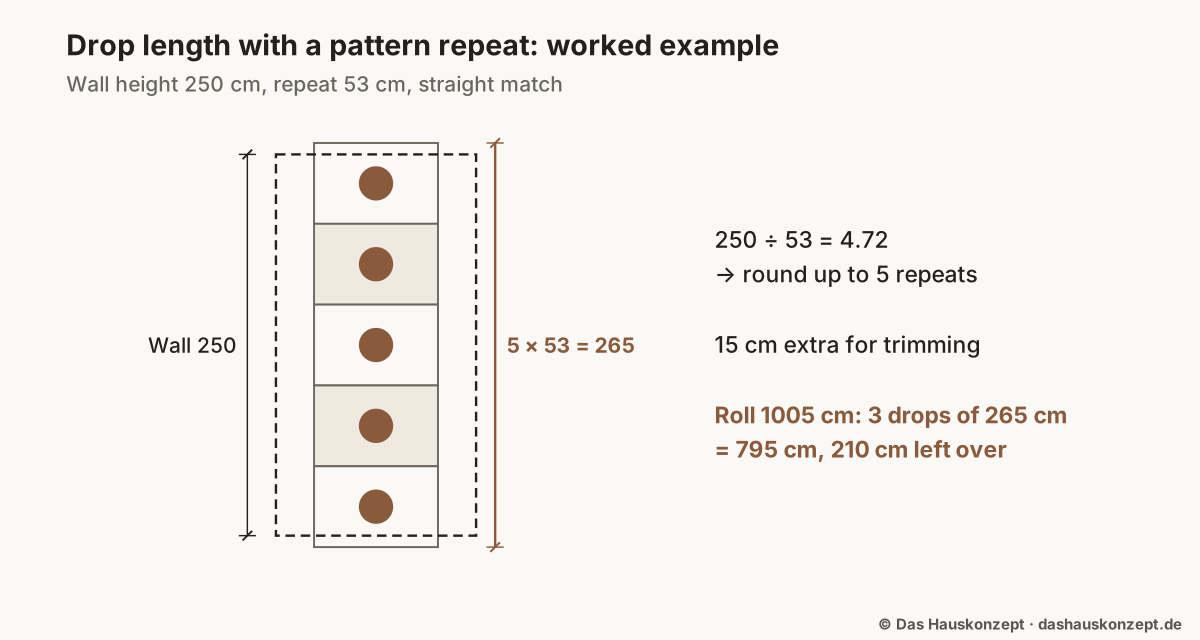 (Open the diagram full size)
A German renovation guide works in a similar way but adds the trimming allowance first: wall height plus 10 to 20 cm, divided by the repeat [4], with any part repeat counted as a whole one. With 10 cm that gives 260 ÷ 53 = 4.9 in the example – again 5 repeats and 265 cm. With 20 cm it is 270 ÷ 53 = 5.1, so 6 repeats and 318 cm: more paper, but more freedom over where the pattern starts at the ceiling. As a rule of thumb, if less than about 5 cm per end is left for trimming after rounding up, add one more repeat.
Waste and number of rolls
Many wallpapers are sold in rolls of 0.53 m × 10.05 m, including the non-woven papers shown in a German DIY retailer's wallpapering guide [3]. Still check the size on the label – other roll sizes exist.
From a 10.05 m roll you get three drops of 265 cm (795 cm), with 210 cm left over. A wall 4.00 m wide needs 4.00 m ÷ 0.53 m = 7.55, so 8 drops, which means 3 rolls.
When the repeat really does cost an extra roll is shown by a high-ceilinged period-home example with the same 4.00 m wall:
| Case | Drop length | Drops per roll | Rolls for 8 drops |
|---|---|---|---|
| Free match, 2.50 m wall, 10 cm allowance | 260 cm | 3 | 3 |
| Straight match, 2.50 m wall, 53 cm repeat | 265 cm | 3 | 3 |
| Free match, 3.10 m wall, 10 cm allowance | 320 cm | 3 | 3 |
| Offset match, 3.10 m wall, 64 cm repeat, drop after drop from one roll | 320 cm + 32 cm offset loss | 2 | 4 |
In the last case each drop is 5 × 64 cm = 320 cm. Because every second drop has to start half a repeat (32 cm) further along, up to 32 cm is lost at each change: 320 + 32 + 320 + 32 + 320 = 1,024 cm – more than the 1,005 cm on a roll. Only two drops fit, and you need four rolls instead of three.
One way round this is to cut alternately from two rolls: roll A supplies drops 1, 3, 5 …, roll B drops 2, 4, 6 … Each roll then only has to be trimmed once at the start to the right pattern point, after which drops follow on without offset loss. Three drops per roll (960 cm) are possible again as long as that first trim costs no more than 45 cm. Eight drops then need only three rolls: three drops each from rolls A and B, and the last two – one of each kind, with a single 32 cm offset loss – from roll C. Whether the first trim stays that small only shows once you unroll the paper, so if in doubt, count on the higher number of rolls. It pays to do the sums before you cut.
Either way, the German Wallpaper Institute recommends buying a spare roll, because waste can only ever be estimated [2]. When buying, make sure all the rolls for one room come from the same production batch to avoid colour differences [2].
Patterned wallpaper in country style
Country and cottage wallpapers are almost always patterned – which makes them a typical case for repeat calculations. Common designs:
- Small florals and sprigs: a small repeat, a calm look from a distance, forgiving in corners and on slopes. Good for bedrooms and hallways.
- Large florals and scenes in the style of toile de Jouy: a large repeat, strong effect, more waste. Best on an uninterrupted wall without windows.
- Stripes and fine checks: look orderly, and vertical stripes emphasise ceiling height; check whether the paper is free match or has a stated match.
In country interiors, wallpaper is often combined with half-height panelling: timber in a muted colour below, pattern above. That has a practical side effect – the papered area gets smaller, the drops shorter, and a large repeat wastes less. In that case calculate with the height from the top of the panelling to the ceiling. Types of panelling and how they are fixed are covered in Wall panelling.
Next steps
- Note the repeat, offset and match type from the label.
- Work out the drop length by rounding up to full repeats and check the trimming allowance.
- Calculate drops per roll – including offset loss for an offset match.
- Work out the number of rolls and add a spare roll from the same batch.
The German edition of the site also has a wallpaper calculator for working out rolls for a whole room.
Related tools
Sources and method
The draft was written with AI assistance. Numbers, standards and safety notes rest on the sources listed below; each source carries the date we last opened and checked it.
Editorially reviewed by Anna Muller on 11 October 2026 before publication.
- Tapetensymbole , Deutsches Tapeten-Institut. checked Supports: Wallpaper label symbols follow EN 235 (DIN EN 235); match types: free match, straight match, offset match (shifted by half the pattern height), reverse hanging.
- Vor dem Tapezieren , Deutsches Tapeten-Institut. checked Supports: Patterned wallpapers may need to be hung with an offset, stated on the roll; a spare roll is recommended because waste can only be estimated; use wallpaper from the same production batch for one room to avoid colour variations.
- Mustertapete tapezieren , toom Baumarkt. checked Supports: Definitions of pattern repeat and offset; roll size 0.53 × 10.05 m for the non-woven wallpapers shown on the page.
- Was bedeutet „Rapport“ beim Tapezieren, und wie funktioniert das? , sanier.de. checked Supports: For the drop length, measure the wall height, add 10–20 cm for trimming and divide the sum by the repeat; with an offset match, also add the offset.