Idea
Battery, plug-in or USB? Holiday lights for small spaces compared
This page is only available in English. The language switch leads to the closest German page.
In short
Battery lights go anywhere without a cord, which suits shelves, wreaths and doors, but batteries run down. Plug-in lights give steady power for long runs, as long as the cord can reach a socket without crossing a walkway. USB lights run from an adapter or a power bank and suit short runs near a socket or desk. Whichever you choose, use lights tested by a recognised lab, outdoor sets only if labelled for outdoor use, and turn them off when you go to bed or leave.
Contents
In a small home the question is rarely "how bright?" and mostly "where does the cord go?". A light string on a bookshelf, a wreath on the front door or a branch in a vase may be nowhere near a socket, and a cord across the floor is a trip hazard in a room you walk through twenty times a day. The power source decides where lights can go.
The three power sources
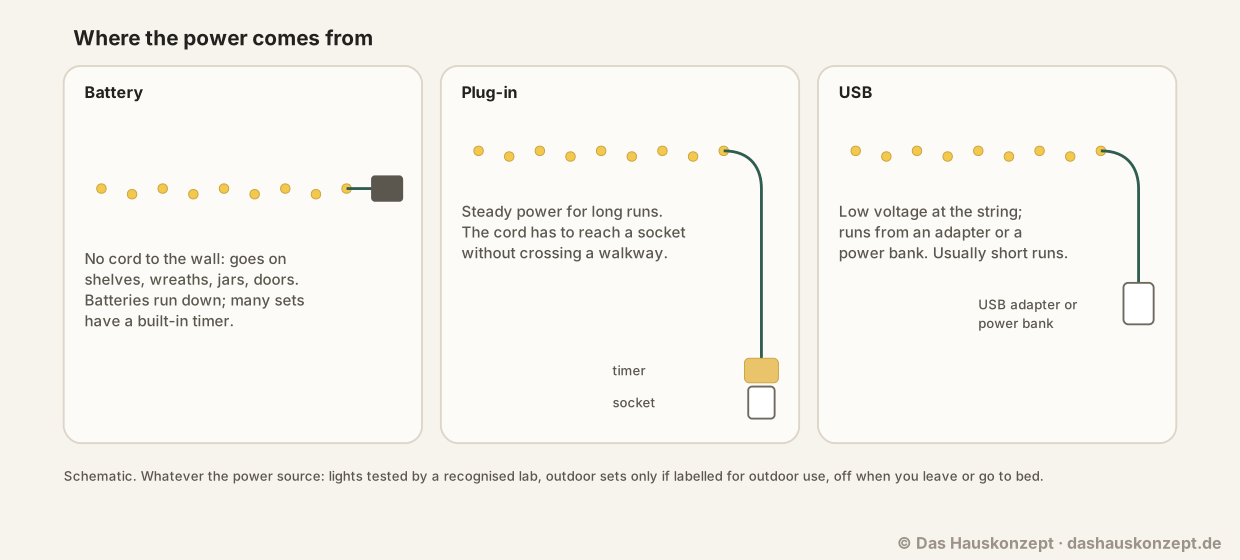 (Open the diagram full size)
- Battery. A small battery box sits at one end of the string. No cord to the wall, so the lights can go on a shelf, in a jar, on a wreath or on a door. Many sets have a built-in timer. The trade-off: batteries run down, and you will be changing or recharging them through the season.
- Plug-in. Mains-powered strings give steady power for longer runs, a window frame or a tree. The cord has to reach a socket along walls and furniture edges, not across a walkway, and a plug-in timer makes switching off automatic.
- USB. The string plugs into a USB adapter or a power bank. Useful for short runs near a desk, a bed or a socket, or for something you want to move around with a power bank.
Side by side
| Battery | Plug-in | USB | |
|---|---|---|---|
| Where it works | anywhere: shelves, wreaths, doors, jars | near a socket, longer runs | near an adapter or with a power bank |
| Cord to the wall | none | yes | yes, or none with a power bank |
| Runtime | until the batteries run down | as long as it is on | as long as it is on; power bank until empty |
| Timer | often built in | add a plug-in timer | some have one built in |
| Typical small-home use | bookshelf, door wreath, table centrepiece | window, tree | headboard, desk, small shelf |
| Main drawback | batteries to replace or recharge | the cord route | short reach, adapter in the socket |
Brightness and battery life depend on the set, not on the type, so read the box. A string that only lasts a few hours on one set of batteries will cost more over a season than its price suggests.
Safety that applies to all three
- Tested lights. The US Consumer Product Safety Commission advises using only lights tested for safety by a nationally recognised testing laboratory [1]. In Europe, look for the equivalent independent test mark on the box.
- Check every set, new or old, for broken or cracked sockets, frayed or bare wires and loose connections [1]. Damaged sets go in the bin.
- Outdoor only if labelled. Outdoor lights must be labelled as certified for outdoor use, and the CPSC advises plugging them only into GFCI-protected outlets [1].
- Extension cords must be rated for the intended use and in good condition [1].
- Keep the tree watered and away from heat. According to the NFPA, a heat source too close to the tree causes nearly one in four Christmas tree fires, and a dried-out tree can reach flashover in under a minute [2].
- Off when you go to bed or leave. A timer or a built-in timer setting makes that automatic.
- If you mix in candles, keep them on a stable, heat-resistant surface out of reach of children and pets, away from trees, decorations and curtains, and put them out before leaving the room [1]. Battery candles avoid the question.
Timers
A timer is the simplest safety upgrade in this article. For plug-in strings, a plug-in timer between the socket and the plug switches the lights on in the evening and off at bedtime. Many battery sets have a built-in timer that runs the lights for a few hours each evening and repeats daily; the box says how long. With USB lights, a power bank simply runs out, which is a crude timer of its own.
Which one for which spot
- Front door wreath, bookshelf, table: battery.
- Window or tree: plug-in, with a cord route planned before you hang anything.
- Bedside or desk: USB, from an adapter you already have in that socket.
For hanging lights without drilling, tension rods are one option; how they work and what they hold is in our guide to tension rods.
Sources and method
The draft was written with AI assistance. Numbers, standards and safety notes rest on the sources listed below; each source carries the date we last opened and checked it.
- Put Safety at the Top of Your List When Decorating this Holiday Season (news release, December 6, 2017) , U.S. Consumer Product Safety Commission. checked Supports: Only use lights tested for safety by a nationally recognized testing laboratory; check each set, new or old, for broken or cracked sockets, frayed or bare wires or loose connections; outdoor lights must be labelled as certified for outdoor use and plugged only into GFCI-protected receptacles; check each extension cord is rated for the intended use and in good condition; keep candles on a stable, heat-resistant surface out of reach of children and pets, away from trees, decorations, curtains and furniture, and extinguish them before leaving the room.
- Winter holiday safety , National Fire Protection Association (NFPA). checked Supports: A heat source too close to the tree causes nearly one in four Christmas tree fires; a CPSC test shows a dried-out tree reaching flashover in less than one minute compared with a well-watered tree; water your tree so it does not become a fire hazard.