Encyclopedia
Bathroom extractor fans explained: why humidity lingers and what helps
Applies to: USRentersOwnersENERGY STARHVI sizing guidance Airflow and run-time figures are US guidance (DOE Building America, ENERGY STAR, HVI); local codes and other countries set their own rates.
This page is only available in English. The language switch leads to the closest German page.
In short
A bathroom extractor fan pulls moist air outdoors through a duct; US Department of Energy guidance calls for at least 50 cfm (23.6 L/s), run an hour after showering. Humidity that lingers usually points to a fan switched off too soon, a dirty grille or a blocked or misrouted duct.
At a glance
| What | Value | Basis |
|---|---|---|
| Fan size for bathrooms up to 100 sq ft | 1 cfm/sq ftHVI rule, about 8 air changes per hour; 100 sq ft is 9.3 m²; larger rooms are sized per fixture | [3] |
| Rated airflow to buy for a 50 cfm intermittent fan | 70 cfmAt least 70 cfm (33 L/s) rated, per ENERGY STAR via DOE, because installed ducts lose airflow | [1] |
| Minimum for a fan that runs continuously | 20 cfm9.4 L/s; DOE Building America guidance | [1] |
| Noise rating | ≤ 1 / ≤ 3 sones1 sone or less for continuous fans, 3 sones or less for intermittent fans (ENERGY STAR via DOE) | [1] |
| Indoor humidity to aim for | 30–50 % RHEPA: below 60 percent if possible, ideally 30 to 50 percent | [2] |
| Straight duct right after the fan | 3 ftAt least the first 3 ft (0.91 m) straight; smooth rigid duct preferred over flex | [1] |
| Duct recommended by one maker (Broan-NuTone EZ80N) | 4 in4 in (102 mm) round rigid metal duct for best performance; use the size your fan's instructions give | [4] |
| Example bathroom, 9 ft × 7 ft 6 in | 67.5 sq ft6.27 m², calculator output; at 1 cfm per sq ft that is a 70 cfm fan | calculated · Square footage calculator |
Contents
- How does a bathroom extractor fan work?
- Why does humidity linger in the bathroom?
- Where should a bathroom fan vent?
- How long should you run a bathroom fan after a shower?
- What size bathroom fan do I need?
- What do cfm and sone ratings mean?
- How to clean a bathroom extractor fan
- How do I know if my bathroom fan is working?
- Bathroom fan problems in a rental
- Bathroom fan electrical safety and mould
- Common questions
- Sources and method
A small bathroom fills with steam in minutes. If that moisture is not removed, it settles on the coldest surfaces: the ceiling, the window, the corners behind the toilet. Day after day, paint peels, grout darkens and mould appears. The extractor fan is the main tool against it, and in a windowless bathroom the only one.
How does a bathroom extractor fan work?
A bathroom extractor fan sucks moist air out of the room and pushes it through a duct to the outside; the same amount of air flows back in, usually under or around the door. That is why a door with no gap and no vent leaves even a strong fan short of air.
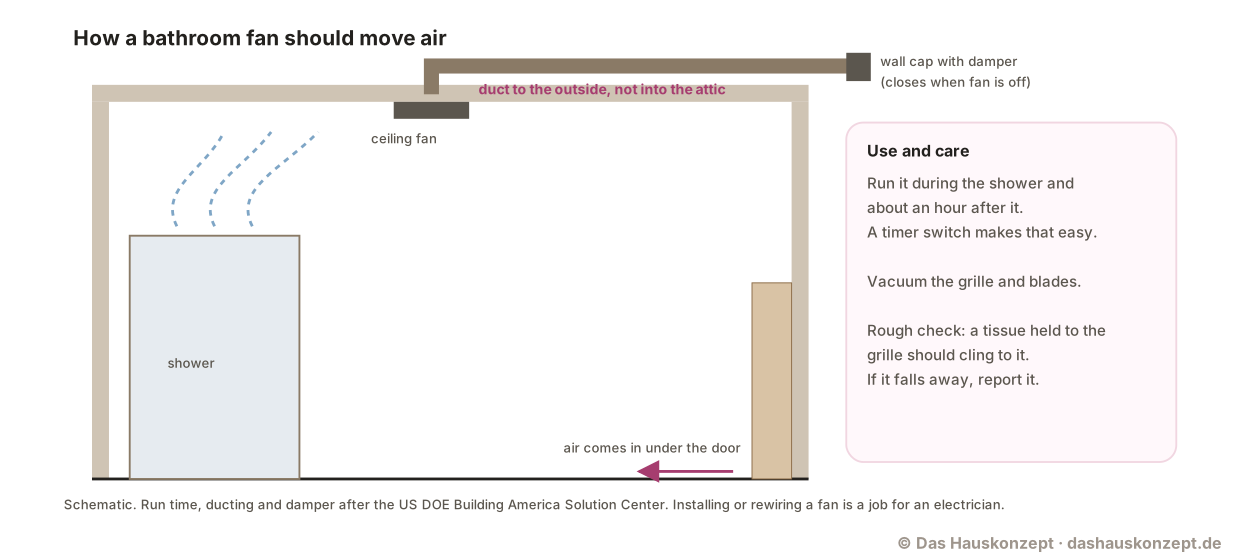 (Open the diagram full size)
The air the fan removes has to go somewhere. The Building America Solution Center, run for the US Department of Energy (DOE), says the exhaust must go directly outside, not into an attic, crawlspace, garage, the space between floors or a wall cavity [1], because there the moisture simply causes damp somewhere else. At the outside wall or roof, a cap with a damper closes when the fan is off, so outside air does not blow back in [1]. Fan makers say the same: Broan-NuTone's installation guide states that ducted fans must always be vented to the outdoors [4].
Why does humidity linger in the bathroom?
Humidity lingers when the fan moves less air than the shower releases, or stops before the room has dried. The usual causes, and what each source says about them:
| Cause | What to look for | Source |
|---|---|---|
| Fan switched off too soon | Mirror fogs again after the fan stops | DOE: run it about an hour after a shower [1] |
| Dusty grille and blades | Grey fluff on the grille, weak pull | DOE: vacuum the cover and blades [1] |
| Long, crushed or narrow duct | Fan is loud but barely pulls | Fans on existing ducts may not reach their rated airflow; avoid smaller ducts than recommended [4] |
| Damper stuck shut | Rattle or hum, no airflow at the outside cap | Cap dampers are sometimes painted shut or blocked by debris [4] |
| Duct ends in the attic | Nobody can find a cap outside | Must vent outside, not into the attic [1] |
| Fan too small for the room | Steam stays even with a clean fan running | Size the fan to the room (see below) [3] |
| No way for air to get in | Door sealed tight all round | Replacement air has to come from somewhere, usually under the door |
Wiping helps whatever the cause. The EPA says to act quickly when condensation collects on windows, walls or pipes [2]; a squeegee on tiles and the shower screen takes a minute and removes water the fan would otherwise have to carry out.
Where should a bathroom fan vent?
A bathroom fan should vent through a duct to a wall or roof cap outdoors, using the duct diameter the fan's maker specifies [1]. DOE guidance adds details that keep the air moving and stop condensation dripping back [1]:
- Straight start. At a minimum, the first 3 ft (0.91 m) of duct after the fan's exhaust port should be straight.
- Smooth, rigid duct. Smooth rigid duct is preferred over flex duct; Broan-NuTone recommends 4 in (102 mm) round rigid metal duct for its EZ80N and the shortest, straightest route possible [4].
- Slope and insulation. The duct slopes down and away from the fan housing so condensation runs away from the fan, and is insulated to limit condensation.
- Outlet position. The outlet sits at least 10 ft (3.05 m) from a mechanical air inlet or 3 ft (0.91 m) from a gravity air inlet, and does not blow onto a walkway.
- Damper. The wall cap includes a damper that closes when the fan is not running.
How long should you run a bathroom fan after a shower?
DOE guidance says to leave a bathroom fan running for one hour after a shower for effective humidity control, and recommends a timer switch so it shuts off by itself [1]. The Home Ventilating Institute (HVI), a ventilation industry association, recommends 20 minutes after using the bathroom [3]. We use DOE's hour as the default because it is the agency's figure for humidity control specifically, and a timer makes the longer run cost no effort. Running the fan during the shower is the other half: the EPA advises running the fan or opening the window when you shower [2].
The goal is the room's humidity, not the clock. The EPA recommends keeping indoor humidity below 60 percent, ideally between 30 and 50 percent [2]. An inexpensive hygrometer shows how quickly your bathroom gets back there; if it takes much longer than the fan runs, the fan or its duct is the problem.
What size bathroom fan do I need?
HVI sizes a bathroom fan at 1 cfm (cubic foot per minute) per square foot of floor for bathrooms up to 100 sq ft (9.3 m²), roughly eight air changes per hour [3]. DOE sets a floor of 50 cfm (23.6 L/s) for a fan that runs when the bathroom is used, and ENERGY STAR advises buying a fan rated at least 70 cfm to reach that, because ducts lose some airflow [1].
| Guidance | Airflow | Run time after a shower | Noise |
|---|---|---|---|
| DOE Building America | 50 cfm (23.6 L/s) intermittent, or 20 cfm (9.4 L/s) continuous [1] | 1 hour, on a timer [1] | ≤ 3 sones intermittent, ≤ 1 sone continuous (ENERGY STAR) [1] |
| ENERGY STAR, via DOE | Rated at least 70 cfm (33 L/s) for a 50 cfm need [1] | Not stated | Maximum sound levels in sones for certified fans [5] |
| HVI, up to 100 sq ft | 1 cfm per sq ft [3] | 20 minutes [3] | Not stated |
| HVI, over 100 sq ft | 50 cfm each for toilet, shower and tub; 100 cfm for a jetted tub [3] | 20 minutes [3] | Not stated |
Take the larger of the HVI figure and DOE's 50 cfm. A small 8 × 5 ft bathroom comes out at 40 cfm on the HVI rule [3], below DOE's 50 cfm minimum [1], so 50 cfm applies. For a large bathroom, add the fixtures: a tub, a shower and a toilet make 50 + 50 + 50 = 150 cfm (70.8 L/s) [3].
What do cfm and sone ratings mean?
The cfm rating on a bathroom fan is the airflow it moves (the unit also used for kitchen range hoods), and the sone rating is how loud it sounds; lower sones mean a quieter fan. ENERGY STAR's limits are 1 sone or less for a fan that runs continuously and 3 sones or less for one that runs intermittently [1]. Noise matters more than it sounds: a quiet fan is one people actually leave running for the full hour.
The rated cfm is measured under test conditions, not in your ceiling. Broan-NuTone warns that a fan connected to existing ducts may not achieve its rated airflow [4], which is why the ENERGY STAR advice is to buy above the minimum [1]. Rules and recommended rates differ by country and local code; the figures here are US guidance.
How to clean a bathroom extractor fan
Cleaning a bathroom fan means switching the power off at the breaker, taking off the grille and vacuuming the inside and the blades; DOE guidance says this improves the fan's draw [1], and Broan-NuTone describes vacuuming the interior with a dusting brush attachment [4]. Clean it whenever the grille looks grey or the tissue test below fails.
Switch the power off at the breaker
Broan-NuTone's instructions say to switch power off at the service panel before servicing or cleaning a fan, and to lock it or tag the panel so nobody switches it back on.[4]
Take the grille off
Remove the grille the way your fan's instructions describe. Leave the motor plug and the wiring cover alone; anything behind them is work for a qualified person.
Vacuum the inside and the blades
Vacuum the interior with a dusting brush attachment, as the maker describes, and the fan blades, which DOE guidance names as the cleaning that improves draw.[4]
Check the outside cap
From the ground, look at where the duct ends outside. DOE guidance says to verify the termination is not clogged with debris; Broan-NuTone notes that cap dampers are sometimes painted shut or blocked by bird and insect debris.[1]
Refit the grille and test
Push the grille back, restore power and run the fan. DOE guidance says a bathroom fan should have enough suction to hold a tissue against the grille.[1]
How do I know if my bathroom fan is working?
A working bathroom fan holds a tissue against its grille while it runs: DOE guidance says a bathroom fan should have enough suction to hold a tissue [1]. If the tissue falls away, the fan or its duct is not moving much air. The other checks take a few minutes:
Is the fan doing its job?
Is the air going outside?
Bathroom fan problems in a rental
In a rental, a bathroom fan that does not pull air, is very loud or vents into the roof space should be reported to the landlord or building manager; report it in writing with the date, what you see and, where you can, a photo of fogged walls or peeling paint. Replacing or rewiring a fan is a job for a qualified person [4], not one of the changes tenants can make. Until it is fixed, open the window during and after showers where you can and wipe surfaces dry; the EPA says water-damaged areas should be dried within 24–48 hours to prevent mould [2].
Bathroom fan electrical safety and mould
A bathroom fan is a wired appliance in a wet room, so installation follows electrical and fire-rated construction codes and is done by a qualified person [4]. A fan over a tub or shower must be one its maker accepts for that position; the Broan-NuTone EZ80N, for example, is acceptable over a tub or shower only in the ceiling and only on a GFCI-protected circuit [4]. Before cleaning, switch the power off at the service panel [4].
If mould has already appeared, the EPA says an area smaller than about 10 sq ft (0.9 m²) is generally one you can clean yourself: scrub hard surfaces with detergent and water, dry them completely, and do not paint over mould [2]. Larger areas, or a lot of water damage, call for EPA's remediation guidance, and damage from sewage or other contaminated water calls for a professional [2].
Common questions
Why is my bathroom fan loud?
A loud fan often has a sticking back-draft damper. Broan-NuTone's troubleshooting says to check that the damper in the fan's duct connector pivots freely, that duct screws are not blocking it, and that the damper in the wall or roof cap is not painted shut or clogged with bird or insect debris. Unusual noise from the motor bearings means the motor needs replacing.[4]
Why does my bathroom fan not turn on?
Start at the breaker panel: Broan-NuTone's troubleshooting lists an open fuse or tripped breaker first, then a motor plug that is not seated and a blower wheel that does not spin freely. Checking the motor plug means opening the fan, so leave that to a qualified person, and in a rental report the fault to the landlord.[4]
Can I paint over mould on a bathroom ceiling?
No. The EPA says not to paint or caulk mouldy surfaces. Scrub mould off hard surfaces with detergent and water and dry them completely first; paint applied over mould is likely to peel. If the mouldy area is larger than about 10 sq ft (0.9 m²), the EPA points to its professional guidance instead.[2]
Does an ENERGY STAR bathroom fan save electricity?
Yes. ENERGY STAR says certified ventilation fans use about 48 percent less energy than standard models, and those with lighting about 70 percent less on average. Certified fans must also meet maximum sound levels in sones.[5]
Related tools
Sources and method
How this article was made: Opened and read on 2026-10-14: the DOE Building America Solution Center guide to bathroom exhaust fans, EPA's mould and moisture guide, HVI's bathroom ventilation page, Broan-NuTone's EZ80N installation guide as an example of manufacturer instructions, and ENERGY STAR's ventilation fan page. Ran the square footage calculator for the example bathroom. No fan was installed, tested or measured; the tissue check is DOE's, not ours.
What this article adds: A table that sets DOE, ENERGY STAR and HVI side by side on airflow, run time and noise, says which run time we use and why, and works fan size for a real bathroom from calculator output.
Use of AI: Revised with AI assistance; every source was opened and checked on 2026-10-14; editorially reviewed before publication.
Editorially reviewed by Anna Muller on 11 October 2026 before publication.
- Bathroom Exhaust Fans , Building America Solution Center (Pacific Northwest National Laboratory for the U.S. Department of Energy). checked Supports: Vent the fan exhaust directly outside, not into an attic, crawlspace, garage, floor space or wall cavity; leave the fan running for one hour after a shower for effective humidity control, and use a timer switch rather than a standard wall switch; at least 50 cfm for intermittent or 20 cfm for continuous operation; for an intermittent rate of at least 50 cfm, ENERGY STAR recommends a fan rated at least 70 cfm; at most 1 sone continuous or 3 sones intermittent; duct diameter as specified by the fan manufacturer; at a minimum the first three feet of duct from the exhaust port straight; smooth rigid duct preferred over flex duct; slope the duct down and away from the housing; insulate the duct to minimize condensation; outlet at least 10 ft from a mechanical air inlet or 3 ft from a gravity inlet and not onto a walkway; the wall cap should include a damper that closes when the fan is not exhausting; vacuum the fan cover and blades and verify the termination is not clogged; a bathroom fan should have enough suction to hold a tissue.
- A Brief Guide to Mold, Moisture and Your Home (last updated February 18, 2026) , U.S. Environmental Protection Agency. checked Supports: Keep indoor humidity below 60 percent, ideally between 30 and 50 percent relative humidity; run the bathroom fan or open the window when showering; act quickly if condensation or moisture collects on windows, walls or pipes; dry water-damaged areas and items within 24–48 hours to prevent mould growth; scrub mould off hard surfaces with detergent and water and dry completely; do not paint or caulk mouldy surfaces; a mouldy area of less than about 10 square feet is generally one you can handle yourself, if there has been a lot of water damage or mould covers more than 10 square feet, consult EPA's remediation guidance; if the damage was caused by sewage or other contaminated water, call in a professional.
- Bathroom Ventilation , Home Ventilating Institute (HVI). checked Supports: For bathrooms up to 100 square feet, HVI recommends 1 cfm per square foot (approximately eight air changes per hour); example 8 ft x 5 ft bathroom, 40 cfm; for bathrooms over 100 square feet, a rate based on fixtures: toilet 50 cfm, shower 50 cfm, bathtub 50 cfm, jetted tub 100 cfm; example 20 ft x 12 ft bathroom with tub, shower and enclosed toilet totals 150 cfm; enclosed toilet rooms need an operable window or a fan; HVI recommends leaving the fan on for 20 minutes after use of the bathroom.
- EZ80N EZ Fit Ventilation Fan, Installation Guide , Broan-NuTone LLC. checked Supports: Before servicing or cleaning, switch power off at the service panel and lock or tag it; installation work and electrical wiring must be done by qualified persons in accordance with all applicable codes and standards, including fire-rated construction; ducted fans must always be vented to the outdoors; acceptable for use over a tub or shower (in the ceiling only) when connected to a GFCI-protected branch circuit; unit must be grounded; to clean, remove the grille and vacuum the interior with a dusting brush attachment; noisy fan: check that the back-draft damper in the duct connector and in the wall or roof cap pivots freely, dampers are sometimes painted shut or obstructed by bird and insect debris; fan does not run: check fuse or breaker, motor plug, blower wheel; use the shortest, straightest duct routing, avoid smaller ducts than recommended, fans on existing ducts may not achieve rated airflow, 4-inch round rigid metal duct recommended; insulation around ducts can reduce energy loss and inhibit mould growth.
- Ventilation Fans , ENERGY STAR (U.S. Environmental Protection Agency). checked Supports: ENERGY STAR certified ventilation fans use about 48 percent less energy than standard models; fans that include lighting use 70 percent less energy on average; certified fans must meet maximum allowable sound levels in sones.