Encyclopedia
What 'renter-friendly' really means: reversible, removable and repairable
This page is only available in English. The language switch leads to the closest German page.
In short
A change is renter-friendly when it passes three tests: it is reversible (you can put things back as they were), removable (it comes off without taking paint, plaster or finish with it) and repairable (any mark it leaves is small enough for you to fix invisibly). Before any of that, check your lease, because what counts as acceptable is set by your agreement and local rules, not by a product label.
Contents
"Renter-friendly", "damage-free", "no drilling": the labels are everywhere, on hooks, wallpaper, shelves and lights. They describe what a product is designed to do under the right conditions, not what will happen in your home. This explainer gives you a way to judge any product or change yourself.
This is not legal advice. Leases and local rules differ, and they decide what you may change.
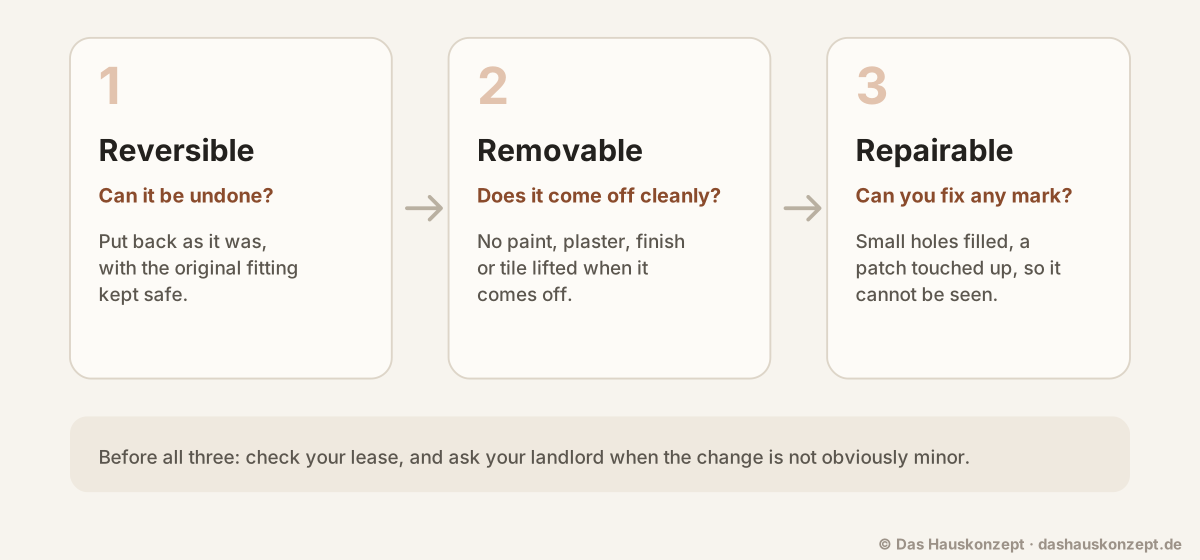 (Open the diagram full size)
Test 1: Reversible
Can the change be undone, so the home is as it was when you moved in? Swapping a ceiling lampshade, changing cabinet knobs or hanging your own curtains on the existing rail are reversible, as long as you keep the original parts. Painting a wall can be reversible too, if you are willing and allowed to paint it back.
Ask: what exactly do I need to keep, and where will I store it until I move out?
Test 2: Removable
Does it come off without taking anything with it? This is where "damage-free" products are tested in practice. An adhesive hook that releases cleanly from glazed tile may lift paint from a wall that was painted over dust, or tear wallpaper. A tension rod comes out without a trace, unless it was tightened so hard that it pressed into soft plaster.
Ask: what surface is it going onto, is that surface sound, and does the maker list it as suitable? Follow the removal instructions on the pack exactly; makers warn that not following them can cause damage [1].
Test 3: Repairable
If it does leave a mark, can you fix it yourself so nobody can see it? A small screw hole in plaster is easy to fill and touch up. A hole through a glazed tile, a gouge in a wooden floor or a patch of different-coloured paint usually is not.
Ask: what is the worst mark this could leave, and could I repair it invisibly with what I have?
When marketing says "damage-free"
A "damage-free" claim almost always comes with conditions: a suitable surface, correct preparation, a weight limit, a waiting time before loading, and a specific way of removing it [1]. Outside those conditions, the claim does not apply. Read the small print on the pack before you buy, not after something falls or peels.
Some practical consequences:
- Weight limits are limits. A hook rated for a set weight on a smooth surface is not rated for a heavy coat that gets yanked every morning.
- Surfaces matter more than products. Flaking paint, textured plaster, wallpaper and rough brick defeat most adhesives.
- "No drilling" does not mean "no risk". A freestanding shelf needs no holes, but a tall one can tip over [2]. Securing it may need a fixing; ask your landlord rather than skip it.
Examples
| Change | Reversible | Removable | Repairable | Verdict |
|---|---|---|---|---|
| Freestanding coat stand | yes | nothing to remove | nothing to repair | renter-friendly |
| Over-the-door hooks | yes | yes, if they fit the door | felt pads prevent scuffs | renter-friendly, if the door still closes |
| Adhesive hook on a sound, painted wall | yes | usually, if removed as instructed | paint touch-up may be needed | renter-friendly with care |
| Peg rail with two screws into plaster | yes | yes | holes filled and touched up | often fine; check your lease |
| Hole drilled through a wall tile | yes | yes | hard to repair invisibly | ask first; use the grout line if possible |
| Painting a wall a strong colour | only by repainting | n/a | a full repaint | check your lease first |
Check your lease first
Your lease, and the rules where you live, decide what you may change, what you must put back and in what condition [3]. If something is not obviously minor, ask your landlord before you start and keep the answer in writing. Keep the original fittings you replace, and note what you changed and where, so moving out is a checklist rather than a surprise.
Sources and method
The draft was written with AI assistance. Numbers, standards and safety notes rest on the sources listed below; each source carries the date we last opened and checked it.
Editorially reviewed by Anna Muller on 11 October 2026 before publication.
- Command™ Adhesive Products: product information sheet , 3M Construction and Home Improvement Markets Division. checked Supports: Clean removal is promised for most surfaces under conditions: a clean, dry surface prepared with rubbing alcohol, a weight range per hook, a one-hour wait before loading and a specific removal method (stretch the tab slowly straight down); failure to follow the instructions may result in damage, and the strips are not for wallpaper or dusty surfaces.
- Anchor It! , US Consumer Product Safety Commission (CPSC). checked Supports: Anchoring furniture with drawers, doors and shelves to the wall prevents tip-over injuries and deaths.
- Landlords and Tenants: Rights and Responsibilities , Office of the Minnesota Attorney General. checked Supports: Leases set rules alongside the law; ordinarily a tenant may not paint or paper walls, install or remove permanent fixtures or make other changes without the landlord's permission, should speak with the landlord before any alterations, and pays for damage beyond normal wear and tear (Minnesota).