Guide · Checklist
Moving out: a wall-repair checklist for hooks, anchors and adhesive
Applies to: USRentersNY GOL § 7-108 Deposit and inspection rules shown for California and New York only; other states differ. Practical guidance, not legal advice.
This page is only available in English. The language switch leads to the closest German page.
In short
Before moving out, stretch adhesive strips straight down along the wall at least 12 in (30.5 cm), fill screw holes slightly proud, sand flush and touch up with matching paint. Finish before the pre-move-out inspection you can request in California and New York, which falls in the last two weeks of the tenancy, and photograph every wall.
At a glance
| What | Value | Basis |
|---|---|---|
| Spackling layer thickness | 1/4 in6 mm per layer; let each layer dry before the next and mound the last one slightly (DAP) | [4] |
| Spackling dry time | 15 min to a few hoursVaries by product and repair size; the pack is the rule | [4] |
| Second coat beyond a mesh patch | 8–12 in20–30 cm wider than the patch, edges feathered (DAP) | [4] |
| Touch-up paint dry / cure time | 1–2 h / up to 24 hCuring depends on humidity and paint type (Sherwin-Williams) | [5] |
| Deposit deadline, California | 21 daysAfter move-out, refund or itemized statement of deductions | [1] |
| Deposit deadline, New York | 14 daysAfter the tenant has vacated, itemized statement and any remaining deposit | [2] |
| Inspection notice, CA and NY | 48 hoursMinimum written notice of the date and time of the pre-move-out inspection | [2] |
Contents
- What do I have to repair before moving out?
- When should I start wall repairs before moving out?
- How do I remove Command strips and adhesive hooks without damaging paint?
- How do I take out screws, plugs and wall anchors?
- How do I fill nail and screw holes before moving out?
- How do I touch up paint so the patch does not show?
- Is it safe to sand old paint when patching holes?
- How do I document the walls for my deposit?
- When does the landlord have to return the deposit?
- Printable move-out wall checklist
- Common questions
- Sources and method
Small holes and adhesive marks are easy to fix while the room is empty and you have time; they are much harder to argue about after the keys are gone. Work through this list early enough that filler and paint can dry, and look at the result in daylight before anyone inspects it.
What do I have to repair before moving out?
What you have to repair before moving out depends on your lease, your move-in record and your state's rules on wear and tear. Start with three checks:
- Read your lease for anything on decoration, holes, fixtures and how the apartment has to be handed back.
- Find your move-in checklist and photos. California's guide encourages tenants to fill in the move-in checklist with date-stamped photos, and since July 1, 2025 landlords there must photograph the unit at the start of the tenancy; ask for copies [1].
- Ask if unsure. Some landlords prefer to handle repairs themselves or want fixtures left in place. Get any agreement in writing.
Normal wear and tear is not yours to fix. New York law says the landlord may not keep any part of the deposit for ordinary wear and tear [2], and may withhold money for tenant-caused damage [6]. California's guide draws the line for walls like this [1]:
| Wall condition | California DRE guide |
|---|---|
| Minor marks or nicks | Normal wear and tear, the landlord's responsibility |
| Large marks or paint gouges | Tenant's responsibility |
| A large number of holes that need filling | Can justify a deduction for repainting, more so if the unit was recently painted |
The guide offers these as suggestions rather than hard and fast rules [1]. Filling the holes you made is the cheapest way to stay on the right side of the line.
When should I start wall repairs before moving out?
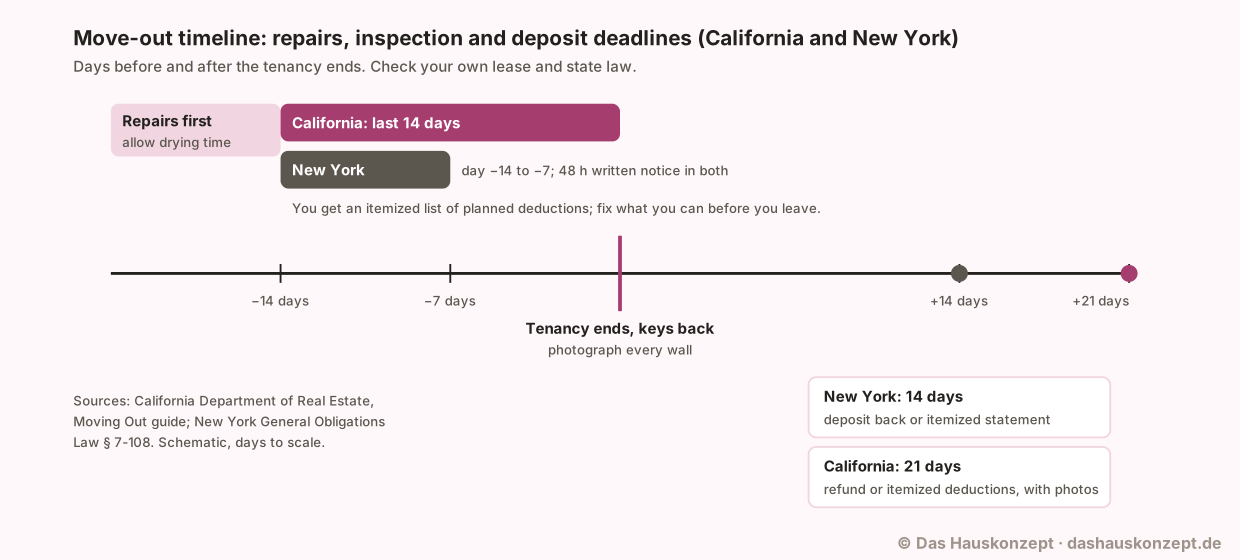
Start wall repairs before the pre-move-out inspection, so the inspector sees finished walls and you still have time to fix what is listed. In both states the inspection happens only if you ask for one. In California it cannot be earlier than two weeks before the tenancy ends [1]; in New York it takes place no earlier than two weeks and no later than one week before the end [2].
 (Open the diagram full size)
Both states require at least 48 hours of written notice of the inspection time, and both give you an itemized statement of the repairs or cleaning the landlord plans to deduct for [1] [2]. That list is your to-do list for the last days. Allow for drying: DAP says many spackling compounds dry within 15 minutes to a few hours, depending on product and repair size [4], and Sherwin-Williams says touch-up paint can take up to 24 hours to cure [5]. A hole that needs two or three layers of filler, primer and paint therefore takes more than one evening.
How do I remove Command strips and adhesive hooks without damaging paint?
Remove Command strips by stretching the tab, not by pulling the hook. 3M's instructions are to slide the hook off its back plate, hold the back plate gently against the wall, then slowly stretch the removal tab straight down along the wall at least 12 in (30.5 cm) until the strip releases, and never pull the strip toward you [3].
3M warns that not following the instructions carefully may result in damage [3], and pulling outward is what takes paint with it. If you no longer have the pack, look up the instructions for that exact product, because other adhesive hooks and foam tapes release differently. If a strip tears before it lets go, stop pulling and look up the maker's advice instead of prying at the paint. Adhesive residue left on the wall goes on the cleaning list, not the repair list.
How do I take out screws, plugs and wall anchors?
Take out screws, plugs and wall anchors by unscrewing the screw first, then pulling the plug or anchor out of the wall. If an anchor will not come out cleanly, follow its maker's advice rather than levering against the wall, which turns a small hole into a large one.
- Shelves, rails and curtain rods: support the weight while you unscrew so nothing tears out of the wall.
- Damaged edges: remove loose debris around the hole and push raised drywall fibers back down with the handle of a putty knife before filling [4].
Which filler you then need depends on the hole. DAP recommends lightweight spackling for small nail holes and shallow dents, heavyweight for medium holes, and heavyweight or hybrid for larger or deeper repairs [4]. A hole that goes completely through the drywall or plaster needs a mesh patch: spackling on the back, press it over the hole, a thin coat over it, then a wider second coat 8–12 in (20–30 cm) beyond the patch with feathered edges [4].
How do I fill nail and screw holes before moving out?
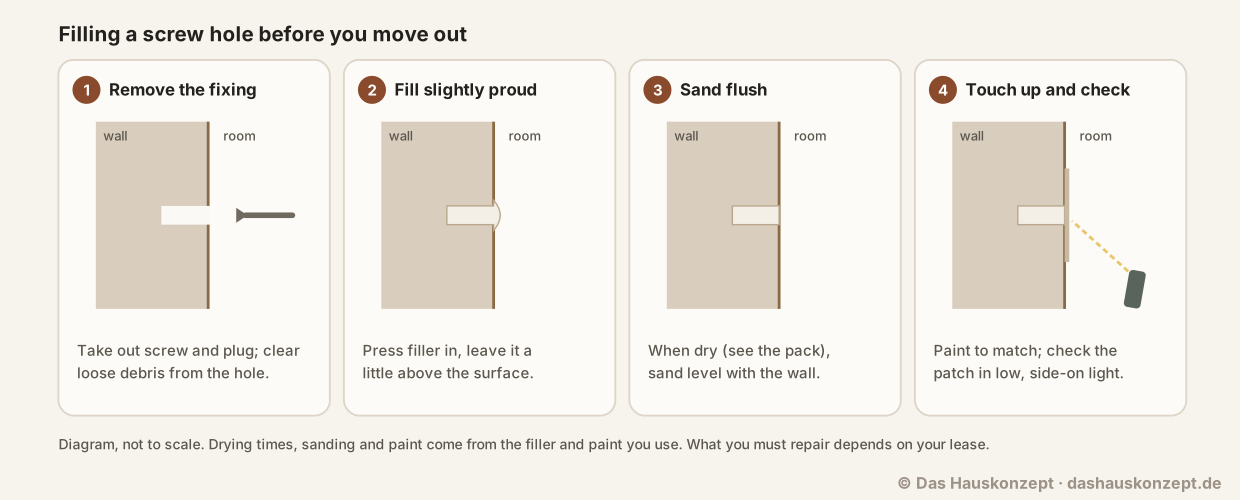
Fill nail and screw holes in thin layers, leave the last layer slightly proud of the wall, let it dry and sand it flush. DAP gives 1/4 in (6 mm) as the layer thickness and recommends spackling over joint compound for most wall repairs because it dries faster and shrinks less [4].
 (Open the diagram full size)
Remove the fixing
Take out the screw, then the plastic plug or anchor, and support any rail or shelf while you unscrew it so nothing tears out of the wall. Remove loose debris around the hole and push raised drywall fibers back down with the handle of a putty knife.[4]
Choose the right filler
DAP recommends lightweight spackling for small nail holes and shallow dents, heavyweight for medium holes and heavyweight or hybrid for larger or deeper repairs. For a hole that goes right through the drywall or plaster, use a mesh patch.[4]
Fill in layers, the last one slightly proud
Press the spackling in with a putty knife in layers about 1/4 in (6 mm) thick, let each layer dry, and leave the final layer slightly mounded so you can sand it flush.[4]
1/4 in (6 mm) per layer
Let it dry
Dry time varies by product and repair size; DAP says many spackling compounds dry within 15 minutes to a few hours. Follow the pack, and wait until a color-change filler has changed color.[4]
Sand flush and wipe off the dust
Flatten the patch with medium-grit paper, finish with fine grit and wipe the dust off with a tack cloth or damp sponge. Lightweight spackling often needs no sanding. Prime the repaired spots before painting for even coverage. In a home built before 1978, read the lead-paint section first.[4]
Touch up the paint
Paint the primed spots with paint that matches in color, sheen and texture, feathering the edges. Test it in a hidden spot first; if the patch still shows once dry, paint the whole wall.[5]
Check in side light
Hold a flashlight flat against the wall, or look along it in low morning or evening light. Side light shows bumps and dips you do not see head-on; sand or refill those spots and touch up again.
Sanding is where most patches go wrong. DAP's sequence is medium grit to flatten, fine grit to smooth, and a tack cloth or damp sponge for the dust; lightweight spackling often needs no sanding at all [4]. Then prime: DAP recommends priming repaired areas before painting for even coverage [4].
How do I touch up paint so the patch does not show?
A touch-up patch blends when the paint matches the wall in color, sheen and texture; Sherwin-Williams suggests leftover paint from the original job and a test in a hidden area first [5]. Feather the edges into the existing paint, and use a roller where you need to copy the wall's texture [5].
| Situation | What Sherwin-Williams says |
|---|---|
| Flat or matte wall | Easier to touch up than satin or semi-gloss |
| Satin or glossy wall | May need the edges sanded for a smoother finish |
| Drying | Touch-up paint typically dries in 1–2 hours; let each coat dry before the next |
| Patch still shows | Repainting the entire wall may be the best solution |
All rows: [5]. Check the dry patch in side light, with a flashlight held flat to the wall or in low morning or evening light; bumps and dips show up there that you do not see head-on.
Is it safe to sand old paint when patching holes?
Sanding is the risky part in an older home: EPA says a home built before 1978 is more likely to have lead-based paint, and that projects creating even a small amount of dust can pose health risks [7]. EPA's advice is to fix small areas, under 6 sq ft (0.56 m²), without sanding where possible; if you must sand, wet the area first, sand the minimum area needed and clean up thoroughly, picking up chips and dust with a damp paper towel [7].
In a pre-1978 rental, EPA says the landlord or property management company must comply with EPA's Renovation, Repair and Painting (RRP) Rule when doing work that disturbs paint [7]. Ask the landlord before you sand or scrape, and report peeling or chipping paint beyond your own fixing holes to them rather than working on it yourself.
How do I document the walls for my deposit?
Document the walls with dated photos of every wall after the repair, taken from across the room and close up, and keep them with your move-in record until the deposit is settled. In New York, the Attorney General notes that a court might let you introduce photographs showing the apartment's condition when you left [6].
- Photograph the same views as at move-in, so before and after can be compared.
- Clean marks that are not damage first: scuffs, fingerprints around switches and adhesive residue, following the cleaning advice for the surface.
- Keep the inspection list and note what you fixed against each item.
- Ask for the landlord's photos. Since April 1, 2025, California landlords must photograph the unit after you return possession, before repairs or cleaning, and again after them [1].
When does the landlord have to return the deposit?
The landlord has a fixed number of days after you move out to return the deposit or explain deductions: 21 days in California [1] and 14 days in New York [2]. Other states set their own deadlines.
| Rule | California | New York |
|---|---|---|
| Pre-move-out inspection | Not earlier than 2 weeks before the end [1] | 2 weeks to 1 week before the end [2] |
| Notice of the inspection time | At least 48 hours, in writing [1] | At least 48 hours, in writing [2] |
| Deadline after move-out | 21 days: refund or itemized deductions, with photos [1] | 14 days: itemized statement and remaining deposit [2] |
| Receipts for deductions | Not required if deductions total under $125, unless you ask [1] | — |
| Missed deadline | Landlord loses the right to keep any of the deposit, under a California Supreme Court decision, but may still claim damages for unpaid rent, repairs and cleaning [1] | Landlord forfeits the right to keep any of the deposit [2] |
Repainting is the large deduction to watch in California. The DRE guide assumes interior paint lasts two years and scales the charge to the length of the tenancy, so after two years or more you cannot be charged for repainting [1].
Printable move-out wall checklist
The printable move-out wall checklist below collects every step on one page; tick it off in the empty apartment and keep it with your photos.
Before you start
Taking things down
Repairs
Checking and documenting
Common questions
How long after painting can I put Command strips back up?
Wait at least 7 days. 3M's product sheet says to wait at least 7 days before applying its strips to freshly painted surfaces, and that they will not adhere to dirty, dusty or oily surfaces.[3]
Can I use Command strips on wallpaper?
No. 3M's product sheet for its water-resistant strips says not to use them with wallpaper, and warns that not following the instructions carefully may result in damage. In a rental with wallpaper, ask the landlord before fixing anything to it.[3]
What is the maximum security deposit in New York?
One month's rent. New York's General Obligations Law § 7-108 says no deposit or advance may exceed one month's rent, with exceptions for seasonal units and owner-occupied cooperative apartments, and the landlord may not keep any of it for ordinary wear and tear.[2]
Where do I go if my landlord keeps my deposit in New York?
You can sue in small claims court. The New York Attorney General lists limits of $10,000 in New York City, $5,000 in Nassau County, Western Suffolk County and City Courts outside NYC, and $3,000 in Eastern Suffolk County, Town and Village Courts; the court may accept your move-out photos.[6]
Sources and method
How this article was made: Opened and read: the California Department of Real Estate's Moving Out guide, New York General Obligations Law § 7-108 and the New York Attorney General's deposit page, 3M's product sheet for Command water-resistant strips, DAP's spackling guide, Sherwin-Williams' touch-up guide and EPA's page on lead exposure at home. No repair was carried out or tested for this page; drying times come from the makers. Deposit rules are shown for California and New York only.
What this article adds: A dated move-out timeline that lines up wall repairs with the California and New York inspection windows and deposit deadlines, a side-by-side rules table for both states, and a worked repaint-depreciation example from the DRE chart.
Use of AI: Revised with AI assistance; every source was opened and checked on 2026-10-14; editorially reviewed before publication.
Editorially reviewed by Anna Muller on 11 October 2026 before publication.
- Landlords' and Tenants' Rights Guide: Moving Out , California Department of Real Estate. checked Supports: A tenant can and should ask for an inspection before the tenancy ends; it cannot be earlier than two weeks before the end of the term, the landlord gives at least 48 hours written notice and an itemized statement of proposed deductions; the landlord has 21 days after move-out to refund the deposit or send an itemized statement; no receipts are needed if total deductions are under $125; from April 1, 2025 landlords must photograph the unit after the tenant leaves and after repairs, and from July 1, 2025 at the start of the tenancy; tenants are encouraged to use the move-in checklist with date-stamped photos; if the landlord misses the 21-day deadline, a California Supreme Court decision means the landlord loses the right to keep any of the deposit; minor marks or nicks in walls are normal wear and tear, while large marks or paint gouges are the tenant's responsibility and a large number of holes that require filling can justify withholding the cost of repainting; the guide assumes interior paint lasts two years: full cost under 6 months, two-thirds for 6 months to 1 year, one-third for 1 to 2 years, nothing for 2 years or more.
- General Obligations Law § 7-108: Deposits and advances for rental of residential premises , New York State Senate (Consolidated Laws of New York). checked Supports: No deposit or advance shall exceed one month's rent (with exceptions); the landlord may not retain any amount for ordinary wear and tear; the landlord must notify the tenant in writing of the right to an inspection before vacating, made no earlier than two weeks and no later than one week before the end of the tenancy, with at least forty-eight hours written notice, and give an itemized statement of repairs or cleaning that will be the basis for deductions; within fourteen days after the tenant has vacated, the landlord must provide an itemized statement and return any remaining deposit, or forfeit the right to retain any portion.
- Command™ Water-Resistant Strips: product information sheet , 3M. checked Supports: To remove: slide the hook off the back plate, hold the back plate gently against the surface, and slowly stretch the removal tab straight down along the wall at least 12 inches; never pull the strip towards you; failure to follow instructions carefully may result in damage; do not use with wallpaper; will not adhere to dirty, dusty or oily surfaces; wait at least 7 days to apply to freshly painted surfaces.
- Spackling 101 , DAP. checked Supports: Lightweight spackling for small nail holes and shallow dents, heavyweight for medium holes, heavyweight or hybrid for larger or deeper repairs; apply in 1/4-inch layers, let each dry and slightly mound the final layer for sanding; many compounds dry within 15 minutes to a few hours, varying by product and repair size; remove loose debris around the hole and push down raised drywall fibers with the handle of a putty knife; sand with medium then fine grit and wipe dust with a tack cloth or damp sponge; lightweight spackling typically doesn't require sanding; mesh patches for holes that go completely through drywall or plaster, then a wider second coat 8–12 inches beyond the patch; prime repaired areas before painting; spackling shrinks less than joint compound.
- How to Touch Up Wall Paint , Sherwin-Williams. checked Supports: Ensure the paint matches in color, sheen and texture, using leftover paint where possible, and test in a hidden area first; flat and matte paints are easier to touch up than satin or semi-gloss; feather the edges; use a roller to mimic the original texture; touch-up paint typically dries within 1-2 hours, curing may take up to 24 hours depending on humidity and paint type; if blending proves difficult, repainting the entire wall may be the best solution.
- Recovering Rent Security Deposits and Interest , New York State Attorney General. checked Supports: The landlord may withhold a sum to cover unpaid rent and/or tenant-caused damage; the court might permit the tenant to introduce photographs showing the condition of the apartment when they left it; small claims courts can award no more than $10,000 in New York City, $5,000 in Nassau County, Western Suffolk County and City Courts outside NYC, and $3,000 in Eastern Suffolk County, Town Courts and Village Courts.
- Reduce the Risk of Lead Exposure at Home , U.S. Environmental Protection Agency. checked Supports: If your home was built before 1978, it is more likely to have lead-based paint; projects that create even a small amount of dust can pose health risks; fix small areas (under 6 square feet) of damaged paint without sanding, and if you must sand, wet the area first, sand the minimum area needed and clean up thoroughly; remove paint chips and dust with a damp paper towel; in rentals, the landlord or property management company must comply with EPA's RRP Rule.