Guide · How-to
How to hang a heavy mirror safely
Applies to: USRentersOwners US wood-frame and drywall walls; glass weights from a glass maker's table. Anchor ratings are each maker's own, not a code value.
This page is only available in English. The language switch leads to the closest German page.
In short
Hang a heavy mirror on two fixings or a French cleat, each rated above the mirror's full weight for your wall: studs or cavity anchors in drywall, plugs in masonry. Weigh it first: a 36 × 48 in mirror in 1/4 in (6 mm) glass weighs about 35 lb (16 kg) before the frame is added. Scan for cables and pipes before you drill.
At a glance
| What | Value | Basis |
|---|---|---|
| Weight of 1/4 in (6.0 mm) float glass | 2.918 lb/sq ftAbout 14.2 kg/m²; Vitro's table for soda-lime float glass at 157 lb/cu ft, glass only | [3] |
| Weight of 3/16 in (5.0 mm) float glass | 2.407 lb/sq ftAbout 11.8 kg/m²; same table, glass only | [3] |
| Heavy loads named for fischer's heavy plasterboard plugs | up to about 40 kgAbout 88 lb (40 ÷ 0.4536); large mirrors, shelves, cupboards; always use the load data of the plug you buy | [1] |
| Traditional wall stud spacing | 16 in on center40.6 cm; DOE: code allows wider spacing, and advanced framing uses 24 in (61.0 cm) | [4] |
| French cleat length that always reaches two studs | 32 / 48 in2 × stud spacing: 2 × 16 in = 32 in (81.3 cm); 2 × 24 in = 48 in (121.9 cm) | calculated · [4] |
| Drywall thickness more common in homes | 1/2 in12.7 mm, more common than 5/8 in (15.9 mm); WallClaw says 5/8 in board holds more, because the board usually fails first | [2] |
| Lead paint more likely in homes built before | 1978EPA; drilling old paint makes dust, so clean it up wet | [5] |
Contents
- How much does a heavy mirror weigh?
- What is the wall made of?
- Which fixings hold a heavy mirror?
- How long should a French cleat be?
- How to hang a heavy mirror step by step
- Is the mirror's own hanging hardware strong enough?
- Can you lean a heavy mirror instead of hanging it?
- Hanging a heavy mirror in a rental
- Common questions
- Sources and method
When a mirror's hanging hardware fails, the falling glass is an injury hazard to anyone nearby [6]. The fixing has to suit both the mirror's weight and the wall, so those two come first.
How much does a heavy mirror weigh?
A mirror's weight is the glass plus the frame and backing, and the glass alone is easy to estimate: Vitro's table gives 2.918 lb per square foot for 1/4 in (6.0 mm) float glass and 2.407 lb for 3/16 in (5.0 mm) [3]. To know which applies, check the product listing or measure the glass at its edge.
| Mirror size | Glass | Area | Glass weight |
|---|---|---|---|
| 24 × 36 in (61.0 × 91.4 cm) | 3/16 in | 6.0 sq ft | 14.4 lb (6.6 kg) |
| 24 × 36 in (61.0 × 91.4 cm) | 1/4 in | 6.0 sq ft | 17.5 lb (7.9 kg) |
| 30 × 40 in (76.2 × 101.6 cm) | 1/4 in | 8.3 sq ft | 24.3 lb (11.0 kg) |
| 24 × 60 in (61.0 × 152.4 cm) | 1/4 in | 10.0 sq ft | 29.2 lb (13.2 kg) |
| 36 × 48 in (91.4 × 121.9 cm) | 1/4 in | 12.0 sq ft | 35.0 lb (15.9 kg) |
| 40 × 60 in (101.6 × 152.4 cm) | 1/4 in | 16.7 sq ft | 48.6 lb (22.1 kg) |
Each row is width × height ÷ 144 × the weight per square foot from Vitro's table [3], converted at 0.4536 kg per lb. A wood frame, a backing board and a bevel all add to it, so the table is a floor, not the number to buy fixings for.
To get the real figure, weigh the finished mirror: hold it on a bathroom scale, read the total, then subtract your own weight. That number, not the size, is what every anchor, screw and hanger must be rated above.
What is the wall made of?
The wall type decides the fixing, and most US homes have one of three: drywall over wood studs, solid masonry or concrete, or older plaster on lath.
- Drywall over studs: sounds hollow between studs; a drill bit goes through easily and breaks into a cavity. Plasterboard is thinner and less load-bearing than a solid wall, so it needs fixings designed for it [1].
- Solid masonry or concrete: knocks dull; the bit needs effort and throws out red, grey or white dust.
- Plaster on lath or mixed walls: inconsistent from one spot to the next; if a test hole leaves you unsure, ask someone who knows the building.
Drywall in houses is more often 1/2 in (12.7 mm) thick than 5/8 in (15.9 mm), and the 5/8 in board holds more load, because it is usually the board, not the anchor, that fails [2]. Most makers give anchor ratings for 1/2 in board, some for 5/8 in, so check which thickness the package means [2].
Studs are the strongest place to fix into a drywall wall. Wood-frame houses have traditionally been built with studs 16 in (40.6 cm) on center, and code allows wider spacing: advanced framing uses 24 in (61.0 cm) [4]. Find one stud with a stud finder, then measure 16 in (or 24 in) to either side to confirm the pattern before you trust it.
Before drilling into any wall, check for electrical cables and water pipes behind it [1], for example with a detector. On an exterior wall, take care not to damage a vapor barrier [1]. In a home built before 1978, the paint is more likely to contain lead [5]; drilling makes dust, so catch it and wet-wipe the area afterwards [5].
Which fixings hold a heavy mirror?
A heavy mirror needs at least two fixing points or a French cleat, each anchored for the wall it goes into; a single nail and wire puts everything on one point.
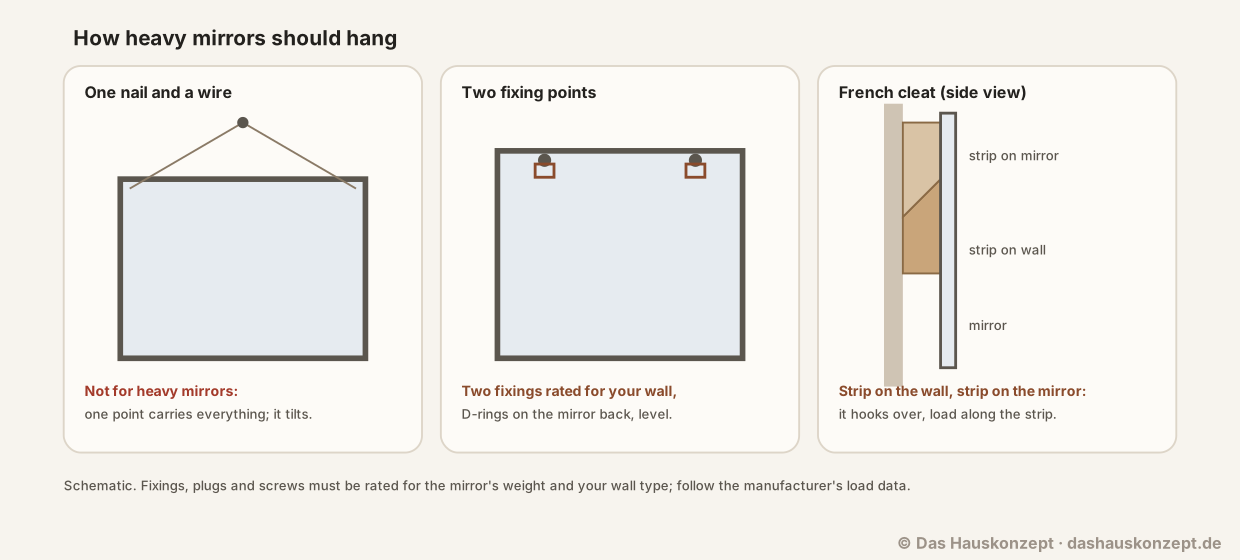 (Open the diagram full size)
- Not one nail and a wire. All the weight hangs on a single point and the mirror can tilt or swing off.
- Two fixing points spread the load and keep the mirror level. Heavy mirrors usually have D-rings or brackets on the back for this.
- A French cleat is a strip on the wall with its top edge bevelled down towards the wall, and a matching strip on the mirror that hooks over it. The cleat spreads the load along its length and makes levelling easy.
Match the fixing to the wall:
| Wall | Fixing for a heavy mirror |
|---|---|
| Drywall, at a stud | wood screws through the board well into the stud |
| Drywall, between studs | a heavy-duty cavity anchor rated above the mirror's weight in your board thickness [1] |
| Drywall, light mirror only | a light-duty plasterboard plug [1] |
| Solid masonry, concrete | plugs for solid material with screws of the size the plug requires |
| Plaster on lath, unsure | get advice before drilling |
fischer, for example, names heavy plasterboard plugs such as its tilting plug for large mirrors up to around 40 kg (about 88 lb) [1]. That figure belongs to those products; always follow the load data of the plug you actually buy [1].
Read the number on an anchor package carefully. Maximum, ultimate and failure load mean the same thing, an average of the maker's load tests, while a recommended load often has a safety factor applied, and makers do not all use the same factor [2]. A maximum load is a guide only: the real load an anchor holds can be lower [2]. Real capacity also depends on the board's age and condition, on how close the anchor sits to a stud or a board edge, and on whether the item sits flush; anything that stands out from the wall reduces capacity substantially [2]. Our default: rate each fixing for the mirror's full weight, so that one point can carry it while you hook it on, choose a recommended load where the package gives one, and where it gives only a maximum load, stay well below it.
Spacing matters as well as rating. Two anchors placed close together weaken the board between them and add no capacity; a single well-placed anchor can do better than two crowded ones [2].
How long should a French cleat be?
A French cleat for a heavy mirror on drywall should be at least twice the stud spacing, so that it always crosses two studs: 32 in (81.3 cm) at 16 in on center, 48 in (121.9 cm) at 24 in [4]. That rule works wherever the cleat starts, which matters because the mirror's position is usually set by the furniture, not by the studs.
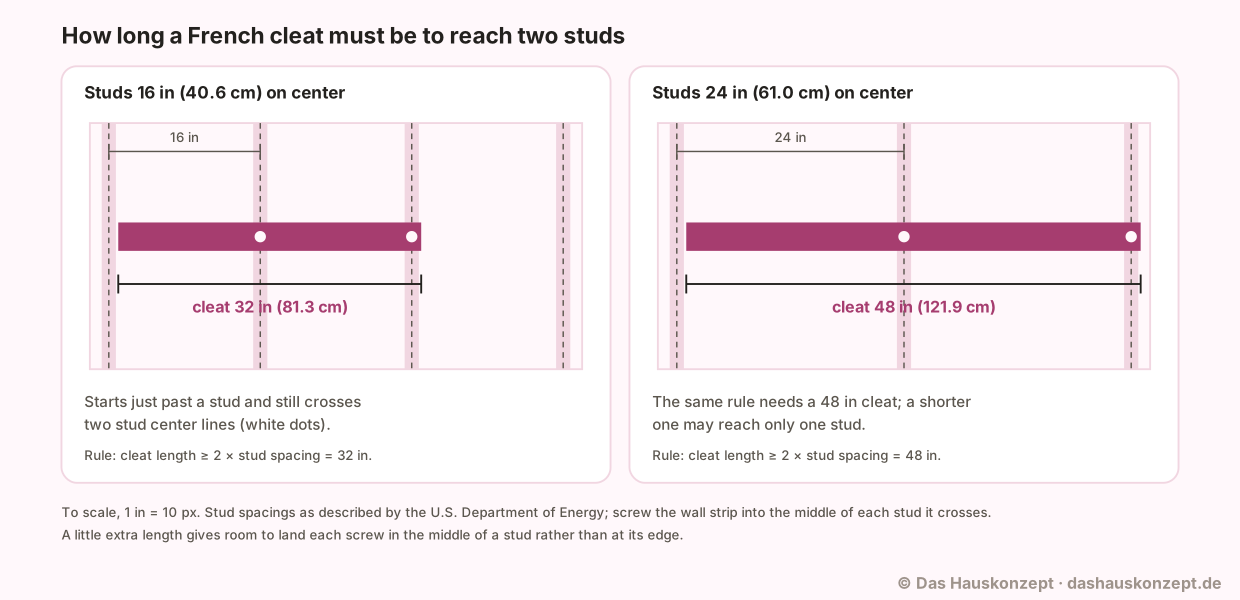 (Open the diagram full size)
A slightly longer cleat gives room to land each screw in the middle of a stud rather than at its edge. If the mirror is narrower than the cleat would need to be, use two fixing points instead: screws into a stud where one falls, otherwise cavity anchors rated above the mirror's full weight.
How to hang a heavy mirror step by step
Hanging a heavy mirror takes nine steps, from weighing it to checking that it does not move once it is up.
Weigh the mirror
Stand on a bathroom scale holding the mirror, read the total, then weigh yourself alone and subtract. If the mirror is too big to hold safely, estimate the glass from its size with the table on this page and add a margin for the frame. Write the number down: every fixing and hanger has to be rated above it.
Example: 36 × 48 in, 1/4 in glass = 35.0 lb (15.9 kg) of glass
Check the hanging hardware on the back
Look at the D-rings, brackets, hooks or cleat on the mirror. They must be screwed firmly into the frame, not bent or cracked, and rated for the weight if a rating is given. CPSC recalls show that the mirror's own hardware can break or let go, so replace anything loose or doubtful before you hang it.[6]
Find out what the wall is and where the studs are
Knock and drill a small test hole if needed: drywall sounds hollow between studs and the bit breaks through into a cavity; masonry is hard and throws out red, grey or white dust. In wood-frame walls, use a stud finder: studs are traditionally 16 in (40.6 cm) on center, in some homes 24 in (61.0 cm).[4]
Scan for cables and pipes
Before drilling, check whether there are electrical cables or water pipes behind the wall, and move the fixing point if the detector shows anything. On exterior walls, take care not to damage a vapor barrier.[1]
Choose fixings for the full weight
Into a stud: wood screws long enough to go well into the stud. Drywall between studs: a heavy-duty cavity anchor whose maker rates it above the mirror's weight in your board thickness. Masonry: plugs and screws for solid material. Check whether the package states a maximum (failure) load or a recommended load; makers do not all use the same safety factor.[2]
Mark the fixing points level
Hold the mirror's hangers taut and measure from each one to the top edge, then transfer those distances to the wall and draw a level line. Keep anchors well apart: WallClaw warns that anchors placed too close together weaken the board between them and add no capacity.[2]
Drill and set the fixings as the package says
Use the drill size, wall-thickness range and screw type printed on the package; with a different screw the maker's tested load may no longer be valid. Do not hang anything on an anchor that turns or sits loose in the wall.[2]
Lift with a second person and hang
Lift a large mirror with two people, one at each side, and lower it onto both fixings or onto the wall cleat together. Keep fingers clear of the gap between the mirror and the wall.
Check level and load
Check the top edge with a spirit level. Push gently on each corner; nothing should move, creak or pull away from the wall. Look at the anchors from the side: they should sit flush. Over a bed, a crib or a sink, check again after the mirror has hung for a while.
Is the mirror's own hanging hardware strong enough?
The hardware on the back of the mirror is as much a part of the load path as the wall anchor, and it can fail. CPSC recalled about 17,000 mirrors and wall decor items in 2018 because their adjustable J-hooks could break; 13 falls were reported, one with a laceration [6]. In 2024, about 27,400 wall mirrors were recalled because they could detach from the metal plate used to hang them, after 15 reports of mirrors falling [7].
Before you hang a mirror, check that every ring, bracket or plate is screwed tight into a sound frame and is not bent or cracked. Replace a thin wire with D-rings or a cleat where the frame allows, and use hardware rated above the mirror's weight.
Can you lean a heavy mirror instead of hanging it?
A leaning floor mirror avoids drilling, but it can slide at the foot or tip forward at the top. Follow the maker's instructions for it, and if it came with a wall strap or bracket, fit it, especially where children or pets play.
Hanging a heavy mirror in a rental
In a rental, a few screw holes for a mirror are common, but check your lease before you drill; it decides what you may fix to the walls and what you must repair. When you move out, the anchors come out and the holes are filled as in our move-out wall repair checklist.
Common questions
Can drywall hold a heavy mirror without a stud?
Yes, if the anchor's maker rates it above the mirror's full weight in your board thickness. fischer names its heavy plasterboard plugs for large mirrors up to around 40 kg (about 88 lb), but that is fischer's figure; other anchors differ. The drywall usually fails before the anchor, and 5/8 in board holds more than 1/2 in.[2]
How do I know if my mirror has been recalled?
Search the CPSC recall list at cpsc.gov for the brand or model. Recent mirror recalls name hanging hardware that broke, such as adjustable J-hooks, or mirrors that separated from a metal hanging plate; those two recalls offered replacement J-hooks or a refund, and owners were told to take the recalled pieces off the wall or stop using them immediately.[7]
Can I drill into an exterior wall to hang a mirror?
Yes, but scan for cables and pipes first and take care not to damage a vapor barrier, which fischer flags for exterior walls and roof areas. Behind drywall on an exterior wall there may also be insulation in the cavity, which affects which cavity anchor works.[1]
Sources and method
How this article was made: Opened and read on 2026-10-14: fischer's plasterboard fixing guidance, WallClaw's anchor load and performance sheet, Vitro's TD-120 glass weight table, the DOE Building Science page on advanced framing, an EPA lead-paint page and two CPSC mirror recalls. Glass weights and cleat lengths are our arithmetic on those figures. No mirror, wall or anchor was tested.
What this article adds: A glass-weight table for common mirror sizes from a glass maker's data, the cleat length that always reaches two studs with a to-scale diagram, and CPSC recalls showing why the mirror's own hanger needs checking.
Use of AI: Revised with AI assistance; every source was opened and checked on 2026-10-14; editorially reviewed before publication.
Editorially reviewed by Anna Muller on 11 October 2026 before publication.
- Secure fixing in plasterboard: practical tips for lightweight walls (press release, March 31, 2026) , fischer group of companies. checked Supports: Plasterboard is less load-bearing than solid walls because it is thin and porous; a bathroom mirror weighs considerably more than a small picture; vibrations such as slamming doors and the wall construction (single or double skin, cavity, insulation, vapour barrier) decide the fixing; light items such as small mirrors suit the self-drilling DuoBlade or the nylon GK plug, medium loads the metal GKM plug; heavy objects such as large mirrors, wall shelves or wall-mounted cupboards weighing up to around 40 kilograms can be fixed with solutions such as the DuoTec tilting plug, with the DuoHM for heavy items; before drilling, check for electrical or water pipes behind the wall; on external walls or in roof areas do not damage vapour barriers; observe the plug manufacturer's load specifications; for very heavy or safety-critical fixings consult a professional.
- WallClaw Anchors: performance, lab testing, screws and load definitions (manufacturer information sheet, April 2024) , WallClaw Anchors (PDF hosted by The Home Depot). checked Supports: Maximum loads are an average of up to 10 tests and are a guide; actual performance depends on drywall age and condition, thickness, proximity to studs or edges, proper installation and flush mounting, and cantilevered items reduce capacity substantially; do not mount any items on the wall if an anchor is loose; anchors placed too close together compromise the board and do not improve capacity, because drywall is the primary cause of failure; 5/8 in drywall holds more than 1/2 in, and 1/2 in board is more common in residential construction; use the screws supplied, a different screw may invalidate the tested load; maximum, ultimate and failure load are the same thing, a recommended load often has a safety factor applied, and manufacturers do not all use the same safety factor.
- Flat Glass Trade Thicknesses and Weights (Glass Technical Document TD-120, revision of November 28, 2024) , Vitro Architectural Glass (archived copy, Internet Archive). checked Supports: Table for soda-lime-silica float glass with a density of 157 lb per cubic foot: 3/16 in (5.0 mm), nominal 0.184 in, weighs 2.407 lb per square foot; 1/4 in (6.0 mm), nominal 0.223 in, weighs 2.918 lb per square foot; weight per square foot = 157 lb/cu ft × actual thickness in inches ÷ 12. The original vitroglazings.com URL returned 404 on 2026-10-14, so the archived copy was read.
- Framing: Building a Wall: Advanced Framing , U.S. Department of Energy, Building Science Education Solution Center. checked Supports: Wood-framed houses have traditionally been built with 2x4 studs spaced 16 inches on center, though code allows for wider spacing; advanced framing specifies 24-inch on-center studs for 2x6 wall framing rather than 16-inch on-center 2x4 framing.
- Reduce the Risk of Lead Exposure at Home , U.S. Environmental Protection Agency. checked Supports: If your home was built before 1978, it is more likely to have lead-based paint; projects that create even a small amount of dust can pose health risks; settled lead dust can re-enter the air when the home is vacuumed or swept; wet mop floors and hard surfaces to reduce lead dust; if you rent a pre-1978 home, your landlord or property management company must comply with the RRP Rule when performing work that disturbs paint.
- Uttermost Recalls Mirrors, Art and Wall Decor Due to Injury Hazard (June 12, 2018) , U.S. Consumer Product Safety Commission (CPSC). checked Supports: The hanging hardware can break and allow the decor to fall, posing an injury hazard to bystanders; the recalled adjustable J-hooks measure about 3.5 in long and 0.75 in wide; about 17,000 units; 13 reports of hanging hardware breaking and mirrors and wall decor falling, one laceration; remedy: free replacement J-hooks.
- Origin 21 Wall Mirrors Sold Exclusively at Lowe's Stores Recalled Due to Laceration and Impact Hazards (August 1, 2024) , U.S. Consumer Product Safety Commission (CPSC). checked Supports: The recalled mirrors can detach from the metal plate used for hanging; rectangle mirror 22 × 31 in and oval mirror 24 × 36 in; about 27,400 units; 15 reports of mirrors separating from the metal hanger and falling, no injuries; consumers should immediately stop using the recalled mirrors; remedy: refund.