Encyclopedia
Ducted or recirculating range hood? Explained for small kitchens
Applies to: USRentersOwners2015 IRC (local exhaust)HVI airflow guidance Code figures are the 2015 IRC as summarized by DOE's Building America Solution Center; check the edition your town or county has adopted.
This page is only available in English. The language switch leads to the closest German page.
In short
A ducted range hood sends steam, smoke, grease and gas-stove fumes outdoors; a recirculating hood filters grease and some odor, then blows the moist air back into the kitchen. The US 2015 IRC sets at least 100 cfm (170 m³/h) for a kitchen fan run while cooking. With a recirculating hood, open a window as you cook.
At a glance
| What | Value | Basis |
|---|---|---|
| HVI recommended rate, hood against a wall | 100 cfm per ftPer linear foot of range; 250 cfm (425 m³/h) for a 30 in range; minimum 40 cfm per ft; island hoods × 1.5 | [4] |
| Makeup air required above | 400 cfm680 m³/h; the makeup air system must run whenever the hood fan runs | [3] |
| Charcoal (ductfree) filter life | up to 6 monthsNormal use, Broan-NuTone economy hoods; not washable; replace sooner if visibly dirty | [5] |
| Hood bottom above the cooktop, minimum | 18 / 26 inElectric 18 in (46 cm), gas 26 in (66 cm); recommended maximum 30 in (76 cm); Broan-NuTone economy hoods | [5] |
| Indoor relative humidity to aim for | below 60 %Ideally 30 to 50 percent (EPA) | [2] |
| Duct outlet from any air inlet | at least 10 ft3.05 m; outlet covered with louvers, a screen or a grille, not aimed at a walkway | [3] |
| Hood capture efficiency in a lab test | under 15 to over 98 %Seven under-cabinet hoods over gas burners, Berkeley Lab 2012 | [8] |
| 5 air changes per hour, 10 × 8 ft kitchen | 53 cfm80 sq ft × 8 ft ceiling = 640 cu ft; 640 × 5 ÷ 60 = 53 cfm (91 m³/h), continuous run | calculated · Square footage calculator |
Contents
- What is the difference between a ducted and a recirculating range hood?
- What does each type of hood remove?
- How many cfm does a range hood need in a small kitchen?
- Is a recirculating hood enough in a small kitchen?
- What changes with a gas stove?
- How do you get the most out of a range hood?
- How often should you clean or replace range hood filters?
- What does installing a ducted range hood involve?
- Common questions
- Sources and method
In many apartments the choice is made for you: there is no duct to the outside, so the hood recirculates. Knowing what each type does still matters, because it changes how you cook in a small kitchen and what to ask a landlord or installer.
What is the difference between a ducted and a recirculating range hood?
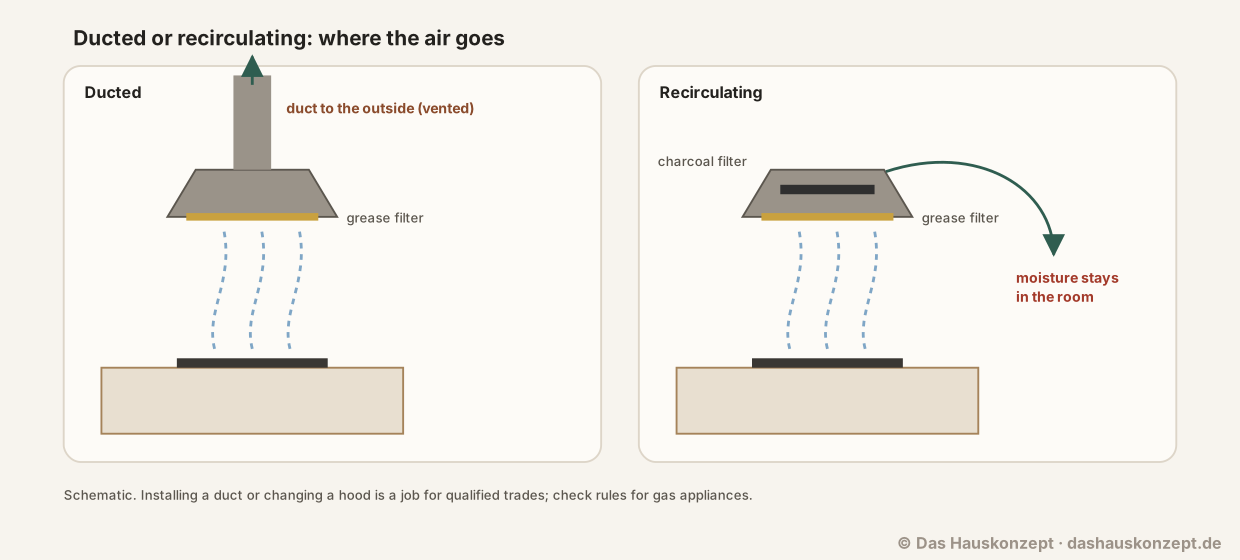
A ducted range hood pulls cooking air through a grease filter and pushes it through a metal duct to the outdoors; a recirculating range hood pulls it through a grease filter and a charcoal filter and blows it back into the kitchen [3].
 (Open the diagram full size)
- Ducted (vented): steam, smoke, odor, grease particles and combustion gases leave the home. The Department of Energy's Building America Solution Center describes the duct as rigid metal with a smooth interior, airtight and fitted with a backdraft damper, running outdoors and never into an attic, a crawlspace or the space between floors [3].
- Recirculating (ductless): the grease filter catches grease and the charcoal filter takes up some odor; the air, with its water vapor, comes back into the room. The same DOE guide says recirculating fans "only filter the air and return it to the kitchen" [3], and the Home Ventilating Institute (HVI) says non-ducted, recirculating hoods "provide no actual ventilation" [4].
Some hoods can be fitted either way. Broan-NuTone's instructions for its economy under-cabinet hoods show a ducted installation through a 3¼ × 10 in (8.3 × 25.4 cm) duct or a 6 or 7 in round duct, and a non-ducted installation with a "ductfree" filter in which no duct hole is cut [5]. Other models are sold for non-ducted use only [6].
What does each type of hood remove?
A ducted hood removes the grease, odor, steam and combustion gases it captures; a recirculating hood removes grease and part of the odor and leaves moisture and gases in the kitchen. The table sets the two side by side.
| What | Ducted (vented) | Recirculating (ductless) |
|---|---|---|
| Where the air goes [3] | Outdoors through a metal duct with a damper | Back into the kitchen through filters |
| Steam and moisture [3] | Removed to the outdoors | Stay in the room |
| Gas-stove combustion gases [1] | Vented outdoors, as EPA advises | Not vented; stay in the room |
| Counts as ventilation [4] | Yes | No: HVI says it provides no actual ventilation |
| Grease [5] | Caught in the metal grease filter | Caught in the grease filter |
| Installation [5] | Duct hole to a wall or roof cap, plus wiring | Wiring only; no duct hole is cut |
| Filter upkeep [5] | Clean the grease filter often | Grease filter, plus a charcoal filter that lasts up to 6 months |
Which fits when?
- Ducted (vented): Any kitchen with a gas stove, and any small kitchen where cooking steam fogs the windows, wherever a duct can reach an outside wall or the roof.
- Recirculating (ductless): Rentals and inside kitchens with no route outdoors, best on an electric cooktop and always with an open window or another exhaust fan while cooking.
How well either type works also depends on how much of the cooking plume the hood catches. In a Lawrence Berkeley National Laboratory test of seven under-cabinet hoods over gas burners, capture efficiency ranged from less than 15 percent to more than 98 percent, and every hood caught more from the back burners than from the front ones [8].
How many cfm does a range hood need in a small kitchen?
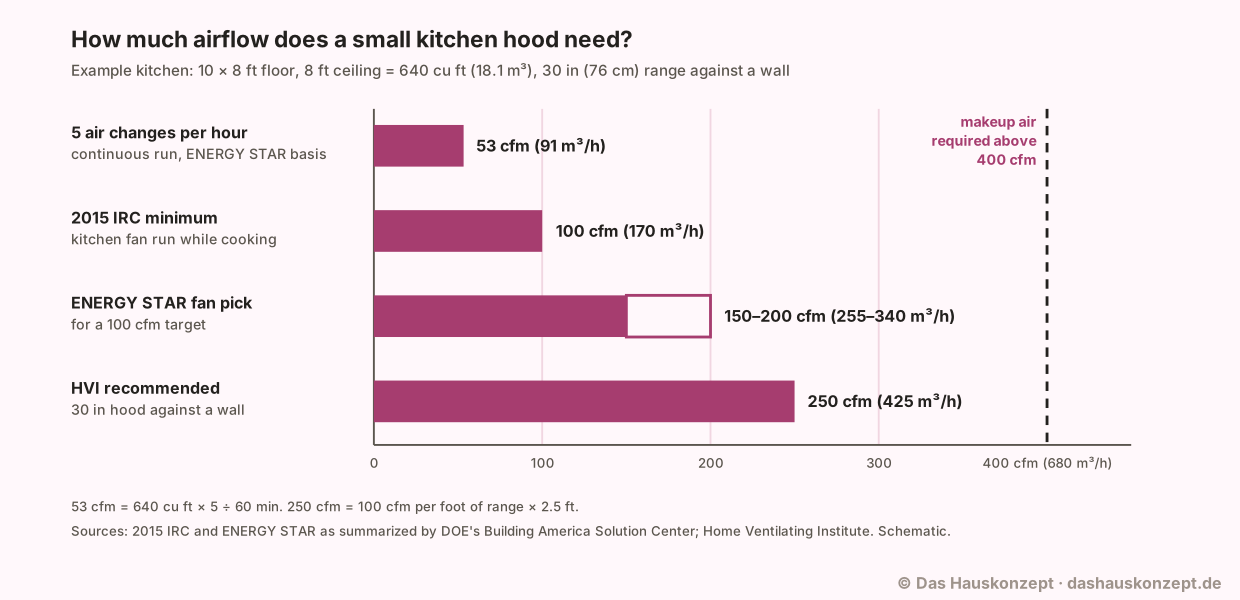
A ducted hood in a small kitchen needs at least 100 cfm (170 m³/h) when it runs while you cook, the 2015 International Residential Code (IRC) minimum for an intermittent kitchen fan in the US; a fan that runs all the time needs 25 cfm (42 m³/h) [3]. HVI recommends more: 100 cfm per linear foot of range for a hood against a wall, 1.5 times that over an island [4].
| Hood width, against a wall | HVI recommended | HVI minimum |
|---|---|---|
| 30 in (76 cm) | 250 cfm (425 m³/h) | 100 cfm (170 m³/h) |
| 36 in (91 cm) | 300 cfm (510 m³/h) | 120 cfm (204 m³/h) |
| 48 in (122 cm) | 400 cfm (680 m³/h) | 160 cfm (272 m³/h) |
Rates from HVI's ventilation guide [4].
ENERGY STAR recommends at least 5 air changes per hour for a continuous kitchen fan, and for the 100 cfm target it suggests buying a fan rated 150 to 200 cfm (255–340 m³/h), so the installed fan still reaches the target [3]. HVI adds that hoods without an HVI-certified rating often have inflated performance figures [4]. These rates describe air sent outdoors; on a recirculating hood, a cfm figure only says how much air passes through the filters.
 (Open the diagram full size)
A bigger fan is not automatically better. Any exhaust fan over 400 cfm (680 m³/h) needs a makeup air system that runs with it, and DOE's guide warns that very powerful hoods can backdraft a furnace, water heater or fireplace that is not sealed-combustion [3]. For a 30 in range against a wall, HVI's recommended 250 cfm stays well below that line [4].
Is a recirculating hood enough in a small kitchen?
A recirculating hood is enough for grease but not for moisture: in a small kitchen the steam from boiling and simmering stays in the room unless a window or another exhaust fan removes it. EPA advises venting moisture-producing appliances, including stoves, to the outside where possible, using exhaust fans or opening windows while cooking, and keeping indoor relative humidity below 60 percent, ideally 30 to 50 percent [2]. Berkeley Lab's advice for a hood that only recirculates is the same: use another exhaust fan or open windows [7].
With a recirculating hood, a workable routine is:
- Open a window, or run another exhaust fan, every time a pot boils or a pan fries [2].
- Treat fogged windows as a signal: EPA says condensation can be a sign of high humidity, and an inexpensive moisture meter shows the actual level [2].
- Dry condensation on windows, walls or pipes quickly and reduce the moisture source [2].
- Keep the charcoal filter current, since it is the filter that takes up odor (see the filter section below).
What changes with a gas stove?
A gas stove adds combustion gases that a grease or charcoal filter does not vent, so with gas the case for a ducted hood is strongest. EPA names unvented combustion appliances such as gas stoves among the primary indoor sources of nitrogen dioxide, notes that indoor levels in homes with gas stoves often exceed outdoor levels, and advises installing and using an exhaust fan vented to the outdoors over gas stoves and keeping gas appliances properly adjusted [1]. Berkeley Lab lists carbon monoxide, nitrogen oxides, formaldehyde and fine particles such as soot among the pollutants that hoods vent [8], and the California Air Resources Board suggests that gas stoves be cleaned regularly and adjusted annually by a trained professional [9].
With a gas stove and only a recirculating hood, ventilate with a window every time you cook, and raise the question of a ducted hood with your landlord.
How do you get the most out of a range hood?
A range hood works best when it is switched on every time you cook, sits over the burners you use and hangs at the height its maker specifies.
- Cook on the back burners. Berkeley Lab says almost any hood works better on the back burners; on low speed with a single back burner a hood typically captures 50 to 70 percent of the pollutants [7]. In its 2012 test, hoods meeting HVI airflows caught about 80 percent or more from the back burners but 50 percent or more from the front ones [8].
- Switch it on every time. Broan-NuTone says to always turn the hood on when cooking at high heat [5], and Berkeley Lab advises ventilating more the more you cook [7].
- Mount it at the right height. Broan-NuTone sets the bottom of its economy hoods at least 18 in (46 cm) above an electric range and 26 in (66 cm) above a gas range, with 30 in (76 cm) as the recommended maximum [5]; other makers' figures can differ, so follow the manual for your hood.
- Cover the front burners when you buy. Berkeley Lab says a better hood covers the front burners and has higher flow [7]; in its test, open hoods captured more than those with grease-screen or metal-covered bottoms [8].
How often should you clean or replace range hood filters?
Clean a metal grease filter frequently and replace a charcoal filter at the maker's interval: Broan-NuTone says its grease filter "should be cleaned frequently" in a warm dishwashing-detergent solution or the dishwasher, and that its ductfree charcoal filter is not washable and lasts up to 6 months with normal use [5].
| Filter | Fitted in | Care | When |
|---|---|---|---|
| Metal grease filter | Ducted and recirculating hoods | Wash in warm detergent solution or the dishwasher | Frequently [5] |
| Charcoal (ductfree) filter | Recirculating hoods only | Not washable; replace | Up to 6 months, sooner if the colored side looks noticeably dirty or discolored [5] |
Grease left in a hood is a fire risk. Broan-NuTone's warning on range-top grease fires says grease should not be allowed to accumulate on the fan, the filters or in exhaust ducts, and to switch the power off at the service panel before cleaning [5]. DOE adds that a duct of too small a diameter can trap grease, creating a fire hazard [3].
What does installing a ducted range hood involve?
Installing a ducted range hood means running a metal duct from the hood to a cap on an outside wall or the roof and wiring the hood, work that Broan-NuTone says must be done by a qualified person to all applicable codes [5]. The main requirements from DOE's guide and the maker's manual:
- Route: the most direct route outdoors with as few bends as possible, in smooth metal duct of the diameter the maker specifies, with seams sealed by mastic or metal tape, never cloth-backed duct tape [3].
- Destination: outdoors only, never into a wall or ceiling cavity, an attic, a crawl space or a garage [5].
- Outlet: at least 10 ft (3.05 m) from any air inlet, covered with louvers, a screen or a grille, and not aimed at a walkway [3].
- Damper: a backdraft damper that closes when the fan is off [3].
- Makeup air: required for hoods over 400 cfm [3].
In an apartment the duct has to pass through an outside wall or the roof, which usually needs the building owner's consent; in a rental, ask the landlord before changing anything.
Common questions
Can a recirculating range hood be converted to ducted?
Yes, if the model is sold for both installations. Broan-NuTone's economy under-cabinet hoods install either ducted, through a 3¼ × 10 in rectangular or a round duct, or non-ducted with a ductfree filter. Some ductless models are sold for non-ducted use only, so check the manual before planning a duct.[5]
Can I vent a range hood into the attic or a wall cavity?
No. Broan-NuTone's instructions say not to exhaust air into spaces within walls or ceilings or into attics, crawl spaces or garages, and DOE's Building America guidance says to vent the kitchen fan directly outside, not into an attic, crawlspace or the space between floors.[3]
Do I need a ducted hood with an electric stove?
A ducted hood still helps, because cooking itself pollutes the air. In a CARB study of 32 cooking activities on gas and electric appliances, airborne particles ranged from 60 to 1,400 micrograms per cubic meter while cooking, levels that CARB says can exceed the ambient standard of 50 micrograms per cubic meter averaged over 24 hours. Berkeley Lab notes that electric burners produce no carbon monoxide and only small amounts of nitrogen dioxide, but steam and cooking particles remain.[9]
How quiet should a range hood be?
ENERGY STAR recommends 3 sones or less for a kitchen fan run while cooking and 1 sone or less for one that runs continuously. Berkeley Lab's advice is to buy a quiet hood you like, because a hood only helps when it is switched on; CARB also recommends a low-noise hood vented to the outdoors.[3]
Related tools
Sources and method
How this article was made: Opened and read on 2026-10-14: EPA's pages on nitrogen dioxide and on mold and moisture, DOE's Building America Solution Center guide to kitchen exhaust fans, HVI's ventilation guide, Broan-NuTone's installation manual for its economy hoods and one product page, two Berkeley Lab articles on hood performance and a CARB release on cooking pollution. Ran the square footage calculator for the example kitchen. No hood was installed, tested or measured; capture figures are Berkeley Lab's laboratory results.
What this article adds: A side-by-side table of what each hood type removes, an airflow chart that puts the IRC minimum, the ENERGY STAR and HVI rates and the 400 cfm makeup air line on one scale, and a worked example for a 10 × 8 ft kitchen.
Use of AI: Revised with AI assistance; every source was opened and checked on 2026-10-14; editorially reviewed before publication.
Editorially reviewed by Anna Muller on 11 October 2026 before publication.
- Nitrogen Dioxide's Impact on Indoor Air Quality (last updated April 29, 2026) , U.S. Environmental Protection Agency. checked Supports: The primary indoor sources of nitrogen dioxide are combustion processes such as unvented combustion appliances, for example gas stoves; in homes with gas stoves, kerosene heaters or unvented gas space heaters, indoor levels often exceed outdoor levels; install and use an exhaust fan vented to outdoors over gas stoves; keep gas appliances properly adjusted.
- A Brief Guide to Mold, Moisture and Your Home (last updated February 18, 2026) , U.S. Environmental Protection Agency. checked Supports: Vent appliances that produce moisture, such as clothes dryers, stoves and kerosene heaters, to the outside where possible; use exhaust fans or open windows when cooking, running the dishwasher or dishwashing; keep indoor humidity below 60 percent, ideally between 30 and 50 percent, measured with an inexpensive moisture meter; condensation can be a sign of high humidity, so dry condensation on windows, walls or pipes quickly and reduce the moisture source.
- Kitchen Exhaust Fans (Building America Solution Center guide, last updated 2022-12-06) , Pacific Northwest National Laboratory for the U.S. Department of Energy. checked Supports: The kitchen fan should be ducted outside, not into the attic, crawlspace or between floors; rigid metal duct with a smooth interior, airtight, with a back-draft damper, as few bends as possible, seams sealed with mastic or metal tape, not cloth-backed duct tape; small-diameter ducts could trap grease, creating a fire hazard; recirculating fans that draw air through a filter and discharge it back into the room are not acceptable and only filter the air and return it to the kitchen; kitchens should use exhaust fans that duct outside to remove moisture and odors; IRC 2015 local exhaust: 100 cfm or more intermittent, 25 cfm or more continuous; ENERGY STAR: at least 5 air changes per hour, a 150 to 200 cfm fan for a 100 cfm intermittent target, at most 1 sone continuous or 3 sones intermittent; any exhaust fan over 400 cfm needs a makeup air system that runs with it; very powerful hoods can backdraft a non-sealed-combustion furnace, water heater or fireplace; outlet at least 10 feet from any air inlet, covered with louvers, a screen or a grille, not directed onto a walkway.
- How Much Ventilation Do I Need? (Home Ventilation Guide) , Home Ventilating Institute (HVI). checked Supports: Range hood rates per linear foot of range: against a wall 100 cfm recommended, 40 cfm minimum; island 150 cfm recommended, 50 cfm minimum (rate × 1.5); by hood width against a wall: 30 in 250 cfm (minimum 100), 36 in 300 cfm (minimum 120), 48 in 400 cfm (minimum 160); nonducted, recirculation kitchen range hoods provide no actual ventilation; use hoods that vent directly outside; non-HVI-certified hoods often have inflated performance ratings.
- Installation, Use, and Care Quick Start Manual: Broan-NuTone Range Hoods (economy under-cabinet hoods) , Broan-NuTone. checked Supports: Installation work and electrical wiring must be done by a qualified person in accordance with all applicable codes; ducted fans must always be vented to the outdoors; use only metal ductwork to reduce the risk of fire; do not exhaust air into spaces within walls or ceiling or into attics, crawl space or garage; the hood may be installed with the UL-approved cord kit designated for it; to reduce the risk of a range-top grease fire, always turn the hood on when cooking at high heat and do not let grease accumulate on the fan, filters or in exhaust ducts; hood bottom at least 18 in above an electric range and 26 in above a gas range, recommended maximum 30 in; ducted with a 3¼ × 10 in duct or 6 or 7 in round duct, non-ducted with a ductfree filter and no duct hole cut; switch power off before cleaning; the grease filter should be cleaned frequently in a warm dishwashing detergent solution and is dishwasher safe; the ductfree filter is not washable and will last up to 6 months with normal use, replace it when the colored side becomes noticeably dirty or discolored.
- 30-Inch Ductless Under-Cabinet Range Hood with Charcoal Filter, model 413001 (product page) , Broan-NuTone. checked Supports: A 30 in under-cabinet hood sold for non-ducted (ductless, recirculating) use only, with a combination grease and charcoal filter that is replaceable; sound rating 3.5 sones.
- Range Hood Advice from Indoor Air Quality Researcher (March 9, 2018) , Lawrence Berkeley National Laboratory. checked Supports: Range hoods are most effective if the hood actually moves air out of the kitchen; if it just recirculates air back into the kitchen, use another exhaust fan or open windows; almost any range hood works better on the back burners, and on low speed with a single back burner it typically captures 50 to 70 percent of the pollutants; use the hood regularly and ventilate more the more you cook; a better hood covers the front burners and has higher flow rates; buy a quiet one that you like.
- Berkeley Lab study assesses residential cooking exhaust hoods' ability to vent pollutants (May 30, 2012) , Lawrence Berkeley National Laboratory. checked Supports: Of seven representative under-cabinet hoods tested over gas burners, capture efficiency varied from less than 15 percent to more than 98 percent; hoods vent pollutants such as carbon monoxide, nitrogen oxides, formaldehyde and fine particles such as soot; all hoods captured more from the two back burners than the front burners; hoods reaching HVI airflow recommendations captured about 80 percent or more from back burners but 50 percent or more from front burners; open hoods captured more than those with grease-screen or metal-covered bottoms; ENERGY STAR ratings consider only energy use and noise, not capture.
- Cooking Activities Cause Unhealthy Indoor Air (news release 01-49, December 21, 2001) , California Air Resources Board. checked Supports: In tests of 32 cooking activities using both gas and electric appliances, airborne particles ranged from 60 to 1,400 micrograms per cubic meter during cooking, which can exceed the ambient standard of 50 micrograms per cubic meter averaged over 24 hours; ARB recommends a low-noise range hood that is vented to the outdoors, and suggests gas stoves be cleaned regularly and adjusted annually by a trained professional.