Encyclopedia
What is a drop zone? The entryway idea explained for small homes
This page is only available in English. The language switch leads to the closest German page.
In short
A drop zone is a fixed spot near the door where everything that comes in with you lands on the way in and is waiting on the way out. It can cover four jobs: hanging (coats and bags), dropping (keys and post), sitting (to deal with shoes) and charging (phones). Most small homes need two or three of them, not all four, and the smallest useful version of each fits on a short stretch of wall.
Contents
"Drop zone" is a common term in English-language home and design writing. It does not describe a type of furniture but a habit with a fixed address: one place by the door where coats, bags, keys, post and shoes land when you come in, and where they are waiting when you leave [1]. If you have ever searched the whole home for your keys, the drop zone is the answer to that problem.
A mudroom is one way to build a drop zone, but it is not the only one [1]. In a small apartment it may be a short stretch of wall beside the front door.
The four jobs a drop zone can do
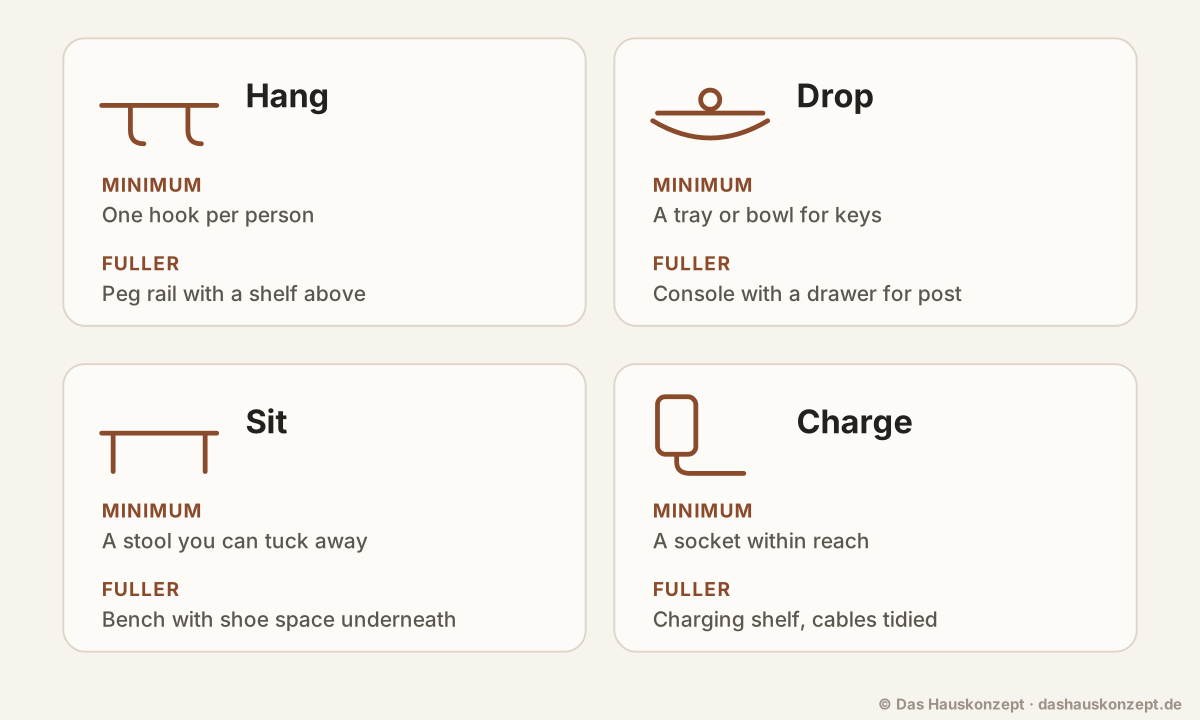 (Open the diagram full size)
- Hang: coats, scarves, bags and umbrellas. The main question is how many people use it every day, and what hangs there in winter.
- Drop: keys, wallet, post, sunglasses, the dog's lead. Small, easily lost things need a surface or a container that is always in the same place.
- Sit: a place to take off and put on shoes, and to put a bag down for a moment. It matters more for children, older people and anyone wearing boots with laces.
- Charge: phones, earbuds and other small devices that you pick up on the way out. This only works where there is a socket in reach.
Not every home needs all four. A single person who leaves a bike helmet and a bag might only need to hang and drop. A family with small children will lean on sit and hang. Start from what currently ends up on the floor, the kitchen table or the sofa: that is the job your drop zone is missing.
The minimum version of each
You do not need a bench, a locker and a console to have a drop zone. The smallest useful versions:
| Job | Minimum | Fuller version |
|---|---|---|
| Hang | One hook per person who uses the door every day | Peg rail with a shelf for hats and gloves above |
| Drop | A tray or bowl in a fixed place | A console or shallow cabinet with a drawer for post |
| Sit | A stool you can tuck under something | A bench with shoe space underneath |
| Charge | A socket within reach and one short cable | A shelf or drawer with cables routed out of the way |
Start with the minimum, use it for a couple of weeks and see what overflows. That tells you what to upgrade.
Where to put it
- By the door you actually use. In a house, that may be the back or side door rather than the front door [1].
- Outside the door's swing. The door needs room to open fully; furniture and hanging coats inside its arc get in the way every day.
- On the side you reach first. If you come in carrying shopping, the drop surface should be within one step, not across the room.
- Without a hallway: if the front door opens straight into the living room, the drop zone also marks where the living room begins. A rug, a low shelf or a bench can draw that line.
- In a narrow hallway: use wall height instead of floor depth (hooks and a shallow shelf rather than a deep cabinet) and check the clear path that is left.
What it is not
A drop zone is not a storage room. It holds what is in use this week. Off-season coats, spare shoes and sports kit for once a month belong somewhere else, or the drop zone fills up and stops working. Clearing it out once at the start of each season keeps it doing its job.
Next steps
If you have a wall but no plan, start with hooks: the peg-rail guide explains how to fix a rail securely. For ideas by situation, see the mudroom bench gallery, the entryway ideas for apartments without a coat closet, and the dog-friendly entryway setups.
Sources and method
The draft was written with AI assistance. Numbers, standards and safety notes rest on the sources listed below; each source carries the date we last opened and checked it.
Editorially reviewed by Anna Muller on 11 October 2026 before publication.
- A Home’s Dirty Little Secret Gets a Design Solution , National Association of REALTORS® (REALTOR® News). checked Supports: Drop zones and mudrooms are landing spots near an entryway for shoes, coats, bags, mail, keys and leashes; they work best by the door people actually use (for example the back door), need no large dedicated room and can fit into a small corner or hallway.