Guide · Checklist
Holiday hosting in a small home: a two-week prep checklist
Applies to: US Food, fire and product-safety figures are from US federal agencies; the NKBA seating clearances are design guidelines, not code.
This page is only available in English. The language switch leads to the closest German page.
In short
Start two weeks ahead: count seats, plates and fridge space for every guest, allowing 24 in (61 cm) of table edge per diner, and borrow what is missing. One week out, plan where coats, shoes and the guest bed go and clear a fridge shelf. The day before, move furniture to open a walkway. On the day, keep the floor clear, the table simple and one spot free for dirty dishes.
At a glance
| What | Value | Basis |
|---|---|---|
| Clearance behind a seated diner | 32 in813 mm where nobody passes behind; 36 in (914 mm) to edge past, 44 in (1118 mm) to walk past | [4] |
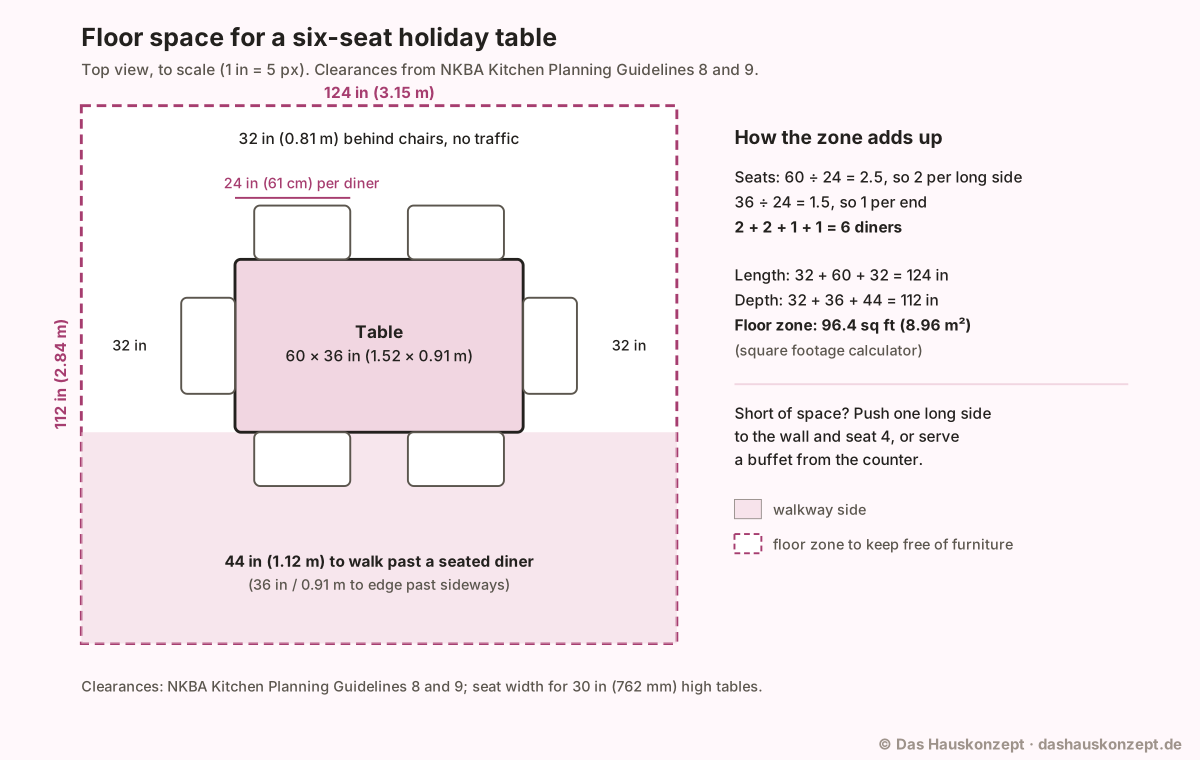
| Floor zone for a 6-seat 60 × 36 in table | 96.4 sq ft8.96 m²; 124 × 112 in with 32 in behind chairs on three sides and a 44 in walkway on one | calculated · Square footage calculator |
| Perishable food at room temperature | 2 hours max1 hour if the room is above 90 °F (32 °C); then discard | [1] |
| Fridge temperature | 40 °F or below4 °C; freezer at 0 °F (−18 °C), checked with an appliance thermometer | [2] |
| Turkey thawing time in the fridge | 24 hoursFor every 4 to 5 lb (1.8 to 2.3 kg) of turkey; a thawed bird keeps 1 to 2 days before cooking | [3] |
| Candle distance from anything that burns | 12 in min30 cm; in a stable holder, never in bedrooms or sleeping areas, out at bedtime | [5] |
| Smoke alarm test | monthlyAlarms inside and outside each sleeping area; replace the whole alarm every 10 years | [7] |
Contents
- How far ahead should you start preparing to host?
- How many guests fit at your table?
- Where will overnight guests sleep?
- Where do coats, bags and shoes go in a small apartment?
- How do you make room in the fridge for holiday food?
- Which furniture should you move before guests arrive?
- How long can food stay out at a holiday buffet?
- Candles and lights in a small room
- What to do after the guests leave
- The full hosting checklist to print
- Common questions
- Sources and method
Hosting in a small home is mostly a logistics problem: where eight coats go, where everyone sits, and where dessert waits while the main course is on the table. Those answers are easy two weeks ahead and stressful on the day, so the list below runs as a countdown. Adapt it to your household and skip what does not apply.
How far ahead should you start preparing to host?
Two weeks ahead is early enough to borrow chairs, plates or a folding bed before everyone else does, and to thaw a large frozen turkey, which takes days in the fridge [3]. Each stage below has one job:
| When | Main job | Why then |
|---|---|---|
| Two weeks out | Count seats, plates and table space; choose the guest bed | Borrowing and renting gets harder close to the holiday |
| One week out | Plan coats and shoes, clear the fridge, fix the thaw date | A 20 lb turkey needs four to five days to thaw in the fridge [2] |
| The day before | Move furniture, lay the table, route cords | Leaves the day itself for cooking and guests |
| On the day | Keep the floor clear, watch food times and flames | Space runs out once everyone is inside |
| After | Leftovers, bedding, borrowed items | Shallow containers cool food faster [1] |
How many guests fit at your table?
A table fits at most one diner per 24 in (61 cm) of edge: the NKBA planning guidelines call for at least a 24 in wide knee space for each seated diner at a 30 in (762 mm) high table [4]. Divide each side's length by 24 and round down. A 60 × 36 in (1.52 × 0.91 m) table gives 2 per long side and 1 per end, so 6.
The table is only half the space. The same guidelines ask for 32 in (813 mm) from the table edge to a wall where nobody passes behind a seated diner, 36 in (914 mm) for someone to edge past, and 44 in (1118 mm) to walk past [4]. In a small living room the walkway side is usually the one between the table and the sofa or the door.
 (Open the diagram full size)
If the room cannot give you that zone, change the format rather than the guest list:
| Room situation | What usually works |
|---|---|
| Zone fits on all four sides | Seated dinner at the full table |
| One long side has to go against the wall | Seat 4 (2 + 1 + 1) and serve from the kitchen |
| No room for a seated table at all | Buffet on the kitchen counter, plates on laps on sofa, chairs and floor cushions |
| Table too short | Butt a desk or folding table onto one end at the same height |
Count the other seats too: stools, a bench, the bed edge in a studio and floor cushions. Count plates, glasses, cutlery and serving dishes for the menu, not just for the number of people, and borrow or rent the gaps now. If your oven and stove are small, ask each guest to bring one dish and plan which dishes can be served at room temperature.
Where will overnight guests sleep?
Overnight guests in a small home sleep on a sofa bed, an air mattress or a borrowed folding bed, and the choice is about floor space when it is open, not when it is folded. Test the sofa bed or inflate the air mattress once two weeks out, check the bedding fits, and find a spot where a suitcase can stay open without blocking the route to the bathroom.
Test the smoke alarms while you are at it. USFA says to put smoke alarms inside and outside each bedroom and sleeping area, to test them monthly and to replace the whole alarm every 10 years [7]. A living room that becomes a guest room is a sleeping area for the night, so it needs an alarm too, and it is no place for lit candles: USFA advises against lit candles in bedrooms and sleeping areas [5].
Where do coats, bags and shoes go in a small apartment?
Coats, bags and shoes need a planned spot by the door before guests arrive, otherwise they end up on the hallway floor and on the sofa. Plan it one week out:
- A coat spot: a rolling rail, an over-door hook rack or the bed in one room, never the hallway floor.
- A tray or mat for wet shoes just inside the door, and a basket for hats, scarves and gloves.
- A clear hallway floor, so the front door opens fully while people are arriving.
- One chair or shelf for handbags, away from the walkway.
How do you make room in the fridge for holiday food?
Fridge space in a small kitchen runs out first, so clear one shelf and part of the freezer for guest food and drinks a week ahead and check the temperatures while it is empty. FDA says to keep the fridge at or below 40 °F (4 °C) and the freezer at 0 °F (−18 °C), checked with an appliance thermometer [2].
A frozen turkey or roast is the item that takes the most fridge time. CDC allows about 24 hours of fridge thawing for each 4 to 5 lb (1.8 to 2.3 kg) of turkey and says a thawed bird can stay in the fridge 1 to 2 days before cooking [3]. That window gives you slack if the bird thaws early, but none if you start late:
Drinks are the easiest thing to move out of the fridge. A cooler bag with ice packs can hold bottles for the evening and frees the shelf for food that has to stay at 40 °F (4 °C) or colder [1]. Set aside shallow containers for leftovers now, so they are ready when the evening ends [1].
Which furniture should you move before guests arrive?
The furniture to move is whatever stands in the line from the front door to the table, the kitchen and the bathroom. Decide a week ahead which pieces move: the coffee table out, chairs in, a side table becomes the drinks station. Then move everything into its hosting position the day before and walk each route once with your arms full.
The NKBA guidelines give 36 in (914 mm) as the minimum width of a kitchen walkway, a useful yardstick for the route through a living room [4]. Where a walkway has to pass a seated guest, you need the 44 in (1118 mm) from the table section above.
Cords are part of the route. CPSC says extension cords are for temporary use and should not run under carpets, through doorways or under furniture [9], so run light and lamp cords along walls rather than across the path, and check the rating on the cord's tag before plugging in several things.
The rest of the day-before list: lay the table, or set up the buffet counter with plates at the start and cutlery at the end; put out the coat rail, shoe tray and guest towels; empty the dishwasher and the bins; charge battery candles and lights.
How long can food stay out at a holiday buffet?
Perishable food can stay out at room temperature for 2 hours, or 1 hour if the room is above 90 °F (32 °C); after that FDA says to discard it [1]. A small, warm apartment full of people heats up, so put food away as soon as the meal winds down.
FDA's buffet advice suits a small kitchen well: put out several small platters instead of one large one, and swap in fresh ones from the fridge or from an oven set at 200 °F to 250 °F [1]. Hot food should stay at 140 °F or warmer and cold food at 40 °F or colder; check the label of a slow cooker or warming tray, since FDA notes some hold food at only 110 °F to 120 °F [1]. Keep one clear surface, such as a stretch of counter or a tray on a stool, for dirty plates so they do not end up on chairs.
Candles and lights in a small room
Candles in a small room go only where nobody brushes past them: USFA says to use stable holders where they cannot be knocked down, keep them at least 12 in (30 cm) from anything that burns, and consider battery-operated flameless candles [5]. On a crowded table, a battery candle is the simple choice. CPSC adds that burning candles should stay in sight and never be left unattended [8].
At the end of the evening, blow out candles and unplug the tree lights before you go to bed [5] [6]. Unplug extension cords that are not in use as well [9].
What to do after the guests leave
After the guests leave, the jobs are leftovers first, then bedding and borrowed things. Refrigerate leftovers within 2 hours, dividing large amounts into shallow containers so they cool quickly [1]. Wash and dry the guest bedding before storing it, fold borrowed chairs and return them within the week, and note what was missing for next time.
The full hosting checklist to print
The printable checklist collects every job above by stage, with the numbers to check against.
Two weeks out
One week out
The day before
On the day
After the guests leave
Common questions
How long do holiday leftovers keep in the fridge?
Three to four days. FDA says to use leftovers within three to four days and to refrigerate them within two hours, and CDC gives the same 3 to 4 days for cooked turkey and dishes made with it. Write the date on each container as you pack it, so guests who take food home know the limit too.[2]
Can I keep food or drinks cold on the balcony?
Drinks, yes; perishable food only if you can show it stays cold. FDA says cold food belongs at 40 °F (4 °C) or colder, and outdoor air rises and falls with sun and weather. An appliance thermometer in the box tells you whether it holds that line; otherwise keep the food, and a thawing turkey, in the fridge.[2]
Where should a visiting baby sleep in a small home?
In a product made for infant sleep. CPSC names cribs, bassinets, play yards and bedside sleepers that meet federal requirements, with nothing in them but a fitted sheet, the baby on its back, and says to move a baby there if they fall asleep elsewhere. Ask the parents to bring a travel play yard and plan a floor spot for it off the walkway.[11]
How many strings of Christmas lights can I plug together?
No more than three sets of incandescent lights, says CPSC, and never overload an outlet. Run the cord along a wall rather than under a rug or through a doorway, and unplug the lights before you go to bed.[8]
Related tools
Sources and method
How this article was made: Opened and read: FDA pages on buffets and holiday food safety, CDC's holiday turkey page, USFA pages on candles, tree lights and smoke alarms, CPSC's holiday safety centre, extension cord publication 5032, home electrical safety checklist 513 and safe sleep page, and the NKBA Kitchen Planning Guidelines. Ran the square footage calculator for the table-space example. Nothing was tested in a home; the checklist is a planning aid.
What this article adds: A two-week countdown that turns NKBA seating clearances into a to-scale table-space plan with a seat count and floor area, and agency thaw and food-time rules into a dated fridge plan.
Use of AI: Revised with AI assistance; every source was opened and checked on 2026-10-14; editorially reviewed before publication.
Editorially reviewed by Anna Muller on 11 October 2026 before publication.
- Serving Up Safe Buffets , U.S. Food and Drug Administration. checked Supports: Prepare a number of small platters ahead and replace them during the party; keep backup dishes cold in the refrigerator or hot in an oven set at 200 °F to 250 °F; hot foods at 140 °F or warmer, cold foods at 40 °F or colder; discard perishables left out at room temperature for more than 2 hours (1 hour above 90 °F); refrigerate leftovers within 2 hours; divide large amounts of leftovers into shallow containers for quicker cooling.
- Food Safety Tips for Healthy Holidays , U.S. Food and Drug Administration. checked Supports: Set your refrigerator at or below 40 °F and the freezer at 0 °F and check both periodically with an appliance thermometer; a 20-pound turkey needs four to five days to thaw completely in the refrigerator; refrigerate leftovers within two hours; leftovers should be used within three to four days; the turkey is safe at 165 °F.
- Preparing Your Holiday Turkey Safely , U.S. Centers for Disease Control and Prevention. checked Supports: Allow about 24 hours of thawing for each 4 to 5 pounds of turkey in the refrigerator; a turkey thawed in the refrigerator can remain there for 1 to 2 days before cooking; cook to a safe internal temperature of 165 °F; refrigerate leftovers within 2 hours; eat cooked turkey and dishes made with it within 3 to 4 days; refrigerator at 40 °F or colder.
- Kitchen Planning Guidelines with Access Standards , National Kitchen & Bath Association (NKBA). checked Supports: Guideline 7: a walkway at least 36 in (914 mm) wide. Guideline 8: 32 in (813 mm) from the table edge to a wall or obstruction where no traffic passes behind a seated diner; at least 36 in (914 mm) to edge past and 44 in (1118 mm) to walk past. Guideline 9: at 30 in (762 mm) high tables, a 24 in wide × 18 in deep (610 × 457 mm) knee space for each seated diner. State or local codes may apply.
- Candle Fire Safety , U.S. Fire Administration (FEMA). checked Supports: Consider battery-operated flameless candles; put lit candles in stable holders where they cannot be knocked down easily; keep candles at least 12 inches away from anything that burns; blow out candles when you leave a room or home, or when you go to bed; don't use lit candles in bedrooms, bathrooms and sleeping areas.
- Pictograph: Christmas Tree Light Safety Tips , U.S. Fire Administration (FEMA). checked Supports: Always unplug Christmas tree lights before going to bed or leaving your home.
- Smoke Alarms , U.S. Fire Administration (FEMA). checked Supports: Put smoke alarms inside and outside each bedroom and sleeping area and on every level of the home; test the alarm monthly; replace batteries in 9-volt alarms at least once every year; replace the entire smoke alarm every 10 years.
- Holiday Safety Information Center , U.S. Consumer Product Safety Commission (CPSC). checked Supports: Never string together more than three sets of incandescent lights and never overload electrical outlets; never leave candles unattended; keep burning candles in sight and away from flammable items and put them out before leaving the room; use flameless candles whenever possible.
- Household Extension Cords Can Cause Fires (Publication 5032) , U.S. Consumer Product Safety Commission (CPSC). checked Supports: Extension cords should only be used temporarily; if any part of the cord is hot while in use it is a warning sign that it may be overloaded; check the rating on the tag or packaging; do not run extension cords under carpets, through doorways or under furniture; replace damaged cords and never tape up damaged insulation; unplug a cord when it is not in use.
- Home Electrical Safety Checklist (Publication 513) , U.S. Consumer Product Safety Commission (CPSC). checked Supports: Are all outlets and switches cool to the touch? If not, make sure appliances are not overloading the outlet and stop using them until an electrician checks the problem; unusually warm outlets or switches may indicate an unsafe wiring condition, such as a loose electrical connection that can start a fire.
- Safe Sleep , U.S. Consumer Product Safety Commission (CPSC). checked Supports: Use products intended for sleep, including cribs, bassinets, play yards and bedside sleepers that meet federal requirements; bare is best, with nothing but a fitted sheet; always place baby on their back; move your baby to their crib, bassinet, play yard or bedside sleeper if they fall asleep elsewhere; don't add pillows or blankets.