Guide · How-to
How to make a curtained bed nook in a studio
Applies to: USRentersOwners Product figures are examples from Kirsch and IKEA US documents; other rods and tracks differ. Safety rules from U.S. agencies.
This page is only available in English. The language switch leads to the closest German page.
In short
Make a curtained bed nook by hanging a curtain from a tension rod across an alcove, or from a ceiling track around the bed's open sides. Measure the run along each open side and plan 2 to 3 times that width in fabric; make the curtain ½ in (13 mm) shorter than the hook-to-floor drop so it floats. Check the track's load rating and keep fabric at least 3 ft (0.91 m) from heaters.
At a glance
| What | Value | Basis |
|---|---|---|
| Bracket spacing on a ceiling or wall track | 4 ft1.22 m; Kirsch recommends a bracket every 4 ft and one under every pole splice | [9] |
| Load rating of one IKEA VIDGA rail | 11 lb5 kg for one 55⅛ in (140 cm) rail, which needs 2 ceiling or wall fittings | [14] |
| Ceiling fitting from each rail end | 2–8 in5–20 cm, as drawn in the VIDGA assembly instructions | [15] |
| Open stack of a 144 in track at 2× fullness | 22¼ in57 cm one-way; 19¼ in (49 cm) per side two-way. Kirsch pleated stack guide, an estimate that fabric changes | [10] |
| Velvet fabric weight | 14–18 oz/sq yd475–610 g/m²; linens and blackout lining 6–10 oz/sq yd (203–339 g/m²), per Kirsch | [11] |
| Unlined linen curtain for a 144 in run | 7.8–13.1 lb3.6–5.9 kg; 288 × 94 in of fabric at 2× fullness; 15.7–26.1 lb (7.1–11.8 kg) with blackout lining | calculated · [11] |
| Kirsch spring tension rod lengths | 8–72 in20–183 cm; steel, inside mount, stationary curtains only | [12] |
Contents
- Where should the curtain run around the bed?
- Tension rod, ceiling track or wall rail: which should you use?
- How do you measure for a bed nook curtain?
- How wide should the curtain be?
- Which fabric works for a bed curtain?
- How heavy is a bed curtain, and can the track hold it?
- How to put up the curtain, step by step
- How do you keep a curtained bed nook fire-safe?
- Can you make a bed nook in a rental without drilling?
- Common questions
- Sources and method
A curtained bed nook is a sleeping corner closed off by a curtain on a rod or track: drawn at night, the curtain screens the bed; open by day, it gathers into a stack at one end. Three decisions shape the job: where the curtain runs, what holds it, and how heavy the curtain will be.
Where should the curtain run around the bed?
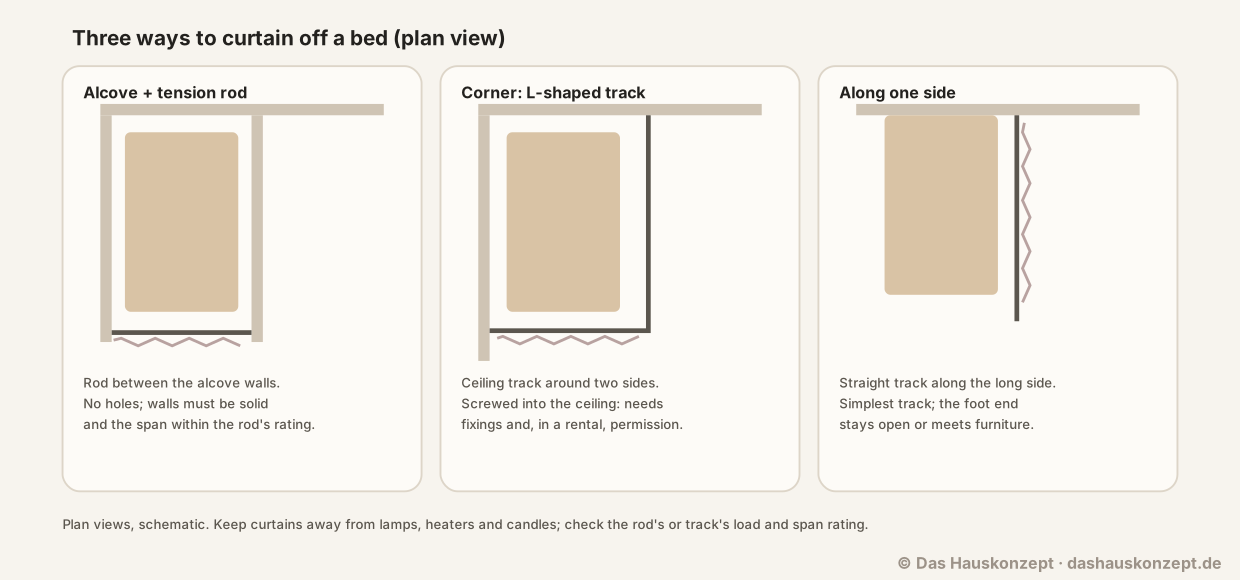
The curtain runs along every side of the bed that is open to the room. That gives three common layouts: across the opening of an alcove, around the two open sides of a bed in a corner, or along one long side of a bed whose other side and head are against walls.
 (Open the diagram full size)
| Layout | Run | What holds it |
|---|---|---|
| Bed in an alcove or niche | One straight span across the opening | Tension rod between the side walls, or a rail on brackets |
| Bed in a corner | Two legs: the open long side and the foot | Ceiling track with a corner piece |
| Bed with one long side against a wall | One straight run along the open long side | Ceiling track, or a rail where there is wall above the run |
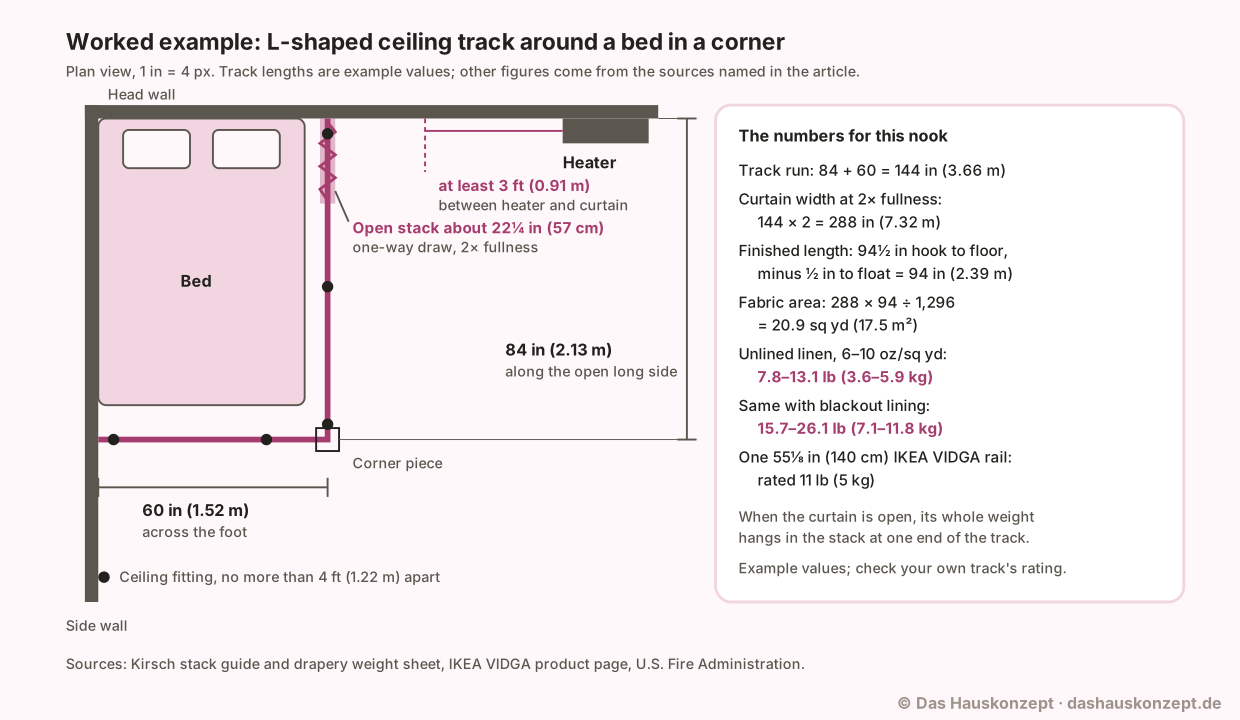
Before you settle the line, plan where the curtain goes when it is open. A drawn-back curtain does not disappear: on a 144 in (3.66 m) track at 2× fullness, Kirsch's stack guide estimates a stack of 22¼ in (57 cm) at one end, or 19¼ in (49 cm) at each end if the curtain splits in the middle [10]. Put the stack where it hides something anyway, such as the head end of the bed, not in front of a window or a closet door.
Check what sits along the line, too. The run should leave heaters and radiators at least 3 ft (0.91 m) away [1], stay clear of lamps and light fixtures [2], and not cover a window you need to open, a door swing or a light switch.
Tension rod, ceiling track or wall rail: which should you use?
A tension rod suits an alcove with two solid facing walls and a light curtain; a ceiling track suits a bed in a corner or out in the room, because it can turn a corner; a wall-mounted rail suits an alcove with wall above the opening when the span or the curtain is too much for a rod.
| What | Tension rod | Ceiling track | Wall-mounted rail |
|---|---|---|---|
| How it is held [9] | Presses between two surfaces; no brackets | Brackets or fittings screwed to the ceiling | Brackets screwed to the wall |
| Support spacing [9] | Held at the two ends only | A bracket every 4 ft (1.22 m) and under every splice | A bracket every 4 ft (1.22 m) and under every splice |
| Turns a corner [16] | No, one straight span | Yes, with a corner piece | Yes, with a corner piece on a wall fitting |
| Load rating, example product [14] | Read the rod's pack; none on Kirsch's spec sheet | Max. load 11 lb (5 kg) listed for one 55⅛ in VIDGA rail | Same VIDGA rail, 11 lb (5 kg); wall fittings sold separately |
Which fits when?
- Tension rod: An alcove or niche with two solid, flat walls facing each other, a span inside the rod's stated range, a light curtain and no holes allowed.
- Ceiling track: A bed in a corner or out in the room, where the curtain must run along two sides and turn a corner, and the ceiling can take screws.
- Wall-mounted rail: An alcove with wall above the opening, where the span is too wide or the curtain too heavy for a tension rod.
Tension rod. A tension rod holds by pressing outwards, so it needs two hard, flat surfaces that face each other [13]. Kirsch's spring tension rods come in lengths of 8–72 in (20–183 cm) and are made for stationary curtains, not ones on a traverse mechanism [12]. Buy a rod longer than the span: one maker's instructions say a tension rod gets weaker the further it is extended, holds very little at full length, and should be checked for weight capacity before anything heavy goes on it [13].
Ceiling track. A ceiling track is screwed to the ceiling and can follow the bed around a corner with a corner piece; IKEA describes its VIDGA corner piece as making it possible for curtains to go around corners and to "create a cozy canopy" [16]. Hospital-style cubicle tracks, which Kirsch lists as soft room dividers, work the same way and can be mounted to the ceiling or suspended from it [9].
Wall-mounted rail. A rail on wall brackets suits a run with wall above it, such as the face above an alcove opening. Kirsch recommends a bracket every 4 ft (1.22 m) and one under every pole splice [9]; IKEA's VIDGA drawing spaces wall brackets no more than 53⅛ in (135 cm) apart [15].
How do you measure for a bed nook curtain?
Measure two things: the run, which is the length of the track along every side the curtain covers, and the drop, which is the height from the hook or glider down to the floor. Add the legs of an L-shaped run together, and measure the drop at several points, because ceilings and floors are rarely level.
For a ceiling track, the track line sits a little out from the wall. IKEA says to mount the ceiling fitting 4¾ in (12 cm) from the wall when its corner piece is used, and to leave enough distance for the curtain to open and close without obstacles [16].
The finished length depends on how the hem should meet the floor:
| Hem style | Finished length | When it fits |
|---|---|---|
| Float | About ½ in (13 mm) above the floor | A curtain you draw every day; Kirsch says it is best for traversing rods [9] |
| Kiss | 1–3 in (2.5–7.6 cm) onto the floor | A relaxed look on a curtain drawn less often [9] |
| Puddle | Pools on the floor | Kirsch says it works best in low-traffic areas [9]; beside a bed it gathers dust |
For the measured drop of 94½ in in the worked example below, a floating curtain is 94½ − ½ = 94 in (2.39 m) long.
How wide should the curtain be?
A curtain for a bed nook should be about 2 to 3 times as wide as the track it hangs on. Kirsch's stack guide works with three fullness levels, 2×, 2½× and 3×, which it ties to 3, 4 and 5 carriers per foot of track [10]. A curtain only as wide as the track hangs flat and leaves gaps when drawn.
More fullness looks softer and blocks more light through the folds, but it needs more fabric, weighs more and makes a bigger stack. For a 144 in (3.66 m) track, Kirsch's chart gives these stacks [10]:
| Fullness | Curtain width needed | Stack, one-way | Stack per side, two-way |
|---|---|---|---|
| 2× | 288 in (7.32 m) | 22¼ in (57 cm) | 19¼ in (49 cm) |
| 2½× | 360 in (9.14 m) | 27¾ in (70 cm) | 22 in (56 cm) |
| 3× | 432 in (10.97 m) | 33¼ in (84 cm) | 24¾ in (63 cm) |
The widths are the run times the fullness; the stacks are Kirsch's estimates for pleated draperies on its Hollis rods, and the fabric can change them. The same guide gives 30¼ in (77 cm) one-way at 2× on a 144 in Architrac track, so leave room for a bigger stack than the table shows [10].
Which fabric works for a bed curtain?
The fabric depends on how much light and view you want to block. Kirsch's guidebook draws the line between a curtain, an unlined light fabric that does not block light or add privacy, and a drapery, which is often lined and does both [9].
| Fabric | Weight per sq yd | Weight per m² | Use in a nook |
|---|---|---|---|
| Printed cotton | 4–6 oz | 136–203 g | A light visual screen |
| Linen | 6–10 oz | 203–339 g | Soft screen, some light through |
| Blackout lining | 6–10 oz | 203–339 g | Added behind the face fabric to block light |
| Velvet | 14–18 oz | 475–610 g | Heavy, blocks more light |
The ounce figures are Kirsch's ranges; for a specific fabric, Kirsch says to ask its manufacturer [11]. Metric values are converted at 1 oz/sq yd = 33.9 g/m². A lining adds its own weight to the face fabric, which matters for the next question.
How heavy is a bed curtain, and can the track hold it?
A bed curtain often weighs more than people expect: an unlined linen curtain for a 144 in (3.66 m) corner run at 2× fullness works out at about 7.8–13.1 lb (3.6–5.9 kg), and 15.7–26.1 lb (7.1–11.8 kg) with a blackout lining. The method is Kirsch's: square yards of fabric times ounces per square yard, divided by 16 [11].
 (Open the diagram full size)
Compare that with the rod's or track's stated load. IKEA lists a maximum load of 11 lb (5 kg) for one 55⅛ in (140 cm) VIDGA rail and does not say how that load adds up when rails are joined [14]. The unlined linen curtain, at 7.8–13.1 lb, already reaches that figure, and when it is drawn open its whole weight hangs in the stack at one end of the track. A lined linen curtain (15.7–26.1 lb) or unlined velvet (up to 23.5 lb (10.7 kg) by the same arithmetic at 18 oz/sq yd) is about twice the figure [11].
Four ways to bring the numbers back in line:
- Choose a lighter fabric, or skip the lining if you do not need the dark.
- Split the curtain in the middle so it stacks at both ends; each stack then holds half the weight.
- Ask the track maker whether its rating covers a joined track with the whole curtain stacked at one end; for a longer VIDGA track, IKEA asks for extra wall hardware for every 55⅛ in [14].
- Use a track whose maker states a load that covers the whole curtain in one stack.
How to put up the curtain, step by step
Putting up a bed nook curtain takes eight steps, from choosing the layout to testing the drawn curtain. The measurements in the steps follow the worked example above.
Choose where the curtain runs
Mark every side of the bed that is open to the room. An alcove needs one straight run across its opening; a bed in a corner needs an L-shaped run along the open long side and across the foot; a bed with one long side against a wall can take a straight run along the other long side.
Check the surroundings before you mark anything
Keep the run at least 3 ft (0.91 m) from heaters and radiators and clear of lamps and light fixtures. Make sure the drawn curtain does not cover a window you need to open, a door swing, a light switch or an outlet you use at night.[1]
Measure the run
Measure the track line along every open side and add the legs together. For a ceiling track with an IKEA VIDGA corner piece, IKEA says to mount the ceiling fitting 4¾ in (12 cm) from the wall and to leave enough distance from the wall for the curtain to open and close.[16]
Example: 84 + 60 = 144 in (3.66 m)
Measure the drop
Measure from the hook or glider eye down to the floor at several points along the run, because floors and ceilings are rarely level. Kirsch's guidebook suggests a curtain that floats about ½ in above the floor for one that is drawn often; letting it kiss the floor by 1–3 in is the relaxed alternative.[9]
Example: 94½ in to the floor, so 94 in (2.39 m) finished
Work out the curtain width
Multiply the run by the fullness: Kirsch's stack guide works with 2×, 2½× and 3× fullness. Add up the widths of the panels you plan to buy until they reach that total, and plan where the open curtain will stack.[10]
Example: 144 in × 2 = 288 in (7.32 m)
Check the weight against the track
Estimate the curtain weight with Kirsch's formula: square yards of fabric times ounces per square yard, divided by 16 for pounds. Compare it with the rod's or track's stated load, and remember that the whole curtain hangs in the stack when it is open.[11]
Example: 7.8–13.1 lb unlined linen vs. 11 lb max. load for one VIDGA rail
Mark and fit the supports
Snap or draw the track line, then mark the fittings: IKEA's VIDGA instructions place ceiling fittings 2–8 in (5–20 cm) in from each rail end, and Kirsch recommends a bracket every 4 ft and under every splice. Use screws that suit the ceiling or wall material, as IKEA's instructions say, and fit the corner piece with the connector supplied with the rail.[15]
Fittings about 4 in from each end: 47⅛ in (1.20 m) apart
Hang the curtain and test it
Clip the track into its fittings, add gliders or hooks, hang the panels and draw the curtain open and shut several times. Nothing should catch at the corner piece or the joints, the stack should sit where you planned it, and the hem should clear the floor along the whole run.
The fitting spacing in step 7 meets both makers' rules at once:
How do you keep a curtained bed nook fire-safe?
A curtained bed nook is fire-safe when nothing hot can touch the fabric: keep anything that can burn at least 3 ft (0.91 m) from heaters and radiators [1], away from lamps, light fixtures and bulbs [2], and never use candles inside it.
- Heaters. CPSC repeats the 3 ft rule for drapes and bedding specifically [6]. A heater under a window next to the bed decides where the curtain may run.
- Lamps and bulbs. Use bulbs that match the wattage on the lamp or fixture [2]. LEDs waste less energy as heat than incandescent bulbs, which release 90% of their energy as heat [3], but a cooler bulb is not a reason to let fabric touch it.
- Candles. USFA says not to use lit candles in bedrooms and sleeping areas, and suggests battery-operated flameless candles; elsewhere it says to keep candles at least 12 in (30 cm) from anything that burns [4].
- Light strings. Turn them off at bedtime; the FAQ below has CPSC's checks [7].
Can you make a bed nook in a rental without drilling?
A bed nook in a rental can go up without drilling if the bed sits in an alcove or niche: a tension rod between the two side walls needs no brackets [9]. A bed in a corner or out in the room needs a track, and a track needs screws in the ceiling or wall.
IKEA's VIDGA rail, for example, ships with ceiling fittings but without screws, and its instructions say to choose screws suited to the material you fix into [14] [15]. Before you drill in a rental, check your lease and ask the landlord, and plan how you will fill the holes when you move out. If the alcove walls are tiled, soft or uneven, a tension rod is the wrong tool, because it needs two hard, flat surfaces facing each other [13]; a rail on screws is then the better choice.
Common questions
Can I put fairy lights on the curtains of a bed nook?
Only with care. CPSC says to use lights tested by a nationally recognized laboratory such as UL or ETL, to check each set for cracked sockets, frayed or bare wires and loose connections, and to turn the lights off when you go to bed. Keep bulbs from resting in the folds: USFA says to keep anything that can burn away from light bulbs.[7]
Do I need a smoke alarm inside a curtained bed nook?
Yes, if no alarm already covers the bed: USFA says to put smoke alarms inside and outside each bedroom and sleeping area, on the ceiling or high on the wall, and to test them monthly. A nook closed off by a curtain is a sleeping area, so follow the alarm maker's instructions for the best place.[8]
Is it safe to run a space heater in a curtained bed nook overnight?
No. CPSC says to turn heaters off when sleeping, to keep them at least 3 ft (0.91 m) from drapes, bedding and furniture, and to plug electric space heaters directly into a wall outlet, never into an extension cord or power strip. Heat the studio before bed instead.[6]
How wide an alcove can a tension rod span?
As wide as that rod's stated range, which differs by product: Kirsch's spring tension rods come in 8–72 in (20–183 cm). Buy a rod longer than the span, because one maker's instructions say a tension rod gets weaker the further it is extended and holds very little at full length, and check its weight capacity before hanging a heavy curtain.[13]
Are curtain cords a danger for children in a bed nook?
Yes, if the rod or track has cords. CPSC says children have strangled on the cords of blinds, shades and draperies, that cordless window coverings are the only way to remove the hazard, and that beds and cribs should be moved away from window covering cords. Choose a hand-drawn curtain or a wand instead of a cord.[5]
Sources and method
How this article was made: Re-opened the five existing U.S. Fire Administration, ENERGY STAR and CPSC pages; opened CPSC's 2026 space heater release, its 2008 holiday lighting release and USFA's smoke alarm page; read Kirsch's guidebook, pleated stack guide, drapery weight sheet and tension rod spec sheet, IKEA US product pages and assembly instructions for the VIDGA track and corner piece, and a spring tension rod instruction sheet. Calculated the worked example by hand. No rod, track or curtain was tested.
What this article adds: A worked example that turns a corner nook's track run into curtain width, finished length, open stack and fabric weight, and checks it against a real track's load rating and two makers' bracket rules, with a dimensioned plan.
Use of AI: Revised with AI assistance; every source was opened and checked on 2026-10-14; editorially reviewed before publication.
Editorially reviewed by Anna Muller on 11 October 2026 before publication.
- Heating Fire Safety , U.S. Fire Administration (FEMA). checked Supports: Keep anything that can burn at least 3 feet from all heat sources, including fireplaces, wood stoves, radiators, space heaters or candles; turn space heaters off when leaving the room or going to bed.
- Appliance and Electrical Fire Safety , U.S. Fire Administration (FEMA). checked Supports: Keep anything that can burn away from lamps, light fixtures and light bulbs; use lightbulbs that match the recommended wattage on the lamp or fixture.
- Learn About LED Lighting , ENERGY STAR (U.S. EPA). checked Supports: LED lighting products produce light up to 90% more efficiently than incandescent light bulbs; incandescent bulbs release 90% of their energy as heat; LEDs use heat sinks to absorb the heat they produce and dissipate it into the surrounding environment.
- Candle Fire Safety , U.S. Fire Administration (FEMA). checked Supports: Don't use lit candles in bedrooms, bathrooms and sleeping areas; keep candles at least 12 inches away from anything that burns; consider battery-operated flameless candles.
- Window Covering Cords , U.S. Consumer Product Safety Commission. checked Supports: Children have strangled on the cords of window blinds, shades, draperies and other window coverings; the safest option when young children are present is to go cordless; cordless window coverings are the only option to eliminate the strangulation hazard; move all cribs, beds, furniture and toys away from windows and window covering cords.
- Keep Warm and Safe This Winter: Tips for Using Generators, Furnaces and Space Heaters (news release, January 23, 2026) , U.S. Consumer Product Safety Commission. checked Supports: Keep heaters at least three feet away from drapes, furniture, bedding and other combustible items; turn off heaters when sleeping; plug electric space heaters directly into a wall outlet, never into an extension cord or power strip.
- CPSC Releases 'Do's and Don'ts' of Holiday Decorating (news release, December 16, 2008) , U.S. Consumer Product Safety Commission. checked Supports: Use only lights that have been tested for safety by a nationally-recognized testing laboratory, such as UL or ETL/ITSNA; check each set of lights, new or old, for broken or cracked sockets, frayed or bare wires, or loose connections; turn off all holiday lights when you go to bed or leave the house.
- Smoke Alarms , U.S. Fire Administration (FEMA). checked Supports: Put smoke alarms inside and outside each bedroom and sleeping area and on every level of the home; put them on the ceiling or high on the wall; check the manufacturer's instructions for the best place; test the alarm monthly.
- Course in Drapery Hardware: Guidebook , Kirsch Drapery Hardware. checked Supports: Float: hang about 1/2 inch above the floor, best for traversing rods; kiss: let draperies fall 1-3 inches onto the floor; puddle works best in low traffic areas; brackets hold the pole or track, and Kirsch recommends a bracket every 4 feet and under every pole splice, including ceiling brackets that mount to the ceiling; tension rods mount inside the frame and don't require brackets; cubicle tracks are used for soft room dividers and can be suspended from or mounted to the ceiling; curtains are unlined light fabric that does not block light or add privacy, draperies are often lined and block light and add privacy; for a ceiling-mounted rod, measure for extra fabric.
- Pleated Stack Guides: Hollis Traverse Rods (v9.26) , Kirsch Drapery Hardware. checked Supports: Columns for 3x fullness (5 carriers per foot), 2½x (4 per foot) and 2x (3 per foot); for a 144 in track: 2x 22.25 in one-way and 19.25 in per side two-way, 2½x 27.75 and 22, 3x 33.25 and 24.75; for 84 in at 2x: 15.5 and 15.75; for 120 in at 2x: 19.5 and 17.75; the Estate Traverse Rods & Architrac Series chart (16mm carriers) gives 30.25 in one-way and 18 in per side for a 144 in track at 2x; stack size is estimated and the fabric used could alter it.
- How to Calculate Drapery Weight (v1.22) , Kirsch Drapery Hardware. checked Supports: Total square yards = (total yards × 36 × fabric width) ÷ 1296; weight = total square yards × ounces per square yard ÷ 16; fabrics by weight per square yard: drapery lining 2-4 oz, blackout lining 6-10 oz, printed cottons 4-6 oz, linens 6-10 oz, jacquards 10-14 oz, velvets 14-18 oz; contact the fabric manufacturer for your specific fabric weight.
- Spring Tension Rod (spec sheet v5.20) , Kirsch Drapery Hardware. checked Supports: Ideal for mounting inside a window frame; pole lengths 8-72 in; steel; stationary operation; inside mount; no brackets; does not bend or curve; the sheet gives no load rating.
- Curtain Rod – Spring Fit: Preparation and Fixing Instructions , Smart Home Products (Windoware). checked Supports: A tension rod needs to be placed between 2 hard, flat surfaces that face one another; purchase a rod that's longer than your measurement; the longer you expand it the weaker it becomes, and at full length it won't hold up very much weight; check the weight capacity before hanging heavy items.
- VIDGA single track rail, included ceiling fittings, white, 55" (204.929.16) , IKEA US. checked Supports: Max. load 11 lb; 2 pieces of ceiling or wall hardware are needed for one 55⅛ in track rail, and wall hardware is added for every 55⅛ in when extending; the rail can be cut to length with a hacksaw; ceiling fittings included, wall fittings sold separately; wall hardware and screws are not included; mount with a distance from the wall that lets the curtain open and close without obstacles.
- VIDGA single track rail, assembly instructions (AA-2234187-5) , IKEA. checked Supports: Different wall materials require different types of screws; choose screws that are specially suited to the material; the ceiling-mount drawings place each ceiling fitting 5-20 cm (2-8 in) from the end of the rail; the wall-mount drawing spaces wall brackets max 135 cm (53 1/8 in) apart.
- VIDGA corner piece, single track, included ceiling hardware, white (304.983.81) , IKEA US. checked Supports: Makes it possible for curtains to go around corners; create a cozy canopy; the rail can be mounted to the wall or ceiling and the corner piece fits both the VIDGA wall fitting and ceiling fitting; if used with a ceiling fitting, mount the ceiling fitting 4¾ in from the wall; leave a distance from the wall to allow opening and closing the curtain; mount with the connector enclosed with the curtain rail.