Guide · Planning
Shoe storage for a small hallway: planning depth, capacity and drying
Applies to: US2010 ADA Standards 403.5.1 The ADA clear widths are used as a yardstick for a comfortable passage, not as a rule for a private home. Your furniture maker's instructions come first.
In short
A tilt-out shoe cabinet about 6.7 in (17 cm) deep is the slimmest shoe storage for a small hallway. In a 47.2 in (1.20 m) hallway it leaves 40.6 in (103 cm) clear. An open rack must be at least as deep as your longest shoe, roughly 11.8 in (30 cm) for EU size 45. Wet shoes dry in the open at room temperature, not in a closed cabinet.
At a glance
| What | Value | Basis |
|---|---|---|
| Length of one Paris point (EU sizes) | 0.666 cmEU shoe size = foot length in cm ÷ 0.666; in reverse, size × 0.666 cm (0.26 in) gives the length | [1] |
| Clear width of an accessible route (ADA) | 36 in915 mm minimum, 2010 ADA Standards 403.5.1 (US); a yardstick for a comfortable hallway, not a home rule | [4] |
| Short pinch point allowed (ADA) | 32 in815 mm minimum, only for a length of 24 in (610 mm) at most | [4] |
| Narrowest point next to a 13.8 in bench | 33.5 in850 mm in the hallway planner: 47.2 × 149.6 in (1.20 × 3.80 m) hallway, bench 39.4 × 13.8 in (100 × 35 cm) | calculated · Hallway planner |
| Narrowest point next to a 15.7 in tall cabinet | 31.5 in800 mm in the hallway planner, same hallway, cabinet 39.4 × 15.7 × 78.7 in (100 × 40 × 200 cm) | calculated · Hallway planner |
| Gap in front of an uninsulated exterior wall | about 4 inThe source states about 10 cm, so air can circulate behind cabinets and furniture | [3] |
| Indoor relative humidity (EPA) | below 60 %Ideally 30–50 %; the Bavarian environment agency gives 40–60 % | [7] |
Contents
- How to plan shoe storage for a small hallway
- How many pairs belong in the hallway?
- How deep does a shoe rack need to be?
- Which shoe cabinet fits a narrow hallway?
- How much clear width should a hallway keep?
- How many pairs fit in a shoe cabinet?
- How to anchor a shoe cabinet to the wall
- How to dry wet shoes in the hallway
- How to check shoe storage in the hallway planner
- Common questions
- Checklist
- Sources and method
How to plan shoe storage for a small hallway
Shoe storage for a small hallway is planned from the shoes to the furniture: count and measure the pairs first, then the clear width of the hallway, then pick the type. If you choose the piece first, you often find out only when it is standing there that the boots do not fit or the passage has become too tight.
Count the everyday pairs
List the pairs that get worn at least once a week this season. Count seasonal pairs and special cases such as walking boots or rain boots separately; only the everyday pairs have to live right by the door.
Example: 12 everyday pairs for two people
Measure your longest and widest pair
Measure the outside length of your longest shoes and the width of your widest pair standing side by side. An EU shoe size only gives a rough guide via the Paris point, because the sole and toe cap add length on the outside.[1]
Size 45 × 0.666 cm = 30.0 cm (11.8 in), a guide value
Measure the hallway at its narrowest point
Measure wall to wall where the shoe storage will stand and subtract anything that projects from the opposite side, such as a radiator or a second piece of furniture. As a yardstick for a comfortable route, the 2010 ADA Standards give 36 in (915 mm) of clear width.[4]
120 cm − 17 cm cabinet = 103 cm (40.6 in) clear in a 47.2 in hallway
Choose a type by depth and remaining width
Compare tilt-out cabinet, open rack, bench and tall cabinet by depth, space needed when opening and the width left over. The hallway planner assumes a tilt-out flap needs about its own depth again in front, a hinged door its leaf width.
Estimate the capacity
Divide the inside width of one shelf by the width of one pair and round down. Multiply by the number of shelves to get the pairs the piece holds, and compare that with your count from the first step.
30 in ÷ 8 in = 3.75, so 3 pairs per shelf
Check the wall and plan the anti-tip fixing
Find out what the wall is made of before you buy. One maker of shoe cabinets requires shoe cabinets, chests and benches to be fixed to the wall, including freestanding models on legs, and says the anchors it supplies are only for solid masonry such as concrete or brick.[8]
Set up a drip spot and check it in the hallway planner
Plan an open spot for wet shoes right by the door, separate from the closed cabinet. Then enter the piece you have in mind in the hallway planner and check the narrowest cross-section before you drill or order.
How many pairs belong in the hallway?
Only the everyday pairs belong in the hallway: the shoes that get worn at least once a week this season. Before you think about furniture, make a short list and split it into three groups:
- Everyday pairs: whatever gets worn at least once a week this season.
- Seasonal pairs: winter boots in summer, sandals in winter. They can go in a basement, on top of a closet or under the bed.
- Special cases: walking boots, rain boots, sports shoes for the club. They often need more height or somewhere to dry.
Plan the hallway for the first group, not for every pair you own. Note who wears what, too: children's shoes need less depth but often a low shelf children can reach themselves. Tall boots and rain boots rarely fit into tilt-out compartments; an open spot on the floor or a taller compartment usually suits them better.
How deep does a shoe rack need to be?
An open shoe rack needs to be at least as deep as your longest shoe measured on the outside, which for EU size 45 works out at roughly 11.8 in (30 cm). Continental European (EU) shoe sizes are based on the Paris point: one point equals 0.666 cm, and the foot length in centimetres divided by 0.666 gives the shoe size [1]. Working backwards, shoe size × 0.666 cm gives rough reference values (converted at 2.54 cm per inch):
| EU shoe size | Calculated length (size × 0.666 cm) |
|---|---|
| 36 | approx. 9.4 in (24.0 cm) |
| 38 | approx. 10.0 in (25.3 cm) |
| 40 | approx. 10.5 in (26.6 cm) |
| 42 | approx. 11.0 in (28.0 cm) |
| 44 | approx. 11.5 in (29.3 cm) |
| 45 | approx. 11.8 in (30.0 cm) |
| 47 | approx. 12.3 in (31.3 cm) |
The shoe itself is usually longer on the outside than this figure, because the sole, toe cap and heel all add to it. So measure the longest pairs in the household, ideally winter boots and sneakers. That outside measurement sets the minimum depth of an open rack, a bench shelf or a shelf in a tall cabinet; if the piece is shallower, the toes poke out into the hallway and the piece is effectively deeper.
Tilt-out cabinets are the exception to this rule. Shoes stand at an angle or almost upright in tilting compartments, so the carcass can be shallower than the shoe is long. How long a shoe can be depends on the angle of the compartment, so try your longest pairs before buying or compare them with the maker's compartment size.
Which shoe cabinet fits a narrow hallway?
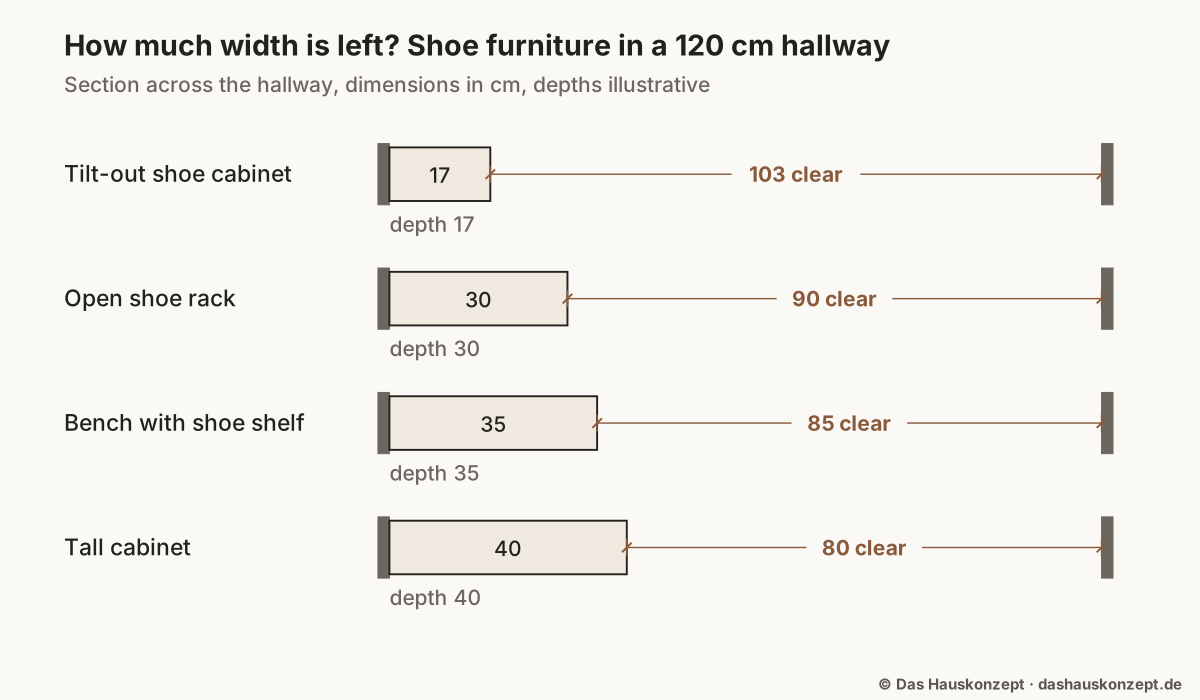
A tilt-out shoe cabinet usually fits a narrow hallway best, because of the four common types it costs the least passage width. Every type takes width away; in a 47.2 in (1.20 m) hallway, with typical example depths, it looks like this:
 (Open the diagram full size)
| What | Tilt-out shoe cabinet | Open shoe rack | Bench with shoe shelf | Tall cabinet |
|---|---|---|---|---|
| Minimum depth for EU size 45 calculated · [1] | No minimum from the length; try your longest pair in a compartment | At least 11.8 in (30.0 cm), more measured on the outside | At least 11.8 in (30.0 cm) for the shelf | At least 11.8 in (30.0 cm) per shelf |
| Clear width left at the example depth calculated · Hallway planner | 40.6 in / 103 cm (6.7 in / 17 cm deep) | 35.4 in / 90 cm (11.8 in / 30 cm deep) | 33.5 in / 85 cm (13.8 in / 35 cm deep) | 31.5 in / 80 cm (15.7 in / 40 cm deep) |
| Meets the 36 in ADA route width calculated · [4] | Yes, 4.6 in to spare | No, 0.6 in short | No, 2.5 in short | No, 4.5 in short |
| Clear width while opening or in use calculated · Hallway planner | 33.9 in / 86 cm (flap about 6.7 in out) | 35.4 in / 90 cm (no front) | 15.7 in / 40 cm (17.7 in legroom when seated) | 11.8 in / 30 cm (19.7 in door leaf, 39.4 in wide piece) |
Which fits when?
- Tilt-out shoe cabinet: Hallways around 47 in (1.20 m) wide or less, and anyone who wants many everyday pairs closed away from dust; try your longest shoes first.
- Open shoe rack: Households whose shoes often come home damp, and hallways with nothing standing opposite.
- Bench with shoe shelf: Anyone who wants to sit down to put on shoes, where the hallway is wide enough at that point for the bench plus legroom.
- Tall cabinet: One side of the hallway with nothing opposite, when bags, hats and seasonal shoes should go in too and the doors can open freely.
Tilt-out shoe cabinet (example: 6.7 in, 17 cm deep). Shoes stand at an angle in tilting compartments, so a shallow carcass is enough. It is the slimmest option and in the example leaves 40.6 in (103 cm) clear. Limits: tall boots and very large shoes often do not fit. The flap projects into the hallway when it opens; the hallway planner allows about the cabinet's own depth again, so roughly 13.4 in (34 cm) from the wall for a 6.7 in carcass.
Open shoe rack (example: 11.8 in, 30 cm deep). Shoes lie flat, so the depth must be at least the shoe length, which makes an 11.8 in rack tight for size 45. Clear width in the example: 35.4 in (90 cm). Advantage: shoes air out and you can see what is there at a glance. Drawback: dust and a busier look.
Bench with shoe shelf (example: 13.8 in, 35 cm deep). A seat on top, one or two open shelves below: somewhere to sit while putting shoes on and storage in one piece. Clear width in the example: 33.5 in (85 cm). Whoever sits needs room for their legs; the hallway planner assumes 17.7 in (45 cm). Make sure shoes under the bench do not stick out at the front.
Tall cabinet (example: 15.7 in, 40 cm deep). Many shelves stacked up, closed fronts, often with room for bags and hats. Clear width in the example: 31.5 in (80 cm). Only sensible where nothing stands opposite and where hinged doors do not get in anyone's way: in this example a 19.7 in (50 cm) door leaf leaves just 11.8 in (30 cm) while it is open.
How much clear width should a hallway keep?
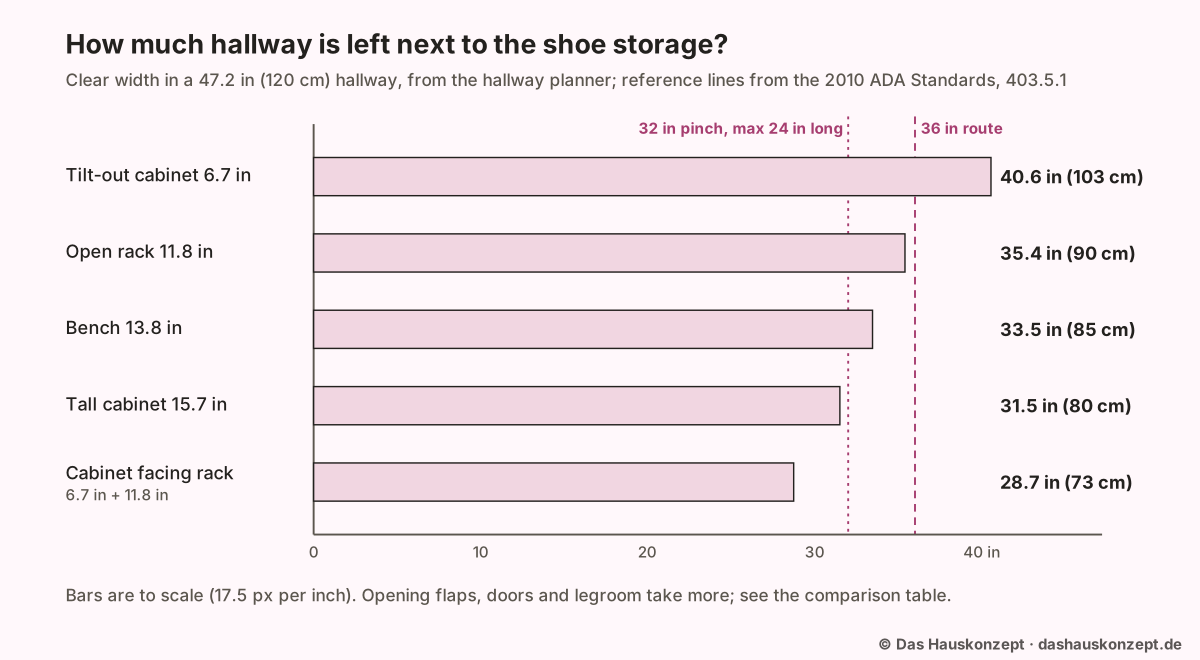
A hallway should ideally keep about 36 in (915 mm) clear next to the shoe storage, the minimum clear width of an accessible route in the 2010 ADA Standards; a narrower point of 32 in (815 mm) is allowed there only for a length of 24 in (610 mm) at most [4]. These figures are written for accessible public buildings in the US, not for private homes. For a small existing hallway they are still a useful yardstick for whether someone can pass comfortably with shopping bags or a child by the hand.
 (Open the diagram full size)
Measured against 36 in, the examples sort themselves clearly. The tilt-out cabinet leaves 40.6 in and so 4.6 in to spare; the 11.8 in rack is 0.6 in short; the bench (33.5 in) and tall cabinet (31.5 in) fall below it [4]. The 32 in allowance does not rescue them, because each of these pieces is longer than 24 in. If your hallway is narrower than 47.2 in, everything shifts by the difference: in a 43.3 in (1.10 m) hallway a 6.7 in cabinet leaves 36.6 in, an 11.8 in rack only 31.5 in.
If two pieces face each other, subtract both depths; the article on hallway clear width explains the measurement. Offset them along the hallway and only the piece standing at each point counts, as the second worked example below shows.
If the cabinet stands against an uninsulated exterior wall, add a gap of about 4 in (10 cm) so air can circulate behind it [3]. A 6.7 in cabinet then takes up about 10.6 in (27 cm) of the hallway.
How many pairs fit in a shoe cabinet?
The number of pairs a shoe cabinet holds is the inside width of one shelf divided by the width of one pair, times the number of shelves. Measure how wide one pair is when the shoes stand side by side, for example your widest everyday pair. Then:
pairs per shelf ≈ inside width of the shelf ÷ width of one pair
Example: one pair takes 8 in (20 cm) side by side and the shelf is 30 in (76 cm) wide inside, a 31.5 in (80 cm) piece minus its side panels. 30 ÷ 8 = 3.75, so three pairs comfortably, four if squeezed. A piece with four shelves holds twelve pairs. Work with your own measurements: stated pair capacities depend on which shoes the maker had in mind, and wide sneakers or boots with shafts need more room than slim dress shoes.
If the capacity is not enough, the answer is usually not a deeper piece but a wider or taller one of the same depth. That costs wall length instead of passage width. Seasonal pairs that are needed only a few weeks a year are better off in a basement, a storage closet or an under-bed box.
How to anchor a shoe cabinet to the wall
A shoe cabinet should be fixed to the wall, even when it stands on legs and looks stable. One maker's safety note requires this for its shoe cabinets, chests and benches, and says the holes in the back of freestanding shoe cabinets are there for wall fixing [8]. CPSC advises anchoring furniture to the wall or the floor and says existing furniture can be anchored with inexpensive anti-tip brackets, following the manufacturer's instructions [6] [5].
This matters most in homes with small children. CPSC describes the most common tip-over scenarios as toddlers climbing onto, falling against or pulling themselves up on furniture, often using drawers to climb [6]. An open tilt-out flap or shelf can serve as a step in the same way, so keep toys and other tempting items off the top of the cabinet [5].
Check what the wall is made of before you drill. The universal anchors supplied with the cabinet are, according to the maker's note, only for solid masonry such as concrete or brick; drywall and other walls may need specific anchors from a hardware store [8]. If you do not know the wall material, find out first, for example from your landlord or a contractor, rather than drilling on a guess.
How to dry wet shoes in the hallway
Wet shoes dry best slowly at room temperature, lying with the sole facing outwards and stuffed with newspaper that you change until they are dry [2]. A closed shoe cabinet is meant for dry shoes; wet shoes need air:
- Not on or under the radiator. Leather dries too quickly there and becomes brittle [2].
- A drip spot by the door. A shallow tray or boot mat in the arrival zone, not inside the cabinet.
- Rotate your shoes. Not wearing the same pair every day gives it time to dry, which also helps against odour [2].
- Ventilate the cabinet. Compartments with ventilation slots or an open back are more pleasant for everyday shoes than fully closed carcasses. Put shoes away only once they are dry.
Every wet pair brings moisture into the hallway in winter. A hygrometer shows whether that becomes a problem: EPA advises keeping indoor relative humidity below 60 %, ideally between 30 and 50 %, and increasing air movement by opening doors or windows when practical, or using a dehumidifier when needed [7]. The Bavarian environment agency gives a slightly higher band of 40–60 % and recommends short bursts of ventilation with the window fully open several times a day [3]. For US homes this page uses the EPA range.
How to check shoe storage in the hallway planner
The hallway planner shows how a piece of shoe storage affects the passage before you drill or order. Three example layouts with the same 31.5 × 6.7 × 43.3 in (80 × 17 × 110 cm) shoe cabinet in a 47.2 × 149.6 in (1.20 × 3.80 m) example hallway can be loaded straight away:
Here are the planner's figures for the first layout and for two pieces facing each other:
In the bench layout the planner reports 33.5 in (850 mm) at the bench and 40.6 in (1,030 mm) at the offset cabinet, because the two do not stand opposite each other. In the third layout a 15.7 in (40 cm) tall cabinet stands on one side with the shoe cabinet offset opposite; the planner reports 31.5 in (800 mm) at the tall cabinet as the narrowest point. Replace the example dimensions with the piece you have in mind and check the narrowest cross-section. If it gets too tight, the problem is usually not the shoe storage itself but whatever stands opposite it.
Common questions
Why does my shoe cabinet smell, and what helps?
Usually damp shoes go into a closed carcass where the moisture cannot escape. Put only dry shoes inside and change pairs daily where you can; ÖKO-TEST says that rotating shoes helps prevent unpleasant odour. Compartments with ventilation slots, or an open rack for the everyday pairs, help as well.[2]
Will the anchors that come with a shoe cabinet hold in drywall?
Not necessarily. One shoe-cabinet maker's safety note says the universal anchors it supplies are only for solid masonry such as concrete or brick; drywall and other walls may need specific anchors from a hardware store. Check the wall material before assembly, and if you are unsure, have a handyperson do the fixing.[8]
How do I get salt stains off winter shoes?
Wipe them off with warm water and a soft, lint-free cloth. Alternatively, ÖKO-TEST suggests dabbing on a little vinegar essence after testing an inconspicuous spot. Let the shoes dry slowly at room temperature before they go into the cabinet.[2]
How often should I waterproof shoes in winter?
In rain and snow, before every third wear, according to ÖKO-TEST, and always before the first wear for shoes that will get heavy use. Waterproofed shoes come into the hallway less soaked and are dry enough for the cabinet sooner.[2]
Checklist
Measure before you buy
Check before you set it up
Related tools
Sources and method
How this article was made: Opened and read on 2026-10-14: the chemie.de entry on the Paris point, ÖKO-TEST on shoe care, the Bavarian environment agency's mould leaflet, the 2010 ADA Standards chapter 4 (U.S. Access Board), CPSC's Anchor It page and Publication 5004, EPA's guide to mould and moisture, and a shoe-cabinet maker's safety note. Clear widths come from the hallway planner engine (three preset layouts plus two custom ones); inch values are converted at 2.54 cm per inch. No furniture was bought, assembled or tested.
What this article adds: A dimensioned cross-section and a to-scale chart that rank four shoe-storage types by clear width, space when opening and the 36 in ADA route width, with hallway-planner values for preset and facing layouts.
Use of AI: Revised with AI assistance; every source was opened and checked on 2026-10-14; editorially reviewed before publication.
Editorially reviewed by Anna Muller on 11 October 2026 before publication.
- Pariser Stich , chemie.de Lexikon. checked Supports: One Paris point (Pariser Stich) equals 0.666 cm; the foot length in centimetres divided by the Paris point gives the shoe size (example: a 20 cm foot gives size 30); in reverse, shoe size × 0.666 cm gives the length.
- Nasse Schuhe nicht auf der Heizung trocknen: Pflegetipps im Herbst und Winter , ÖKO-TEST. checked Supports: Wet shoes and boots must always dry slowly, lying with the sole facing outwards, at room temperature, stuffed with newspaper that is changed until they are dry; never put leather shoes on or under a radiator, as the leather dries too fast and becomes brittle; change shoes every day if possible, which prevents unpleasant odour; remove light salt rings soon with warm water and a soft, lint-free cloth, or dab with a little vinegar essence after testing an inconspicuous spot; in rain and snow, waterproof before every third wear, and before the first wear for heavily used shoes.
- Tipps zur Vermeidung von Schimmelbefall in der Wohnung , Bayerisches Landesamt für Umwelt (Energie-Atlas Bayern). checked Supports: Ventilate in short bursts with the window fully open, several minutes several times a day, or better cross-ventilate; use a hygrometer and ventilate so the relative humidity is roughly between 40 % and 60 %, in unrenovated old buildings with cold surfaces in winter preferably not above 40 %; cabinets and furniture in front of uninsulated exterior walls should stand about 10 cm from the wall so air is exchanged behind them.
- Chapter 4: Accessible Routes, 403.5 Clearances (2010 ADA Standards for Accessible Design) , U.S. Access Board. checked Supports: 403.5.1: the clear width of walking surfaces shall be 36 inches (915 mm) minimum; it may be reduced to 32 inches (815 mm) minimum for a length of 24 inches (610 mm) maximum.
- AnchorIt.gov (Anchor It! safety education center) , U.S. Consumer Product Safety Commission (CPSC). checked Supports: The campaign aims to prevent furniture and TV tip-overs from killing and seriously injuring children; existing furniture can be anchored with inexpensive anti-tip brackets; new dressers come with anti-tip devices that should be installed right away; follow the manufacturer's instructions to secure TVs and furniture; remove items that might tempt kids to climb, such as toys and remote controls, from the top of furniture.
- Anchor It and Protect a Child (Publication 5004) , U.S. Consumer Product Safety Commission (CPSC). checked Supports: The most common tip-over scenarios involve toddlers who have climbed onto, fallen against or pulled themselves up on furniture; many such pieces have drawers that children can use to climb; anchor furniture to the wall or the floor; keep items that might be attractive to children off furniture; supervise children in rooms where these tips have not been followed.
- A Brief Guide to Mold, Moisture and Your Home , U.S. Environmental Protection Agency (EPA). checked Supports: If possible, keep indoor humidity below 60 percent (ideally between 30 and 50 percent) relative humidity; dry water-damaged areas and items within 24–48 hours to prevent mold growth; increase ventilation or air movement by opening doors and/or windows when practical; use air conditioners and/or dehumidifiers when needed.
- Warn- und Sicherheitshinweis (shoe cabinets, chests, benches, coat panels) , Arredokit S.r.l. (manufacturer's safety note, hosted by Zurbrüggen). checked Supports: Shoe cabinets, chests and benches must always be fixed to the wall for safety reasons, even freestanding shoe cabinets supplied with legs; check the wall before assembly; the universal anchors supplied are only for solid masonry such as concrete or brick, other walls such as plasterboard may need specific anchors from a hardware store; the holes in the back of freestanding shoe cabinets are for wall fixing; observe the maximum load of the furniture where stated.