Guide · How-to
How to protect an entryway floor from grit and water
Applies to: USRentersOwners2010 ADA Standards 302-303 The ADA figures are used as a yardstick for trip edges; they are not a rule for a private home. Mat backing rules come from floor makers' care sheets.
This page is only available in English. The language switch leads to the closest German page.
In short
Protect an entryway floor with three zones: a coarse scraper mat outside, an absorbent, breathable-backed wiper mat inside, and a boot tray with a washable runner for wet shoes. Skip rubber- or latex-backed mats on vinyl, laminate and wood, keep mat edges at 1/4 in (6.4 mm) or lower, or beveled up to 1/2 in (13 mm), and clean the mats and the floor beneath them routinely.
At a glance
| What | Value | Basis |
|---|---|---|
| Mat pile height, ADA yardstick | 1/2 in13 mm maximum for carpet in the 2010 ADA Standards (302.2), measured from the backing; exposed edges fastened and trimmed | [7] |
| Bevel for a 1/4 to 1/2 in edge | 1:2 slopeAn edge between 6.4 and 13 mm high is beveled no steeper than 1:2; above 1/2 in (13 mm) the ADA requires a ramp | [7] |
| Bevel needed by a 3/8 in mat | 3/4 in2 × 3/8 in = 3/4 in (19 mm) of bevel when the whole 9.5 mm height is beveled at 1:2 | calculated · [7] |
| Sets of exterior mats (Mohawk laminate care) | 2 setsOne set in use at every exterior entrance, the other swapped in while the soiled set is cleaned | [1] |
| Floor protector under an entry bench | at least 1 inNon-staining felt or plastic protectors at least 1 in (25 mm) across, per Mohawk's laminate care sheet | [1] |
| Example floor left bare beside a 3 × 5 ft mat | 9 sq ft6 × 4 ft entry (24 sq ft, 2.23 m²) minus a 5 × 3 ft mat (15 sq ft, 1.39 m²) | calculated · Square footage calculator |
Contents
- What damages an entryway floor?
- How do the three mat zones work?
- Which doormat backing is safe for my floor?
- How thick can a doormat be?
- How big should an entryway mat be?
- Where should wet boots and umbrellas go?
- How do I set up entryway floor protection?
- How do I clean entry mats and the floor under them?
- What if the entryway floor is already marked?
- Entryway floor protection checklist
- Common questions
- Sources and method
Most damage to an entryway floor does not come from one big spill. It comes from grit carried in on soles and ground into the surface step after step, and from water that sits in the same spot every wet day. You do not need a new floor to deal with it; you need to catch the grit and water before they reach the floor.
What damages an entryway floor?
Grit and standing water do most of the damage to an entryway floor. Fine grit and dirt act like sandpaper: floor makers tell you to sweep, dust mop or vacuum to remove loose dust, dirt, grit and debris, and to clean the floor beneath mats so trapped grit does not dull the finish [2] [1]. Shoe treads also carry small pebbles that can scratch hardwood [4].
Water is the second problem. Bruce says that water, especially standing water, causes warping and cupping in hardwood [4], Mohawk says not to let liquid puddle or moisture stand on laminate [1], and AHF warns that vinyl can become slippery when wet and that wet feet should be wiped up immediately [2]. A third, less obvious cause is the mat itself: the wrong backing can stain the floor or trap moisture under it [1].
How do the three mat zones work?
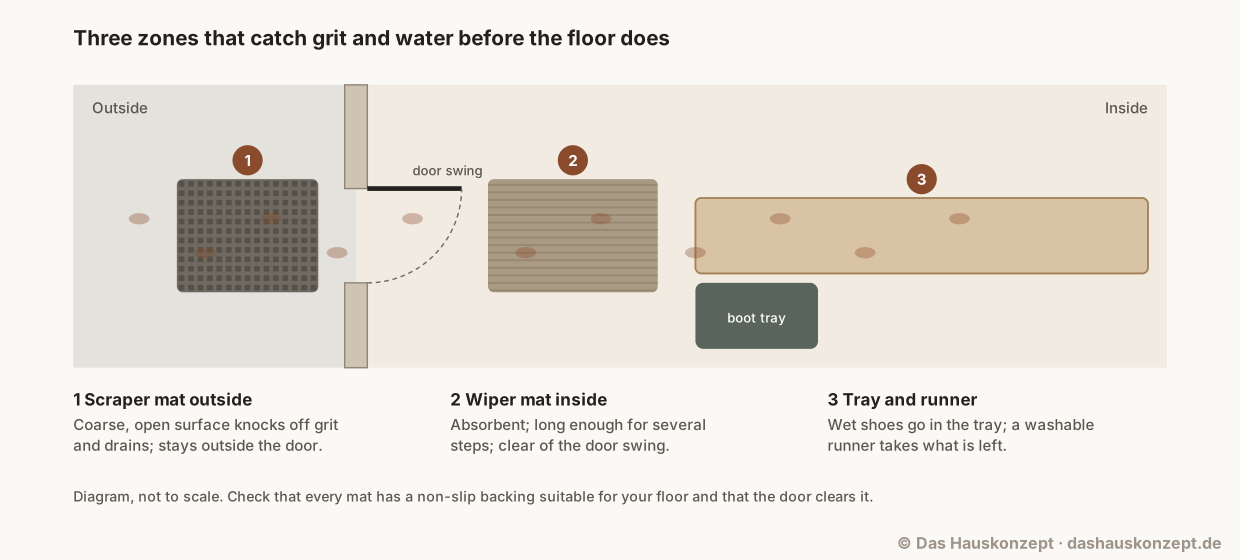
The three mat zones work as a relay: a scraper mat outside takes the coarse grit, a wiper mat inside takes the fine dirt and moisture, and a tray and runner take what wet shoes still carry. Mohawk's care sheet describes the first two zones in exactly this order [1], and EPA also advises doormats outside and inside all entryways [5].
 (Open the diagram full size)
Zone 1: scraper mat outside. A coarse, open mat on the step or landing knocks off grit and mud before anyone reaches the door [1] [2]. It needs to drain and dry, so it stays outside. Mohawk suggests buying two sets of exterior mats so a clean set goes down while the soiled one is cleaned [1]. In a shared building, check the house rules first; corridors and stairwells often have to stay clear.
Zone 2: wiper mat inside. An absorbent mat just inside the door takes the moisture and fine dirt that the scraper missed [1] [3]. Longer is better here, because every step that lands on the mat is a step that does not land on the floor. Keep it clear of the door swing, or check that the door passes over it without catching.
Zone 3: tray and runner. Wet boots and umbrellas go into a tray with a raised edge, so water collects there instead of on the floor. A washable runner beyond it takes whatever is left and can go in the machine or be hosed down, depending on its care label.
Which doormat backing is safe for my floor?
A safe doormat backing for vinyl, laminate and wood is breathable, non-staining and slip-resistant, without rubber or latex. All four care sheets cited here warn against rubber backings, and their wording and reasons differ slightly by floor type:
| Floor type | What the maker or guidance says about mats | Why |
|---|---|---|
| Laminate (Mohawk) | Interior mats of absorbent fibre with a breathable, non-staining back; do not use rubber mats [1] | Rubber may stain the floor or trap moisture underneath [1] |
| Rigid core vinyl (AHF/Bruce) | Walk-off mat at outside entrances; mats without latex or rubber backing strongly recommended [2] | These backings may cause permanent discoloration [2] |
| Vinyl sheet and tile (RFCI, quoted by Sherwin-Williams) | Breathable mats with a slip-resistant backing; avoid rubber- or latex-backed mats [3] | They can eventually create permanent stains; the backing also prevents falls [3] |
| Hardwood (Bruce) | A natural or colorfast mat at exterior doors; breathable rugs; avoid rubber or vinyl backings if possible [4] | Those backings can trap moisture [4] |
The common ground is clear, but the details are not identical. Bruce's hardwood page softens its rule to "if possible", while the vinyl and laminate sheets are firmer [4] [2]. Our default is the strictest version: no rubber, latex or vinyl backing on any of these floors, unless your own floor's care sheet explicitly allows it. Slip resistance still matters, so look for a backing the mat maker describes as non-slip and breathable, and if a mat still creeps, CDC's fall checklist suggests double-sided tape or a non-slip backing to stop a rug slipping [6]. Test any tape on a hidden spot of your floor first.
Tile and sealed stone are not covered by the sheets above. For those floors, check the tile or sealer maker's instructions before choosing a backing.
How thick can a doormat be?
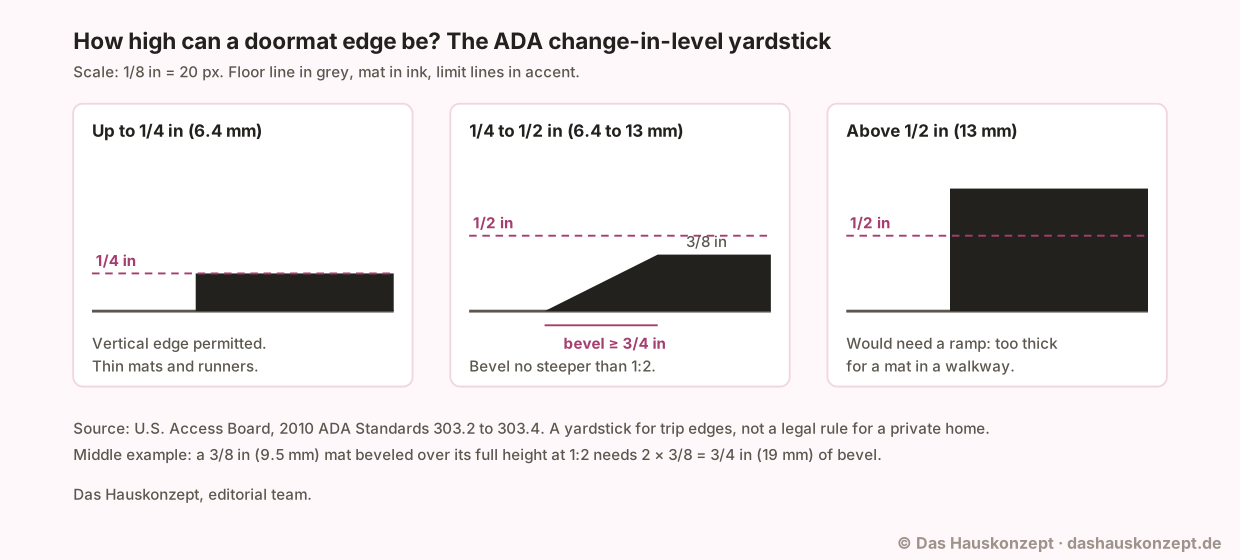
A doormat in a walkway should be 1/4 in (6.4 mm) thick or less, or up to 1/2 in (13 mm) with a beveled edge, to keep its edge within the ADA trip-edge yardstick. Those figures come from the 2010 ADA Standards: a change in level of up to 1/4 in may be vertical, one between 1/4 and 1/2 in must be beveled no steeper than 1:2, and anything higher needs a ramp [7]. The ADA Standards apply to places of public accommodation, commercial facilities and state and local government facilities, and the part of a home used only as a residence is not covered [8], so treat them as a yardstick for a trip edge rather than a legal limit.
 (Open the diagram full size)
The same chapter caps carpet pile at 1/2 in (13 mm), measured from the backing, and asks for exposed edges to be fastened and trimmed [7]. A thick, plush mat may feel absorbent, but its soft edge is easy to catch with a toe, and the Access Board notes that carpets and permanently affixed mats make a wheelchair harder to roll [7].
Thickness also decides whether the door clears the mat, and door gaps vary, so measure yours: close the door, measure the gap at its lowest point, and compare it with the mat's thickness. If the door catches, a thinner mat or a position just beyond the door swing is the fix; a door that drags over a mat also pushes it out of place.
How big should an entryway mat be?
An entryway mat should be as long as the floor allows along the walking line, because each step that lands on it is a step of grit and water that does not reach the floor. A useful check is how much of your entry floor the mat leaves bare.
In the example, 9 sq ft (0.84 m²) of floor stays uncovered. Where those square feet are matters more than how many there are. Lay the mat where people actually walk from the door, not centred in the space, and let the runner pick up the path beyond it. In a narrow hallway, check the remaining clear width before you add a runner and a tray.
Where should wet boots and umbrellas go?
Wet boots and umbrellas should go into a tray with a raised edge, because water that drains off them otherwise stands on the floor. AHF's vinyl sheet says to wipe up wet areas from spills or wet feet immediately [2], and Mohawk says not to let liquid puddle or moisture stand on laminate [1].
Put the tray where shoes actually come off, which is usually a step or two past the wiper mat. Empty and dry it after a wet day; a tray full of water is just another puddle. An umbrella can stand in the tray or in a stand with its own drip cup. Shoes that live permanently by the door belong in a rack or cabinet rather than on the floor: CDC's fall-prevention checklist says to pick up shoes and other objects and keep them off the floor [6].
If a bench or cabinet stands in the entry, give it floor protectors as well. Mohawk recommends non-staining felt or plastic protectors at least 1 in (25 mm) across, covering the part that rests on the floor [1], and Bruce suggests wider protectors for heavier items [2].
How do I set up entryway floor protection?
Setting up entryway floor protection takes a tape measure, the floor's care sheet and about four purchases: scraper mat, wiper mat, tray and runner. Work through the steps in this order so that the mats fit the door and the floor before you buy.
Measure the three zones
Measure the step or landing outside the door, the floor between the door swing and the first piece of furniture, and the path from the door to where shoes actually come off. Write down length and width for each, in inches and feet.
Check the door against the mat
Measure the gap under the door at its lowest point and compare it with the thickness of the mat that will sit under it. If the door would catch, choose a thinner mat or move the mat just beyond the door swing.
Check your floor's care sheet for mat backings
Look up the care instructions for your floor type. Mohawk (laminate), Bruce (rigid core vinyl and hardwood) and the vinyl guidance quoted by Sherwin-Williams all warn against rubber-backed mats, and the vinyl sheets against latex backings too; choose a breathable, non-staining, slip-resistant back.[1]
Check the mat edges
Measure each mat's thickness. An edge up to 1/4 in (6.4 mm) can be square; between 1/4 and 1/2 in (13 mm) it should be beveled no steeper than 1:2; anything thicker does not belong in the walkway.[7]
Edge height: ≤ 1/4 in square, ≤ 1/2 in beveled
Place the scraper and wiper mats
Put the coarse scraper mat outside the door, if the house rules allow it, and the absorbent wiper mat just inside, clear of the door swing. Lay the wiper mat along the walking line so the most steps land on it.[1]
Place the tray and runner
Set the boot tray where shoes actually come off, not where it looks tidiest, and run a washable runner from the tray along the rest of the path.
Set a cleaning routine
Vacuum the mats, or shake them out outdoors (vacuum only in a home that may have lead-based paint), empty the tray after wet days, wash the runner to its label, and lift the mats to clean and dry the floor underneath before you put them back.[1]
How do I clean entry mats and the floor under them?
Clean entry mats often enough that they never become a source of dirt themselves, and clean the floor underneath them too. Mohawk says routine cleaning prevents mats becoming a soil source, that both sides of interior mats should be cleaned, and that the floor beneath should be cleaned so grit does not get trapped and dull the finish [1]. AHF simply says to clean walk-off mats frequently [2].
- Clean the mats frequently, as AHF advises [2]: vacuum the wiper mat or shake it out outdoors, and do it when grit shows on the mat rather than waiting for the floor to look dirty.
- If your home has or may have lead-based paint, vacuum the mats rather than shaking or beating them; EPA advises not to shake or beat carpets and rugs in such homes [5].
- Swap the outdoor mat for the spare set when it is clogged, and clean the soiled set [1].
- Empty and dry the boot tray after wet days.
- Wash the runner according to its label.
- Lift the mats now and then, clean underneath, and let the floor dry before the mats go back [1].
- Use the cleaning method your floor's maker gives; Mohawk, for instance, warns against flood mopping and steam mops on its laminate [1].
What if the entryway floor is already marked?
An entryway floor that is already scratched or water-marked will not be repaired by mats, but mats stop the marks getting worse. For repairs, follow your floor manufacturer's care instructions. If boards have cupped or swollen, standing water is the likely cause [4]; find out where the water comes from before covering the spot with a mat. If you rent, note existing marks in your move-in record so they are not blamed on you later.
Entryway floor protection checklist
The entryway floor protection checklist below covers mats, wet shoes and the routine; print it and tick it off when you set up or check your entry.
Mats
Wet shoes and the path
Routine
Common questions
Should you take shoes off at the door to protect floors?
Yes, if your household can. Bruce's hardwood care advice says to leave shoes at the door, especially ones with spiky heels or treads that collect sharp pebbles, and EPA advises doormats outside and inside every entryway plus removing shoes to limit soil, which can carry lead, tracked indoors.[4]
Can I mop under the doormat and put it straight back?
No. Mohawk's laminate care sheet says to let the floor dry completely before replacing interior mats, and warns against leaving moisture standing on the floor; a mat laid on a damp floor holds that water against the surface.[1]
Can I put a mat or rug on a floor with radiant heating?
Only with care. Mohawk warns that rugs over radiant-heated floors may push flooring temperatures beyond recommended levels and void the warranty, so check your floor's and your heating system's instructions before covering a heated entry floor.[1]
How do I stop a dog tracking dirt onto the entry floor?
Wipe the dog's paws as it comes in and keep its nails trimmed. EPA says pet fur and paws can carry soil indoors and should be wiped after time outside, and Mohawk's laminate care sheet advises keeping pet nails trimmed to minimize scratches.[5]
Related tools
Sources and method
How this article was made: Opened and read: Mohawk's laminate use and care instructions, AHF's care sheet for rigid core vinyl and Bruce's hardwood care page, Sherwin-Williams' vinyl floor care page quoting the RFCI, EPA's page on reducing lead exposure at home, CDC's 2017 Check for Safety checklist and the U.S. Access Board's 2010 ADA Standards chapter 3. Ran the square footage calculator for the coverage example. No mats, backings or floors were tested; no source opened gives a mat length, a door clearance or a cleaning interval in days, so none is stated.
What this article adds: A backing table that reconciles four floor makers' mat rules by floor type, an original dimensioned diagram and worked example checking mat edge height against the ADA change-in-level limits, and a mat coverage example from the calculator.
Use of AI: Revised with AI assistance; every source was opened and checked on 2026-10-14; editorially reviewed before publication.
Editorially reviewed by Anna Muller on 11 October 2026 before publication.
- Laminate Wood Flooring Use and Care Instructions , Mohawk Industries (care sheet hosted by Lowe's). checked Supports: Place exterior mats outside all exterior entrances, with soft moisture-absorbing fibres and coarse fibres that remove dirt from shoe soles; buy two sets of exterior mats and swap in the fresh set while the soiled one is cleaned; cleaning mats routinely prevents them becoming a soil source; place interior mats inside all exterior entrances to capture residual dirt, grit or moisture, made of absorbent fibre with a breathable, non-staining back; clean both sides of interior mats and underneath so grit does not dull the finish; do not use rubber mats, which may stain the floor or trap moisture; non-staining felt or plastic protectors at least 1 inch in diameter under furniture; keep pet nails trimmed; protect flooring from spiked heels; caution with area rugs over radiant heating, which may raise floor temperatures beyond recommended levels and void the warranty; do not allow liquid to puddle; allow floor to dry completely before replacing interior mats; remove spills promptly; flood mopping is never recommended and laminate should not be steam mopped unless covered by a Steam Mop Warranty.
- Maintenance Recommendations for Residential Rigid Core Vinyl Floor Care , AHF, LLC (Bruce). checked Supports: Place a walk-off mat at outside entrances to reduce the amount of dirt brought into the home; mats without a latex or rubber backing are strongly recommended because these backings may cause permanent discoloration; sweep, dust mop or vacuum to remove loose dust, dirt, grit and debris and clean walk-off mats frequently; vinyl may become slippery when wet; immediately wipe up wet areas from spills, foreign substances or wet feet; use floor protectors on furniture, wider for heavier items.
- Floor Care: Tips for Vinyl Floor Cleaning and Maintenance , Sherwin-Williams. checked Supports: Where vinyl floors are right inside an exterior entrance door, walk-off mats can help trap dirt, minimize moisture and prevent tracking; to head off discoloration, the RFCI recommends mats or rugs made of breathable materials with a slip-resistant backing to prevent falls; mats with rubber or latex backing should be avoided since they can eventually create permanent stains on vinyl flooring; felt glides or rubber casters under furniture legs prevent scratching.
- Hardwood Floor Care Tips , Bruce (AHF, LLC). checked Supports: Stop dirt and moisture with a natural or colorfast mat at your exterior doors; mats trap small pebbles and other debris that can scratch hardwood; use breathable area rugs and avoid rubber or vinyl backings if possible because they can trap moisture; leave your shoes at the door, especially ones with spiky heels or treads that collect sharp pebbles; don't let spills sit; water, especially standing water, causes warping and cupping; use protectors on furniture legs, wider ones for heavy items.
- Reduce the Risk of Lead Exposure at Home , U.S. Environmental Protection Agency. checked Supports: To reduce exposure to lead in soil, place doormats outside and inside all entryways and remove your shoes before entering; pet fur and paws can carry soil indoors, so wipe them off after time outside; leave shoes outside your home if they might contain lead dust; if you know or suspect your home contains lead-based paint, do not shake or beat carpets and rugs.
- Check for Safety: A Home Fall Prevention Checklist for Older Adults (2017) , Centers for Disease Control and Prevention (CDC), National Center for Injury Prevention and Control. checked Supports: Floors: if you have throw rugs, remove the rugs, or use double-sided tape or a non-slip backing so the rugs won't slip; pick up papers, shoes, books or other objects on the floor and always keep objects off the floor; stairs and steps indoors and outdoors: keep objects off the stairs and fix loose or uneven steps.
- Chapter 3: Building Blocks, floor and ground surfaces and changes in level (2010 ADA Standards for Accessible Design, sections 302 and 303) , U.S. Access Board. checked Supports: 302.1: floor surfaces stable, firm and slip resistant; 302.2: carpet securely attached with a firm cushion or backing or none, pile height 1/2 inch (13 mm) maximum, exposed edges fastened to floor surfaces with trim along the entire exposed edge; advisory: carpet and mats increase the force needed to roll a wheelchair; 303.2: changes in level of 1/4 inch (6.4 mm) high maximum may be vertical; 303.3: changes between 1/4 inch and 1/2 inch (13 mm) beveled with a slope not steeper than 1:2, and per the advisory a 1/2 inch change may be 1/4 inch vertical plus 1/4 inch beveled; 303.4: changes in level greater than 1/2 inch shall be ramped.
- ADA Accessibility Standards , U.S. Access Board. checked Supports: The ADA Standards apply to places of public accommodation, commercial facilities and state and local government facilities; where a commercial facility is located in a private residence, the portion used exclusively as a residence is not covered.