Encyclopedia
Light reflectance value (LRV) explained for small rooms
This page is only available in English. The language switch leads to the closest German page.
In short
Light reflectance value (LRV) is the percentage of light a paint color reflects, on a 0 to 100 scale: 0 is absolute black, 100 pure white. For a small, dim room, daylighting guidance suggests ceilings above 80% and walls of 50–70%. LRV describes the color, not your room, so test a sample on your wall.
At a glance
| What | Value | Basis |
|---|---|---|
| Walls' share of surfaces, 10 × 10 ft room | 58.8 %285 of 485 sq ft (walls after one door and one window, ceiling, floor); 8 ft (2.44 m) ceiling | calculated · Square footage calculator |
| Recommended floor reflectance | 20–40 %Illuminating Engineering Society recommendation quoted by Lawrence Berkeley National Laboratory; furniture 25–45% | [7] |
| Default average room reflectance | 0.5Value the LBNL daylighting guide uses when the area-weighted average of a room's surfaces is not known | [7] |
| LRV of a soft white (White Dove OC-17) | 83.16Benjamin Moore color page; an example of the range, not a recommendation | [2] |
| LRV of a deep navy (Hale Navy HC-154) | 8.36Benjamin Moore color page; an example of the range, not a recommendation | [5] |
| Contrast asked for on transit step edges | at least 70 %Advisory guidance to 49 CFR Part 38 (US vehicles), contrast = (B1 − B2) ÷ B1 × 100 from the two LRVs; not a rule for homes | [8] |
Contents
- What is light reflectance value (LRV)?
- How do you read an LRV number?
- What LRV should walls and ceilings have in a small, dim room?
- How much does the wall color change a small room?
- Does paint sheen change how much light a wall reflects?
- How do you use LRV to measure contrast between trim, doors and walls?
- When is a low LRV the right choice?
- What LRV cannot tell you
- Common questions
- Sources and method
What is light reflectance value (LRV)?
Light reflectance value (LRV) is a paint maker's measure of how much light a color reflects, on a scale from 0, a surface that absorbs all light, to 100, one that reflects all light [1]. Benjamin Moore defines it as a measurement that "expresses the percentage of light reflected from a surface", with 100 being pure white and 0 absolute black [2]. Sherwin-Williams calls the same number light reflectivity value and prints it on the back of every color chip [1].
Because LRV is a percentage, it reads the same way as the reflectance figures lighting designers use for room surfaces. Lawrence Berkeley National Laboratory (LBNL) defines reflectance as the ratio of light bouncing away from a surface to the light striking it, expressed as a percentage [7]. A color with an LRV of 83 sends back about 83% of the light that reaches it, so a paint chip can be held against published targets for ceilings and walls.
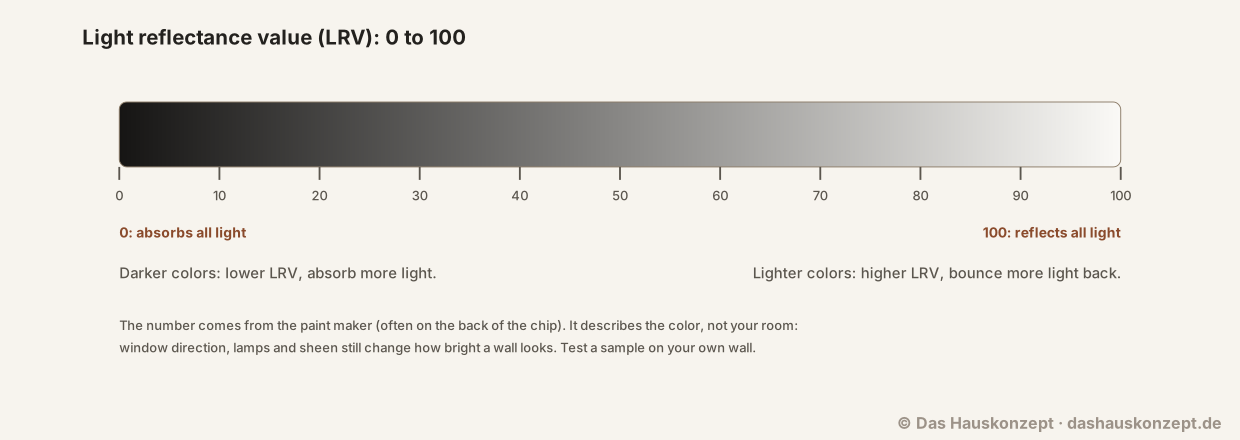 (Open the diagram full size)
How do you read an LRV number?
An LRV number is read as a position between black and white: the higher it is, the more light the color returns and the lighter it looks. Benjamin Moore's color pages show how far apart real paints sit on the scale; the four below are examples of the range, not recommendations.
| Color (Benjamin Moore) | Maker's color family | LRV |
|---|---|---|
| Chantilly Lace OC-65 | White | 90.04 [3] |
| White Dove OC-17 | White | 83.16 [2] |
| Revere Pewter HC-172 | Gray, Neutral | 55.05 [4] |
| Hale Navy HC-154 | Gray, Neutral | 8.36 [5] |
Three things follow from the table:
- "White" is not one number. Two whites from the same maker are almost 7 points apart (90.04 against 83.16), and Benjamin Moore describes high-LRV whites simply as colors that "reflect a lot of light" [6].
- Mid-scale neutrals return about half the light. A greige at 55.05 sends back a little more than half of the light that reaches it.
- Low numbers absorb most of the light. A navy at 8.36 returns less than a tenth. That can be exactly what you want in a room used mainly in the evening.
What LRV should walls and ceilings have in a small, dim room?
In a small or dim room, aim for a ceiling above 80% reflectance and walls of 50% to 70%, higher on a wall that contains a window: these are the Illuminating Engineering Society (IES) recommendations quoted in LBNL's daylighting guide [7]. The guide is written for building designers rather than for homes in particular, but daylight bounces the same way in a bedroom.
| Surface | Recommended reflectance | Example LRVs inside the range |
|---|---|---|
| Ceiling | Above 80% [7] | 90.04, 83.16 |
| Walls | 50% to 70%, higher if the wall contains a window [7] | 55.05 |
| Floor | 20% to 40% [7] | – |
| Furniture | 25% to 45% [7] | – |
How to use the targets in practice:
- Light on the wall facing the window. The LBNL guide says it is especially important that the wall facing the window be light-colored, and that sills and window reveals stay light, for good distribution of daylight through the room [7].
- No large dark areas near windows. The same guide advises against large areas of dark color and says to keep dark colors as accents, away from windows, because dark surfaces impede daylight penetration and cause glare beside bright windows [7].
- North-facing rooms and rooms with one small window. The guide gives no separate figure for these rooms. With little daylight to work with, the upper part of the 50–70% wall band and a ceiling clearly above 80% leave the most light in play; this is a reading of the IES targets, not an extra rule.
- Hallways that borrow light. Sherwin-Williams' STIR article reports that lighter colors, in a long hallway especially, can help illuminate the space if the lighting is placed correctly, and that a lighter palette can pull natural light in from adjacent spaces [1].
How much does the wall color change a small room?
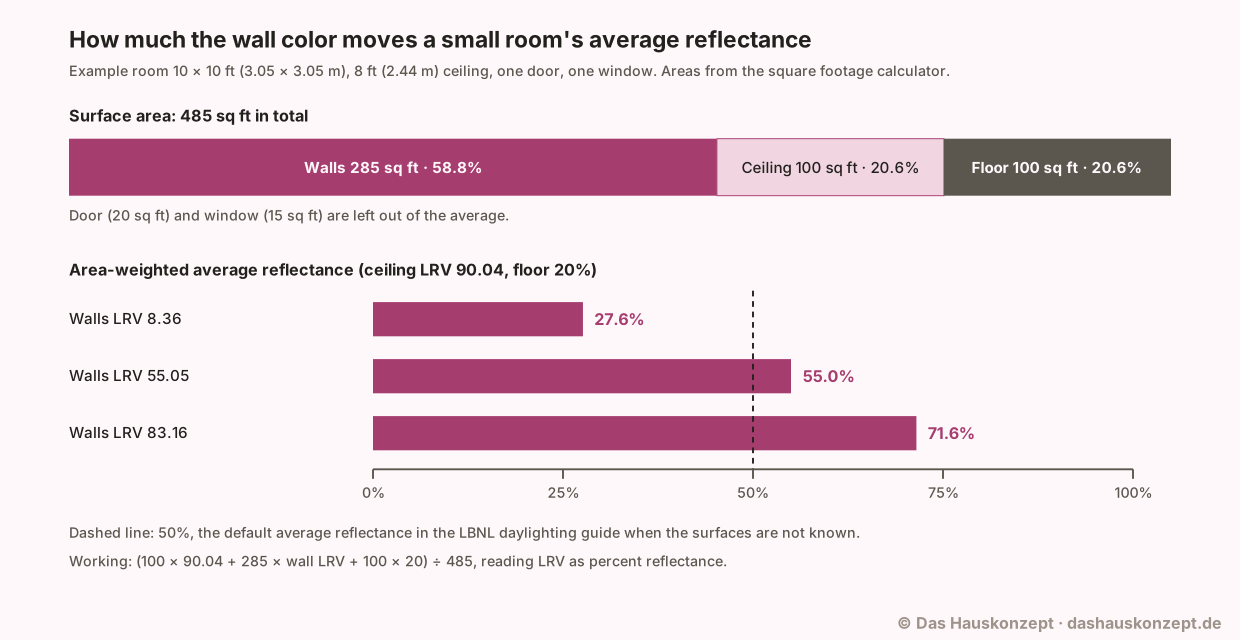
In a small room the wall color changes the overall brightness most, because the walls are by far the largest surface. In a 10 × 10 ft (3.05 × 3.05 m) bedroom with an 8 ft (2.44 m) ceiling, one door and one window, the square footage calculator gives 285 sq ft (26.5 m²) of wall against 100 sq ft (9.29 m²) each for ceiling and floor, so the walls are 58.8% of the 485 sq ft that reflect light.
LBNL's daylight estimate works with the area-weighted average reflectance of a room's surfaces and uses 0.5 when that average is not known [7]. Working the average with LRVs as reflectances shows what the wall choice does, with the ceiling and floor held constant:
 (Open the diagram full size)
| Wall LRV | Room average reflectance |
|---|---|
| 8.36 (Hale Navy) | 27.6% |
| 55.05 (Revere Pewter) | 55.0% |
| 83.16 (White Dove) | 71.6% |
Moving the walls from the greige to the white raises the room average by 16.5 points (71.56 − 55.04), and four navy walls halve the greige room's average (27.6% against 55.0%). Changing the ceiling from 90.04 to 83.16, by contrast, moves the average by only 100 × 6.88 ÷ 485 = 1.4 points. In this example room, once the ceiling is above 80%, the wall color is the bigger decision.
The arithmetic leaves out the door, window, furniture and rugs, takes 20% for the floor (the low end of the IES range) and treats LRV as the finished wall's reflectance. Use it to compare options, not to predict light levels.
Does paint sheen change how much light a wall reflects?
Sheen changes how a wall reflects light, while the color page still gives one LRV per color [2], and the two sources on sheen pull in different directions. Sherwin-Williams says higher-sheen surfaces can increase reflectivity [1]; the LBNL guide recommends matte over specular finishes on room surfaces for good distribution of daylight and no reflected glare, or hot spots [7].
One way to follow both is to get the brightness from the color's LRV and keep the sheen low on the big surfaces: Benjamin Moore's finish recommendation for its whites is matte or eggshell on walls, flat on ceilings and semi-gloss on trim and doors [6].
How do you use LRV to measure contrast between trim, doors and walls?
LRV can also put a number on contrast between two surfaces: contrast in percent = (B1 − B2) ÷ B1 × 100, where B1 is the LRV of the lighter area and B2 that of the darker one. The formula comes from the US Department of Transportation's advisory guidance to its accessibility specifications for transportation vehicles (49 CFR Part 38), which asks for at least 70% contrast on step edges and lift platform edges and notes that B1 never reaches 100 and B2 never falls to 0 [8]. It is guidance for vehicles, not a rule for homes, but it gives a concrete yardstick for "stands out".
| Pair | Contrast |
|---|---|
| White Dove walls (83.16), Hale Navy door (8.36) | 89.9% |
| White Dove walls (83.16), Revere Pewter trim (55.05) | 33.8% |
| Chantilly Lace ceiling (90.04), White Dove walls (83.16) | 7.6% |
A low-contrast pair, such as two whites a few points apart, keeps the line between ceiling and wall quiet; a high-contrast pair outlines every door frame and baseboard. In a small room, decide which edges you want to see and choose LRVs for them on purpose.
When is a low LRV the right choice?
A low LRV can be the right choice for a room used mostly in the evening under lamps, where the aim is a cozy room rather than a bright one. Sherwin-Williams' article suggests limiting darker accent colors to a single wall rather than an entire room [1], and the LBNL guide points the same way for rooms that depend on daylight: dark colors as accents, away from windows [7]. Four dark walls take the example room's average to 27.6%, half that of the greige room, so plan the lamps rather than relying on daylight.
What LRV cannot tell you
LRV tells you how light a color is, not which way it leans or how it will look in your light.
- Undertone. Two colors with similar LRVs can lean warm or cool; the undertone explainer covers that half of the decision.
- Your light. Window direction, bulbs and the floor color all change how bright a wall looks. The LBNL guide says to choose interior colors and finishes under daylight and under the electric lamps you plan to use, to avoid surprises [7], and Sherwin-Williams' article says to coordinate color placement with the window glass and the artificial lighting in a space [1].
- How it feels. The number does not say whether a white reads as crisp or stark, or a dark color as snug or gloomy, in your room; only a sample on the wall shows that.
That is why LRV is a filter, not a decision: use it to shortlist colors, then put large samples on your own walls and look at them morning and evening, as in the paint swatch test checklist.
Common questions
Where do I find a paint color's LRV?
Look on the chip or the maker's color page. Sherwin-Williams prints the LRV on the back of every color chip, and Benjamin Moore lists it under Color Information on each color's page, for example 83.16 for White Dove OC-17. If a store chip shows no number, search the color name on the maker's site.[2]
Related tools
Sources and method
How this article was made: Re-opened the Sherwin-Williams STIR article; opened four Benjamin Moore color pages and its guide to white paints, Lawrence Berkeley National Laboratory's daylighting guide (2013) and the advisory appendix to 49 CFR Part 38. Ran the square footage calculator for the example room and worked the average reflectance and contrast by hand. No paint was applied or measured; the room average treats LRV as finished-wall reflectance and ignores furniture.
What this article adds: Turns paint-chip LRVs into a room-level number: an area-weighted average reflectance for a small bedroom with three wall colors, set against the IES surface targets, plus LRV contrast pairs for walls, trim and doors.
Use of AI: Revised with AI assistance; every source was opened and checked on 2026-10-14; editorially reviewed before publication.
Editorially reviewed by Anna Muller on 11 October 2026 before publication.
- Worthy of Reflection , Sherwin-Williams (STIR magazine). checked Supports: On the back of every Sherwin-Williams color chip is that color's light reflectivity value (LRV); the scale goes from 0 (absorbs all light) to 100 (reflects all light); a lighter color palette and higher-sheen surfaces can increase reflectivity; lighter paint colors, in a long hallway especially, can help illuminate that space if lighting is placed correctly; you can pull natural light from adjacent spaces with a lighter palette; designers can still use darker accent colors but may want to limit them to a single wall rather than an entire room; coordinate color placement with the window glass and the artificial lighting.
- White Dove OC-17 (color page) , Benjamin Moore. checked Supports: Color Information: LRV 83.16; color family White; tooltip: LRV, or Light Reflectance Value, is a measurement commonly used by design professionals, such as architects and interior designers, that expresses the percentage of light reflected from a surface; LRVs range from 0-100, with 100 being pure white and 0 being absolute black.
- Chantilly Lace OC-65 (color page) , Benjamin Moore. checked Supports: Color Information: LRV 90.04; color family White.
- Revere Pewter HC-172 (color page) , Benjamin Moore. checked Supports: Color Information: LRV 55.05; color family tags Gray and Neutral; described as a neutral that bridges warm and cool tones.
- The Ultimate Guide to White & Off-White Paint Colors , Benjamin Moore. checked Supports: In color parlance, a high LRV means they reflect a lot of light; for finishes, we recommend semi-gloss for trim and doors, matte or eggshell for walls, and flat for ceilings.
- Tips for Daylighting with Windows: The Integrated Approach (second edition, 2013) , Lawrence Berkeley National Laboratory (U.S. Department of Energy). checked Supports: Desirable reflectances (Illuminating Engineering Society recommendations): ceilings >80%, walls 50%–70% (higher if wall contains window), floors 20%–40%, furniture 25%–45%; don't use large areas of dark color, avoid dark colors except as accents and keep them away from windows, since dark surfaces impede daylight penetration and cause glare beside bright surfaces; it is especially important that the wall facing the window be light-colored; keep sills and reveals light; choose matte over specular finishes for good daylight distribution and no reflected glare (hot spots); choose interior colors under daylight and under the proposed electric lamps; area-weighted average reflectance of walls, ceiling, floor and other surfaces, or 0.5 as a default; glossary: reflectance is the ratio of light bouncing away from a surface to the amount striking it, expressed as a percentage.
- Appendix to Part 38, Guidance Material, II. Color Contrast: Step Edges, Lift Platform Edges (49 CFR Part 38, ADA Accessibility Specifications for Transportation Vehicles) , U.S. Department of Transportation, via Legal Information Institute (Cornell Law School). checked Supports: The appendix contains materials of an advisory nature; the material used to provide contrast should contrast by at least 70%; contrast in percent = [(B1 − B2)/B1] × 100, where B1 is the light reflectance value (LRV) of the lighter area and B2 the LRV of the darker area; in any application white and black are never absolute, so B1 never equals 100 and B2 is always greater than 0.