Idea gallery · 25 ideas
Christmas door decorations: 25 ideas for apartment and front doors
Idea gallery 9 sources
Decorate an apartment door with things that hang from the door itself, such as a wreath on an over-door hanger or a magnetic hook on a metal door, and keep the shared corridor clear. On a front porch, frame the door with pots and outdoor-rated lights while keeping steps and the walkway free.
-
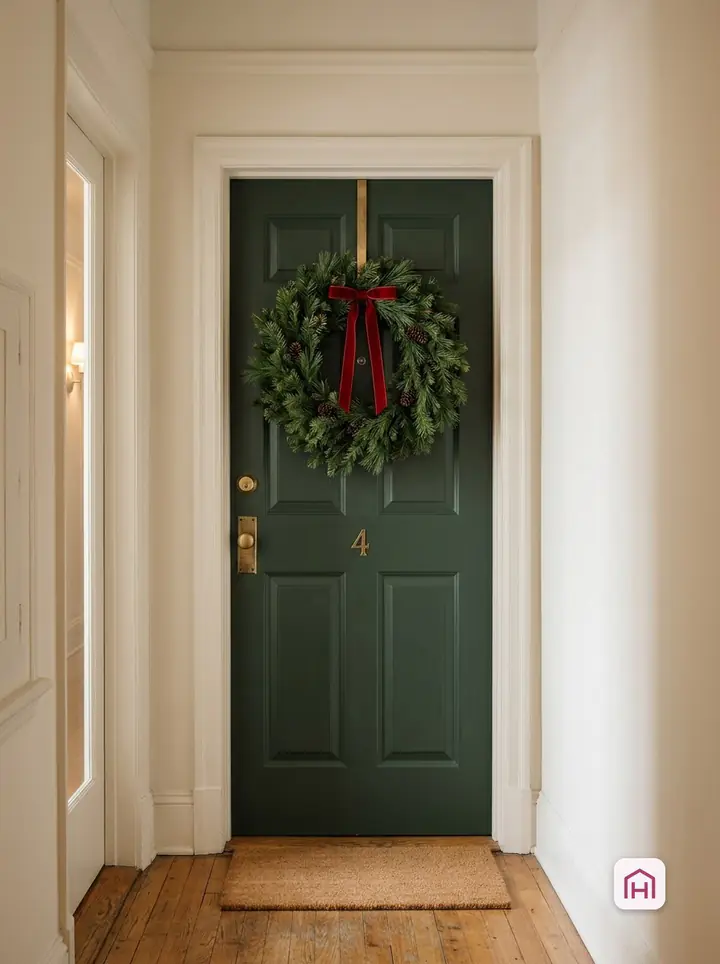
A wreath on an over-door hanger
No nails, no tape: the hanger hooks over the top of the door.
Why it works
An over-door wreath hanger hooks over the top edge of the door, so it needs no holes or adhesive. Check that the door still closes fully with the hanger in place.
Materials and furniture
- Wreath
- Over-door wreath hanger
- Ribbon
Check first
- Check the door closes and locks with the hanger fitted.
- Pad the hanger if it could scratch the door.
Steps, sizes and budget
How to set it up
- Measure the door width and pick a wreath 8 to 12 in (20 to 30 cm) narrower, picks and ribbon included.
- Hook the empty hanger over the top of the door, then close and lock the door to check it still latches.
- If the hanger touches the paint, wrap the part that sits on the door in felt or ribbon.
- Hang the wreath, set its height with the hanger's adjustable arm or a loop of ribbon, and check the peephole.
- Open and close the door five times with the wreath on; nothing should rattle, catch or swing into the frame.
- Sizes and clearances
- On a standard 36 in (91 cm) door, a 24 to 28 in (61 to 71 cm) wreath leaves 4 to 6 in bare on each side. The hanger runs through the gap between the top of the door and the frame, so that gap decides whether it fits: test it with the empty hanger before you buy the wreath.
- Effort and budget
- Low: an over-door hanger is one of the cheapest fittings and is reused every year. The wreath is the main cost; a plain faux wreath plus your own ribbon costs less than a fully decorated one.
- For renters and smaller spaces
- If the building does not allow anything on the corridor side, hang the same wreath on the inside of the door with the same hanger. You see it every time you come home, and the corridor stays untouched.
-
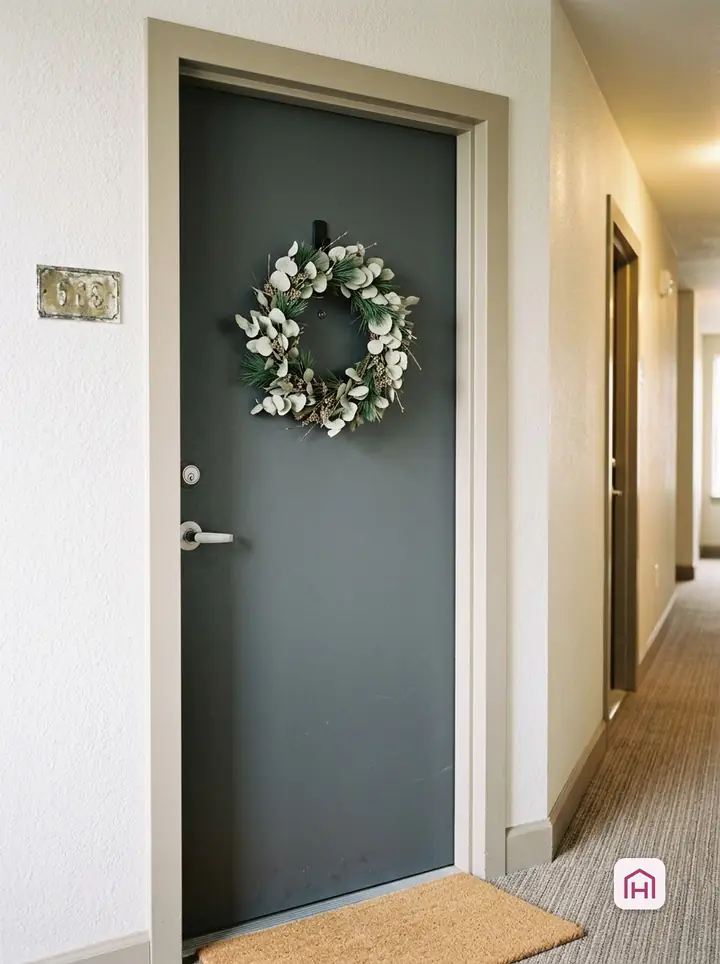
A magnetic hook on a metal door
A light wreath suits a restrained entrance; verify a magnetic attachment on your actual door.
Why it works
A magnetic hook is an option only on a suitable magnetic door surface and within its stated load. The photograph does not establish the door material or show the fixing. Test compatibility and closing before leaving a wreath in place.
Materials and furniture
- Strong magnetic hook
- Light wreath
Check first
- Check door material and the actual hook instructions; metal appearance alone does not establish magnetic compatibility.
- Keep the shared route clear and follow building rules.
Steps, sizes and budget
How to set it up
- Test the door with a fridge magnet first: if it does not hold firmly, a magnetic hook will not either.
- Check the hook's packaging for its rated load and choose a wreath lighter than that.
- Wipe the door clean and dry where the magnet goes, so grit does not scratch the paint.
- Place the hook, hang the wreath and slam-test it: close the door firmly once and check the wreath has not slipped.
- Lift the hook straight off when you take it down; sliding it can mark the paint.
- Sizes and clearances
- A magnet holds only on a steel surface; aluminum, wood-grain fiberglass and many painted doors that look like metal will not hold. Stay within the hook's stated load and keep the wreath clear of the peephole and handle.
- Effort and budget
- Low: one magnetic hook and a light wreath. A lighter wreath also lets you use a smaller, cheaper hook.
- For renters and smaller spaces
- On a steel apartment door with a no-nail rule, a magnetic hook is often the only fitting that leaves no trace at all. If the door is a fire door, keep the decoration small and make sure it never stops the door closing and latching.
-
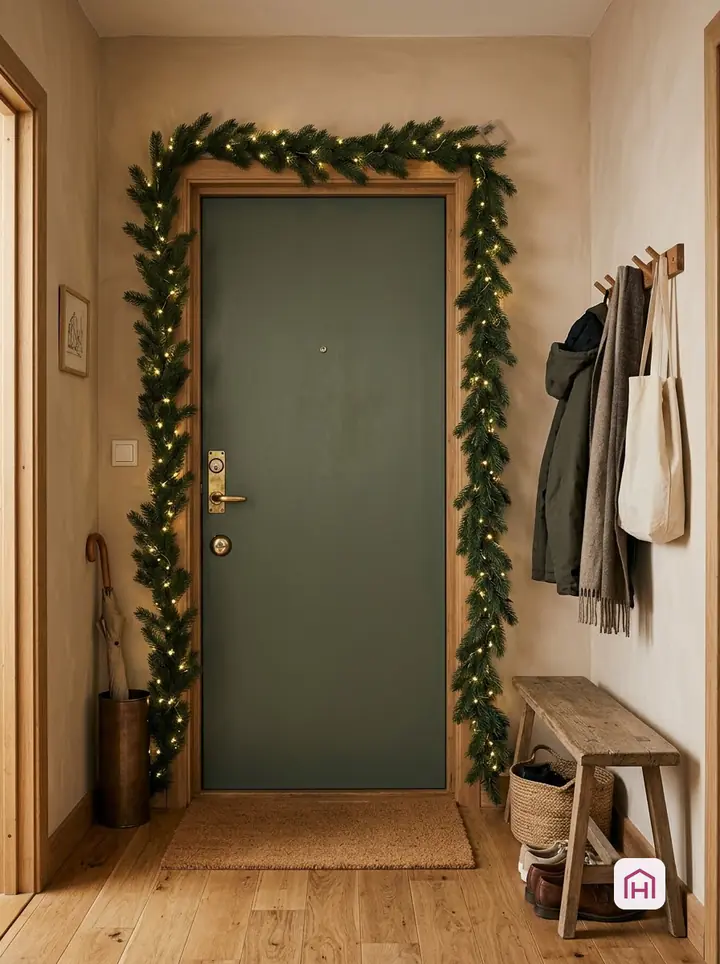
A garland around the door frame
Frame the door from inside the flat, where you control the space.
Why it works
Running a garland around the inside of the door frame decorates your own entrance without touching the shared corridor. Removable hooks hold it without drilling.
Materials and furniture
- Faux garland
- Removable adhesive hooks
- Battery lights
Check first
- Keep the garland out of the hinge side and the latch.
- Use hooks suited to painted frames.
Steps, sizes and budget
How to set it up
- Drape a piece of string around the top and both sides of the frame to find the garland length you need.
- Fix removable hooks on the wall next to the frame, not on the door leaf: one at each top corner and a few evenly spaced down each side.
- Let the hooks set for the time stated on the pack before hanging anything.
- Lay the garland across the top first, then down each side, and fluff the branches.
- Add battery lights and keep the battery box where you can reach it without moving the garland.
- Sizes and clearances
- Garland for a doorway covers the top and both sides of the frame, plus a few extra inches to swag or hang lower; a 7 to 10 ft garland suits most single doorways. Keep the garland off the hinge side and clear of the latch, so the door moves freely.
- Effort and budget
- Medium: garland is sold by length, so a full frame costs more than a wreath. Using last year's garland or a 6 ft piece across the top only keeps it low.
- For renters and smaller spaces
- In a rental with a narrow entry, frame only the top of the door on the inside and skip the sides. Use hooks rated for painted surfaces and remove them slowly, as the instructions say.
-
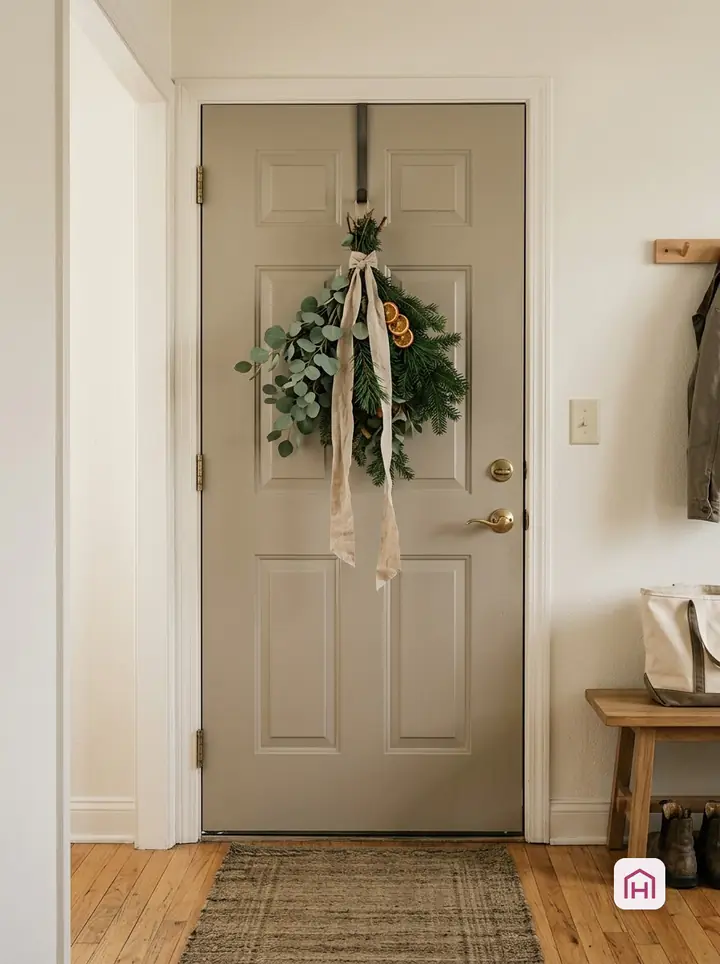
A eucalyptus swag instead of a wreath
A loose bunch hung upside down, lighter than a wreath.
Why it works
A swag of eucalyptus and pine tied with ribbon is lighter and flatter than a wreath, so it suits doors with little clearance and light hooks.
Materials and furniture
- Eucalyptus and pine stems
- Ribbon
- Over-door hanger or hook
Check first
- Allow greenery to dry away from heat; replace shedding stems.
- Test door movement and keep locks and handles clear.
Steps, sizes and budget
How to set it up
- Lay three to five stems of eucalyptus and pine in a fan, longest at the back.
- Tie the stems tightly at the top with wire or twine, then cover the tie with a wide ribbon bow.
- Add dried orange slices with thin wire if you want color.
- Hang the swag upside down from an over-door hanger or a light removable hook.
- Check it weekly: fresh stems dry and shed, so replace the worst ones.
- Sizes and clearances
- A swag is flatter than a wreath, so it suits doors with little clearance to a wall or a second door. Its length is up to you; keep the bottom above the handle so it does not get crushed every time the door opens.
- Effort and budget
- Low: a few stems from a florist or the garden, ribbon and twine. Faux stems cost more up front but come back every year.
- For renters and smaller spaces
- On a tight landing where a wreath would stick out, a swag is the lighter, flatter choice. Hang it inside the door if the corridor must stay bare.
-
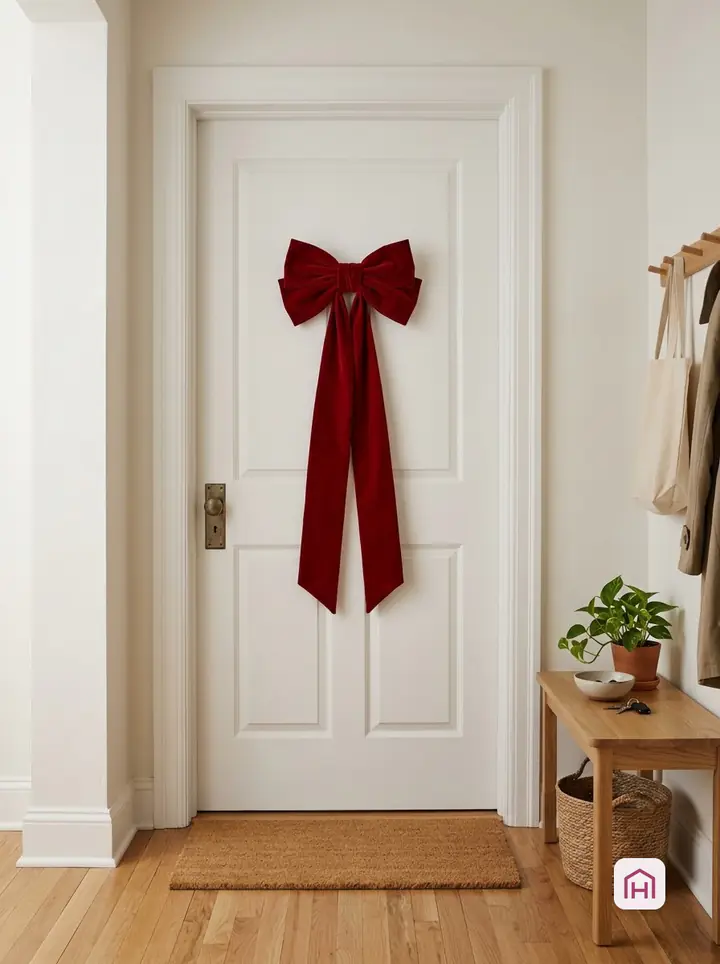
One big bow
The simplest decoration that still reads from a distance.
Why it works
A single large velvet bow at eye level is visible from the end of a corridor and works on any door color. It weighs almost nothing.
Materials and furniture
- Large velvet bow
- Over-door hanger or removable hook
Check first
- Use a hook suited to the door surface.
- Keep tails out of the latch.
Steps, sizes and budget
How to set it up
- Pick a bow wide enough to read from the end of the corridor and in a color that contrasts with the door.
- Attach it with an over-door hanger or a removable hook rated for its weight.
- Set the knot at roughly eye level, above the peephole or centered on the door.
- Trim the tails so they end above the handle and well clear of the latch.
- Sizes and clearances
- Keep the bow and its tails away from the handle and latch; door hardware sits about 34 to 48 in (865 to 1220 mm) above the floor in accessible buildings, so tails should end above that zone. A bow sticks out only an inch or two, so it rarely gets in the way.
- Effort and budget
- Low: one velvet bow costs less than any wreath and stores flat. A wide ribbon you tie yourself costs even less.
- For renters and smaller spaces
- For a rental door that must not be marked, a bow on a ribbon looped over the top of the door and tied off on the inside needs no fixing at all. It is also the most discreet option in a strict building.
-
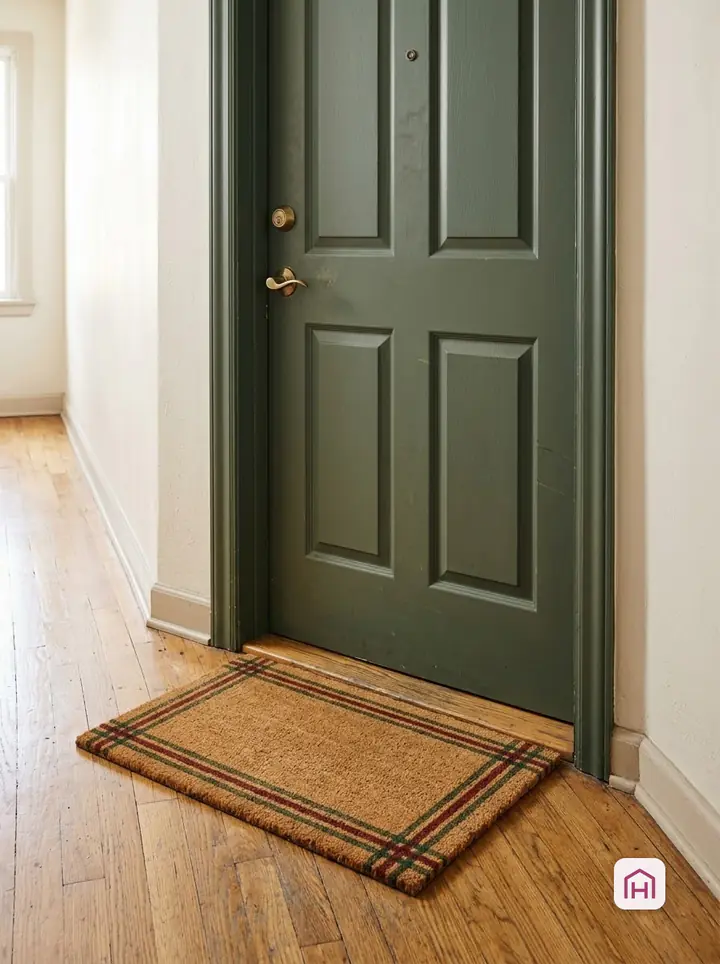
A seasonal doormat
Decoration on the floor where it is meant to be walked on.
Why it works
Swapping the doormat for a seasonal one adds color without adding anything that can block the corridor or the door swing.
Materials and furniture
- Seasonal doormat with non-slip backing
Check first
- Use a flat mat that cannot catch the door.
- Check building rules for mats in shared corridors.
Steps, sizes and budget
How to set it up
- Measure the space in front of the door and check how far the door swings over it.
- Choose a flat mat with a non-slip back that fits that space.
- Lay it, then open and close the door: the door must pass over it without catching.
- Check the edges lie flat and tape or replace a mat whose corners curl.
- Sizes and clearances
- The mat must be flat enough for the door to swing over it; a curled corner is a trip hazard. In a shared corridor, the mat stays within your doorway and does not narrow the route.
- Effort and budget
- Low: a seasonal mat is cheap and the only floor decoration that does not block anything. Switch it back after the holidays and store it flat.
- For renters and smaller spaces
- Some buildings ban mats in corridors altogether. Then put the seasonal mat inside your own door, where it still catches wet boots.
-
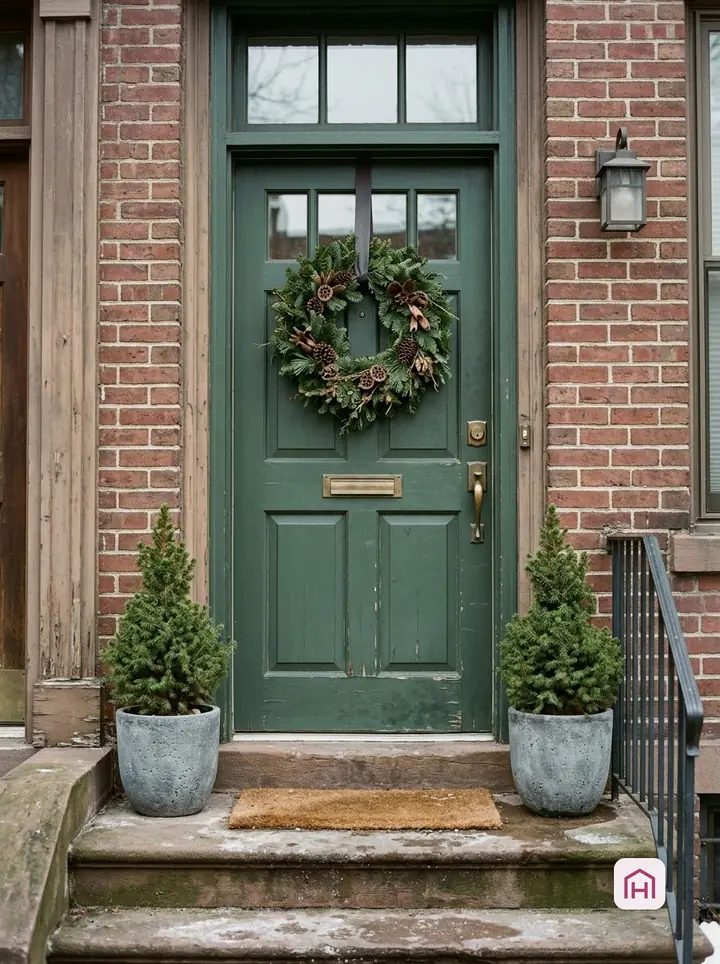
Two potted evergreens beside the front door
Frame the door from the ground, steps left clear.
Why it works
A pair of small potted evergreens either side of a front door frames it symmetrically. Choose pots heavy enough not to blow over and keep the steps clear.
Materials and furniture
- Two potted dwarf conifers
- Heavy pots
Check first
- Keep pots off the steps and the walking line.
- Bring tender plants in during hard frost if needed.
Steps, sizes and budget
How to set it up
- Pick two matching pots with drainage holes, heavy enough not to tip in the wind.
- Plant a small dwarf conifer in each, or set it in still in its nursery pot.
- Place one either side of the door, beside the step, not on it.
- Add a ribbon or a few lights only if they stay off the steps and the walking line.
- In hard frost, move tender plants against the house wall or into a cold garage.
- Sizes and clearances
- Leave the full width of the steps and the path free. Choose pots wide and heavy enough that a gust or a passing bag will not knock them over.
- Effort and budget
- Medium: two plants and two heavy pots. After the holidays the conifers can stay as year-round porch plants or be planted out, so the cost is spread.
- For renters and smaller spaces
- Without a porch: one small potted evergreen inside the entrance, on a tray, gives the same welcome where you control the space.
-
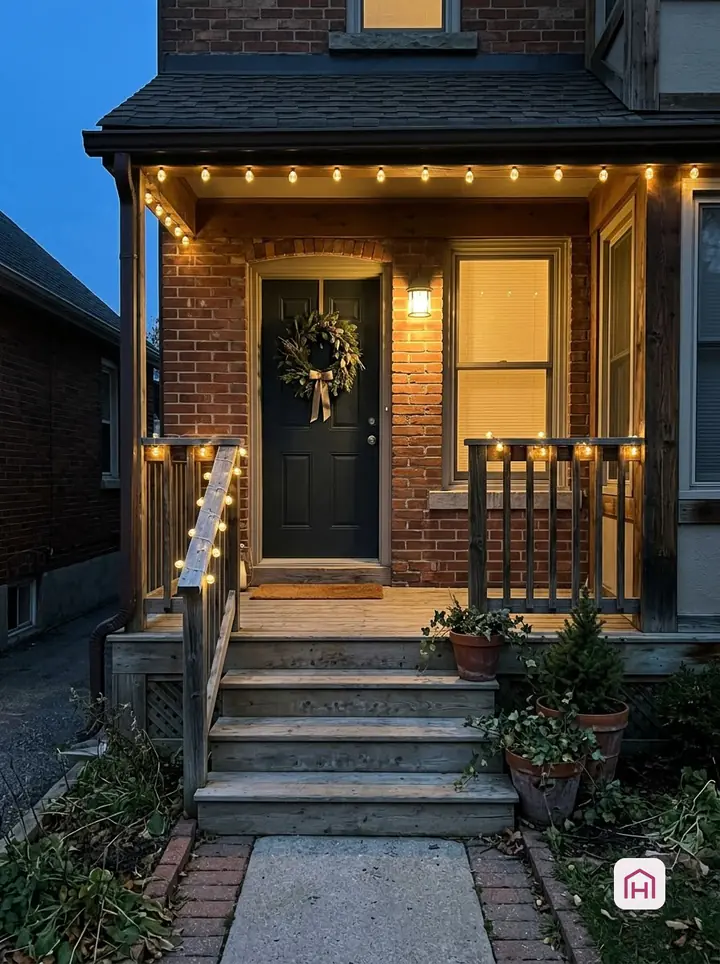
Outdoor-rated lights around the porch
Warm lights outline the porch; use products explicitly rated for the intended outdoor location.
Why it works
String lights along a porch railing or canopy make the entrance welcoming in the dark. Use lights labeled for outdoor use and an outdoor-rated extension cable.
Materials and furniture
- Outdoor-rated string lights
- Outdoor extension cable
- Light clips
Check first
- A photograph cannot establish an outdoor rating or electrical suitability. Follow the actual product instructions.
- Keep pots and cables off the steps and walking route.
Steps, sizes and budget
How to set it up
- Check the label: only use lights certified for outdoor use outside.
- Inspect every set for cracked sockets, bare wires and loose connections before you hang it.
- Clip the lights along the railing or canopy with plastic light clips, not nails or staples through the wire.
- Plug into a GFCI-protected outdoor outlet, using an extension cord marked for outdoor use.
- Route the cord along the edge of the porch, never across the steps or the path, and put the lights on a timer.
- Sizes and clearances
- Measure the railing and canopy edge you want to light and buy lights to that length plus the run to the outlet. Extension cords should not run through doorways or under mats, and are meant for temporary use only.
- Effort and budget
- Medium: outdoor-rated lights and an outdoor extension cord. Battery lights with a timer avoid the cord entirely on a short railing.
- For renters and smaller spaces
- On an apartment balcony or landing without an outlet, battery lights labeled for outdoor use around the door frame or railing, with a timer, avoid any cord through the door.
-
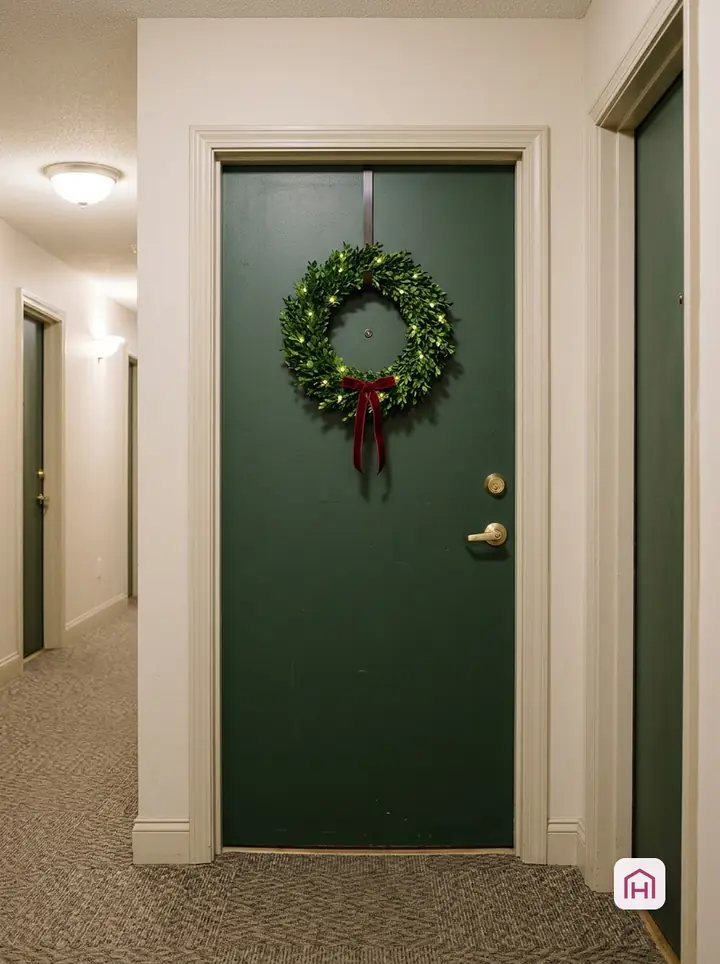
A slim boxwood wreath for a shared hallway
In a shared corridor, keep the decoration on your own door and keep it flat.
Why it works
In a shared hallway the wreath should stay on your own door and stick out as little as possible. A flat boxwood wreath on a slim over-door hanger adds little depth, and the carpet in front of the door stays clear.
Materials and furniture
- Slim boxwood wreath
- Narrow over-door hanger
- Velvet bow
- Battery LED lights
Check first
- Check the door closes and latches with the hanger fitted.
- Keep the wreath clear of the peephole, handle and any door closer.
- Follow the building's rules for corridors and fire doors.
Steps, sizes and budget
How to set it up
- Measure the door width and choose a wreath 8 to 12 in (20 to 30 cm) narrower, counting the bow and any picks.
- Fit the empty hanger, then close and lock the door to confirm it still latches.
- Hang the wreath so it clears the peephole and the handle, and tie the bow on last.
- Open and close the door fully a few times; nothing should catch on the frame.
- Sizes and clearances
- Christmas Central advises 4 to 6 in (10 to 15 cm) of bare door on each side, which means a 24 to 28 in (61 to 71 cm) wreath on a 36 in (91 cm) door. Measure the full width, bow included. A flat wreath also keeps the depth small where neighbors walk past.
- Effort and budget
- Low: a small faux wreath and a narrow hanger, both reused every year. A ribbon you already own can replace the bow.
- For renters and smaller spaces
- If the building allows nothing on the corridor side, hang the same wreath on the inside of the door from the same hanger. The corridor stays untouched.
-
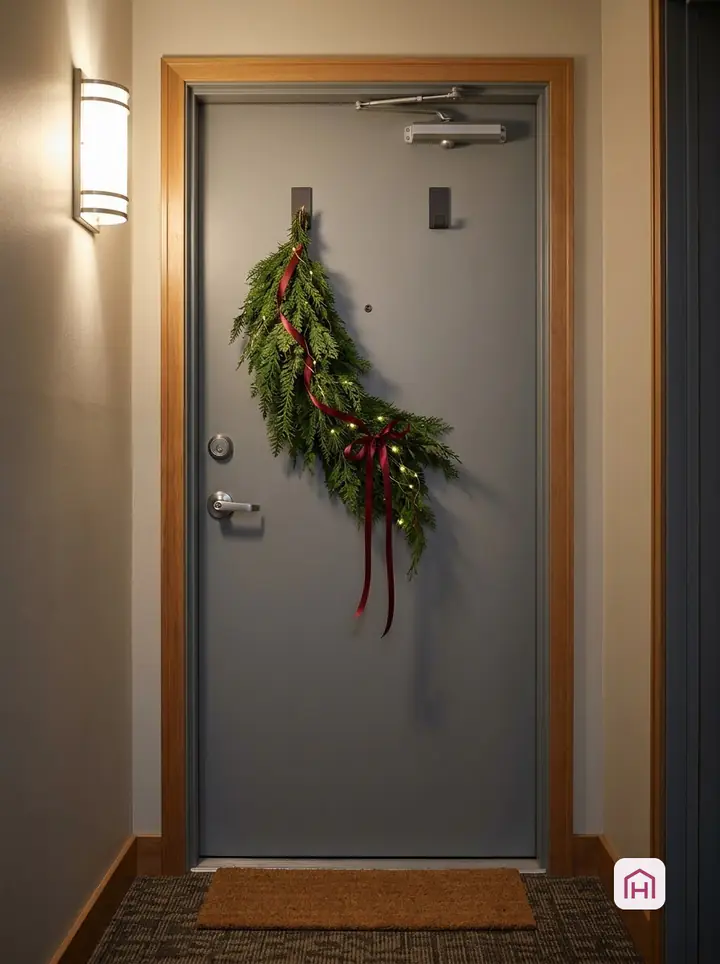
A cedar swag on magnetic hooks
Magnets hold the swag; the door closer at the top stays untouched.
Why it works
A swag is flatter than a wreath, so it suits a corridor door, and a magnetic hook leaves no mark on a magnetic surface. Test the surface and the hook's rated load first, and keep everything away from the door closer.
Materials and furniture
- Two flat magnetic hooks
- Cedar and pine swag
- Satin ribbon
- Battery LED string
Check first
- Check that the door surface is really magnetic before relying on the hooks.
- Keep the hooks and the swag clear of the door closer and the latch.
- Check building rules, as many apartment entrance doors are fire doors.
Steps, sizes and budget
How to set it up
- Test the door with a fridge magnet: if it does not hold firmly, a magnetic hook will not either.
- Check the hooks' stated load and choose a swag lighter than that.
- Wipe the door, set the hooks flat, well below the closer arm and its body, and hang the swag.
- Weave the ribbon and the battery lights through it, keeping the battery pack easy to reach.
- Open and close the door fully; the swag must not touch the closer or the frame.
- Sizes and clearances
- A magnet holds only on a steel surface; aluminum, wood-grain fiberglass and many painted doors that look like metal will not hold. Stay within the hook's stated load and keep the swag above the handle and clear of the latch.
- Effort and budget
- Low: two magnetic hooks and a swag, with ribbon and lights you may already own. The hooks are reused every year.
- For renters and smaller spaces
- On a door where magnets do not hold, use a light swag on a ribbon looped over the top of the door, if the gap and the closer allow it.
-
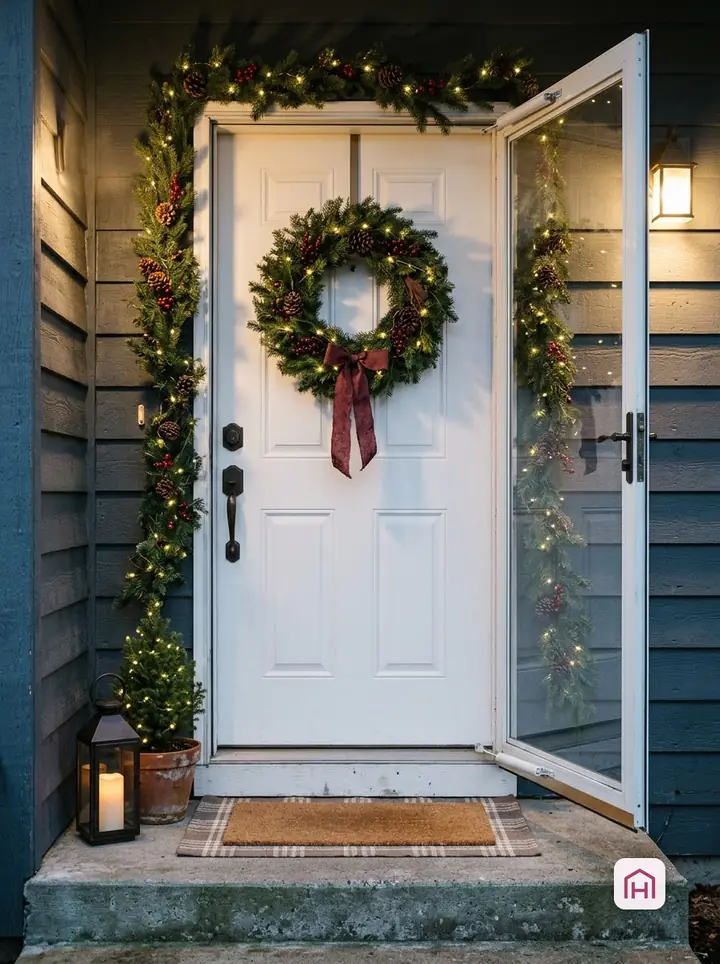
A wreath behind a full-glass storm door
With a storm door, measure the space between both doors before you buy a wreath.
Why it works
A storm door leaves only the gap between the two doors for a wreath. Christmas Central advises measuring that space, because a very full wreath that is too deep for it risks being crushed or broken.
Materials and furniture
- Wreath that is not too deep
- Over-door hanger
- LED lantern
- Battery lights labeled for outdoor use
Check first
- Close the storm door with the wreath on to check that it does not press on it.
- Keep the lantern and pot off the path and use an LED lantern, never a flame.
- Use lights labeled for outdoor use.
Steps, sizes and budget
How to set it up
- Close the storm door and measure the space between it and the main door.
- Choose a wreath whose depth, with picks and bow, fits that space with room to spare.
- Hang it on the main door from an over-door hanger, centered and clear of the handle.
- Close the storm door slowly and check that the glass does not touch the wreath.
- Set the lantern beside the step, not in the path to the door.
- Sizes and clearances
- Measure the depth between the storm door and the main door, and compare it with the wreath's depth. For width, choose a wreath 8 to 12 in (20 to 30 cm) narrower than the main door, so 24 to 28 in (61 to 71 cm) on a 36 in (91 cm) door.
- Effort and budget
- Medium: a slimmer wreath may cost the same as a full one, but a lantern and a mat add up. Reuse last year's wreath and lantern to keep it low.
- For renters and smaller spaces
- If the gap is too shallow for any wreath, hang a small wreath on a suction cup on the glass of the storm door, or use a flat swag on the main door.
-
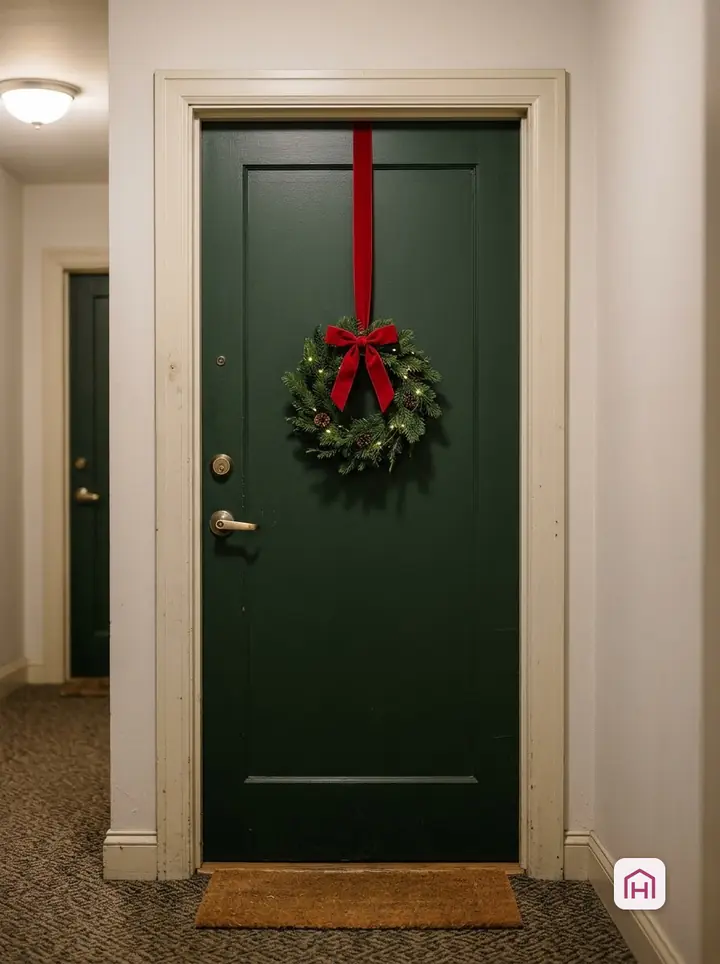
A ribbon over the top of the door, no hooks
No hooks, no tape, no holes: the ribbon hangs over the top of the door.
Why it works
A wide ribbon looped over the top of the door carries a light wreath with nothing fixed to the paint. King of Christmas describes looping ribbon over the top and securing it inside. Check that the door still closes on the ribbon.
Materials and furniture
- Wide velvet ribbon
- Small light wreath
Check first
- Close and latch the door on the bare ribbon before hanging anything.
- Choose a wreath light enough for the ribbon to carry.
Steps, sizes and budget
How to set it up
- Loop the ribbon over the top of the door and close the door on it to check that it still latches.
- Tie or pin the ends together on the inside of the door, away from the frame.
- Slide the wreath onto the ribbon and set it above the handle and lock.
- Open and close the door fully; the ribbon must not drag or twist.
- Sizes and clearances
- The ribbon passes through the gap between the top of the door and the frame, and no standard sets that gap, so test it with the bare ribbon first. Keep the wreath light and clear of the peephole, handle and latch.
- Effort and budget
- Low: a length of wide ribbon and a small wreath. The ribbon comes back every year and can be ironed flat.
- For renters and smaller spaces
- For a firmer hold, replace the ribbon with a padded over-door hanger; for a door that must stay completely bare, hang the wreath on the inside instead.
-
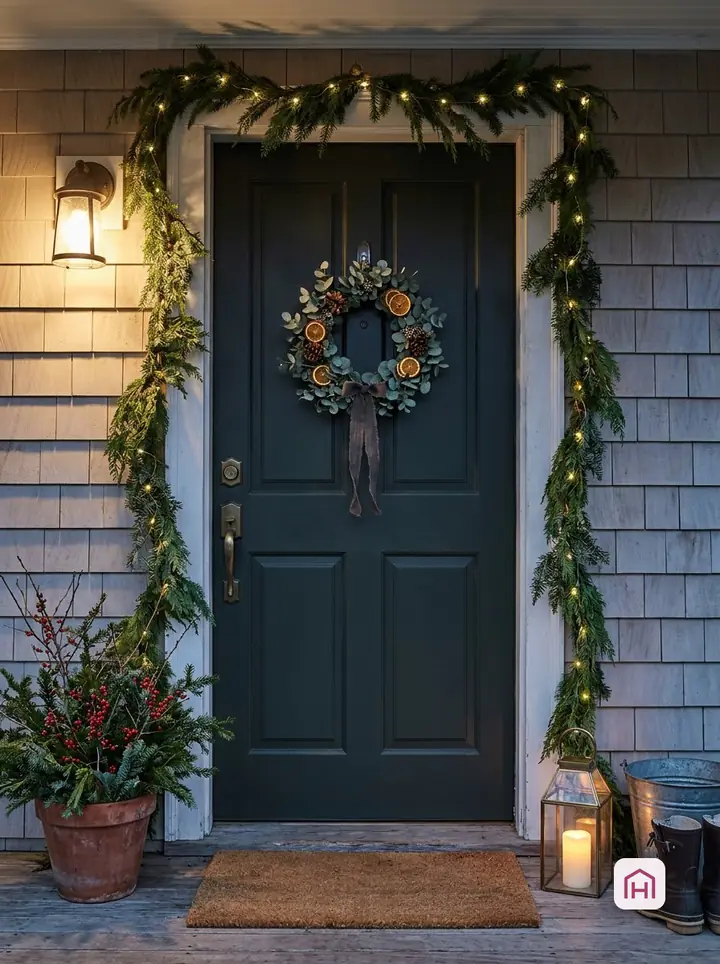
A removable adhesive hook for a tight door top
One hook on the panel, so nothing has to pass over the top of the door.
Why it works
When the top of the door fits too tightly for a hanger or ribbon, a single removable adhesive hook on a smooth panel can carry a light wreath. King of Christmas says adhesive hooks suit lightweight wreaths on clean, smooth surfaces and come off after the season.
Materials and furniture
- Removable adhesive hook
- Light eucalyptus wreath
- Dried orange slices
- Ribbon
Check first
- Use the hook only within its stated load and on a clean, smooth surface.
- A cold, damp or textured door weakens the hold; test it first.
Steps, sizes and budget
How to set it up
- Try an empty hanger or a ribbon over the top; if the door will not close freely, use a hook instead.
- Clean and dry the smooth part of the panel and press the hook on as its instructions say.
- Wait the time stated on the pack before hanging the wreath.
- Hang the wreath, then close the door firmly once and check that the hook has not shifted.
- Take the hook off slowly at the end of the season, as the instructions say.
- Sizes and clearances
- Do not force the door shut over a hanger or ribbon: if it binds, use a hook. Choose a wreath lighter than the hook's rated load and 8 to 12 in (20 to 30 cm) narrower than the door, so 4 to 6 in stay bare on each side.
- Effort and budget
- Low: one adhesive hook and a light wreath. Dried orange slices you make yourself cost almost nothing.
- For renters and smaller spaces
- On a cold exterior door where adhesive might let go, hang the same light wreath on the inside of the door, or use a magnetic hook if the door is steel.
-
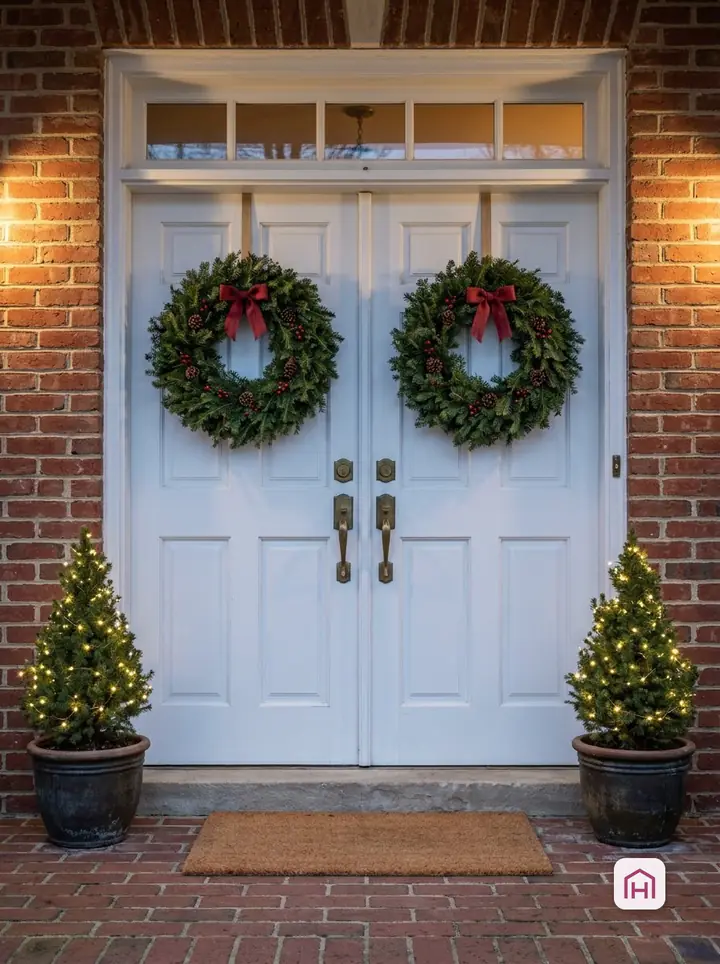
Matching wreaths on double front doors
One identical wreath per leaf, each sized to a single door.
Why it works
Christmas Central advises a pair of identical wreaths on double doors, each 8 to 12 in smaller than the width of one door. Hang both at the same height so the pair reads as one design, and check that each leaf still opens.
Materials and furniture
- Two identical wreaths
- Two over-door hangers
- Two bows
- Two potted evergreens
Check first
- Check that both leaves open and close freely with the wreaths on.
- Keep the pots and mat off the steps and the walking line.
Steps, sizes and budget
How to set it up
- Measure the width of one leaf, not the whole opening.
- Choose two identical wreaths 8 to 12 in (20 to 30 cm) narrower than that width.
- Hang them at the same height, each centered on its leaf, clear of the seam and the handles.
- Open each leaf fully, one at a time, and check that the wreath does not catch the frame.
- Set a pot on each side beside the step, not on it.
- Sizes and clearances
- Measure one leaf and apply the usual margin: wreaths 8 to 12 in (20 to 30 cm) narrower, picks and bows included. Check that the two wreaths do not touch each other or the seam when both leaves are shut.
- Effort and budget
- Medium: two wreaths and two bows cost double, and so do the pots. Buying one matching pair every few years and reusing it keeps the yearly cost low.
- For renters and smaller spaces
- If only one leaf is used day to day, a single wreath centered on that leaf keeps the seam free and halves the cost.
-
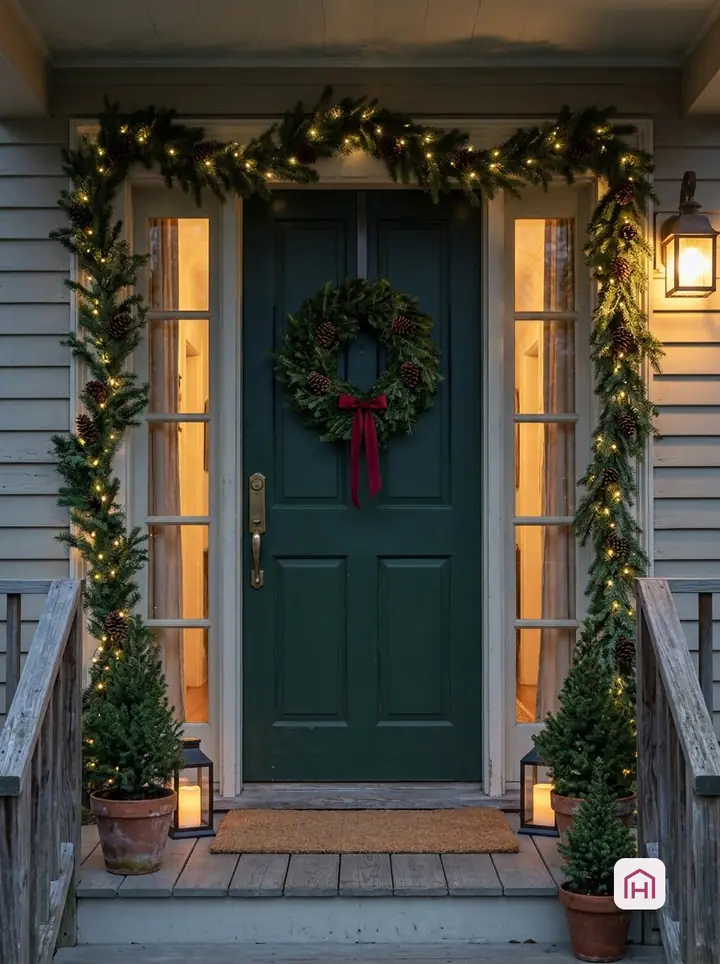
A garland around a door with glass sidelights
Frame the outer trim and leave the glass clear.
Why it works
A garland around the outer trim of the whole doorway decorates the entrance and leaves the sidelight glass clear, so you can still see who is at the door. Christmas Central says to allow the top and both sides plus a few extra inches.
Materials and furniture
- Garland approved for outdoor use
- Removable hooks or zip ties
- Battery lights labeled for outdoor use
- Wreath and hanger
Check first
- Keep garland and lights off the glass and out of the door's swing.
- Use lights labeled for outdoor use, and no cord through the doorway.
- Keep lanterns and pots at the edges of the porch, off the steps.
Steps, sizes and budget
How to set it up
- Drape a piece of string around the outer trim of the whole doorway and measure the string.
- Fix removable hooks or zip ties to the trim, not to the glass or the door leaf.
- Lay the garland across the top first, then down both sides.
- Add battery lights labeled for outdoor use, with a timer if the pack has one.
- Open and close the door; garland and wreath must not catch.
- Sizes and clearances
- For a doorway, Christmas Central allows the top and both sides of the frame plus a few extra inches to swag or hang lower; drape string around the outer trim, sidelights included, and measure the string.
- Effort and budget
- Medium: garland is sold by length, and a doorway with sidelights needs more than a plain door. A shorter garland across the top only keeps it low.
- For renters and smaller spaces
- On a doorway with no outlet, battery lights with a timer avoid any cord through the door. In a rental, use removable hooks and take them off slowly.
-
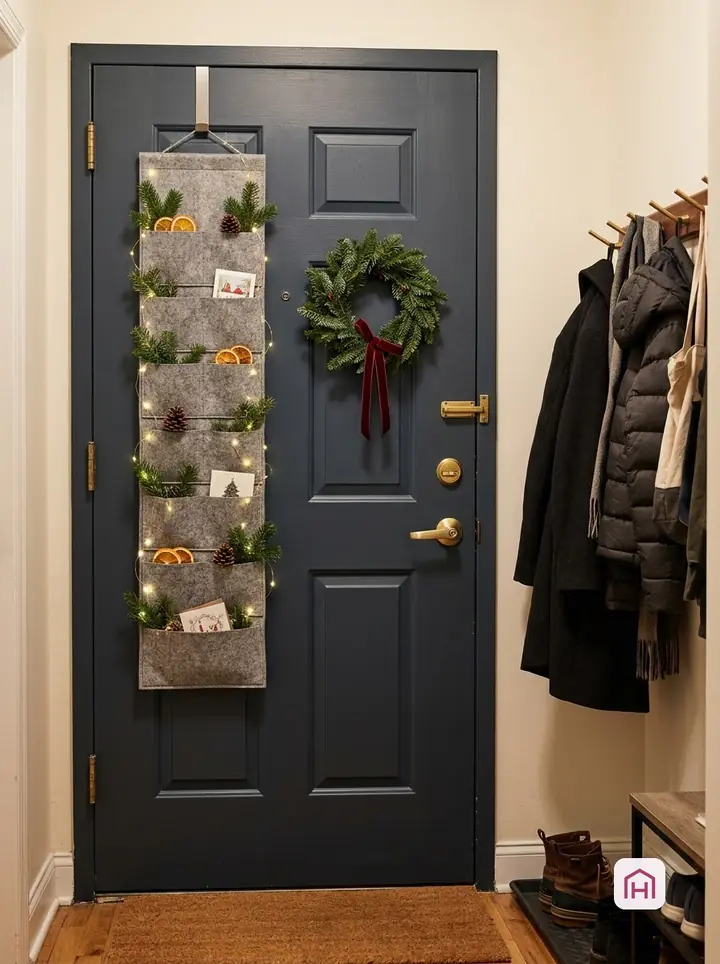
The inside of the door as a display
The inside of the door is yours to decorate, and the corridor side stays bare.
Why it works
The inside face of an entrance door is the one surface you fully control. An over-door felt pocket hanger carries greenery, cards and small items with no fixings. Check that it passes the gap at the top and that the door still latches.
Materials and furniture
- Over-door felt pocket hanger
- Fir sprigs and dried orange slices
- Small wreath
- Battery LED string
Check first
- Keep the hanger, wreath and lights clear of the deadbolt, bolt and handle.
- Many apartment entrance doors are fire doors, so check the building's rules and keep it small.
Steps, sizes and budget
How to set it up
- Hook the empty hanger over the door and close and lock the door to check it still latches.
- Fill the pockets with greenery, dried orange slices, pine cones or cards.
- Wind battery lights through the pockets and keep the battery pack easy to reach.
- Hang a small wreath beside it, clear of the lock and the handle.
- Open the door fully and check that nothing hits the wall, the coats or the rail.
- Sizes and clearances
- The hanger passes through the gap at the top of the door, so test it empty first. NFPA limits combustible signage on a fire door to 5 percent of its face (about 12 by 12 in on a 36 by 80 in door); it does not mention wreaths, so keep it small and clear of the latch.
- Effort and budget
- Low: a felt hanger is a cheap fitting, and greenery and cards come from what you already have. The hanger is reused each year.
- For renters and smaller spaces
- In a very small entry, a felt strip with only a few pockets, or the wreath alone, takes the same idea with less width.
-
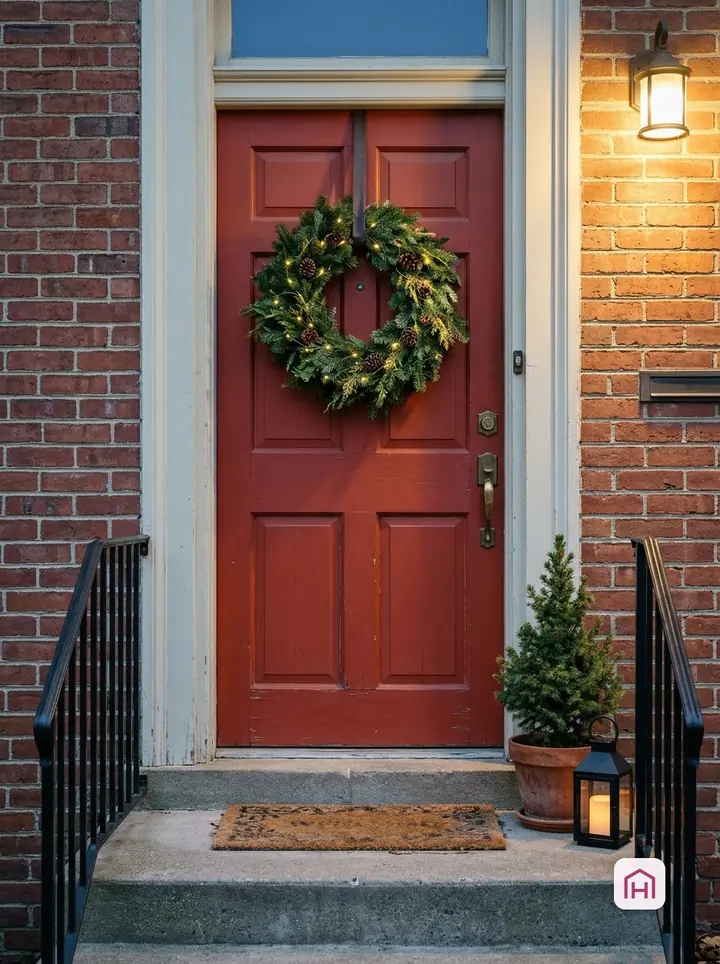
A lantern and a potted spruce on a narrow stoop
Both pieces hug the wall, so the steps stay clear.
Why it works
On a narrow stoop, one small potted evergreen and one lantern placed against the wall beside the door add warmth without narrowing the steps. Use an LED lantern, never a flame, and keep both off the walking line.
Materials and furniture
- LED lantern
- Small potted dwarf spruce
- Wreath and over-door hanger
Check first
- Keep the pot and lantern against the wall, off the steps and the walking line.
- Use an LED lantern, not a candle, and a pot heavy enough not to tip.
Steps, sizes and budget
How to set it up
- Pick a pot and lantern small enough to sit against the wall beside the door.
- Place them to one side of the landing, not on the treads.
- Hang the wreath on the door from an over-door hanger and check that the door still latches.
- Walk up and down the steps in the dark: nothing may be in the way.
- Sizes and clearances
- Leave the full width of the steps and the landing in front of the door free. Choose a pot wide and heavy enough that a gust or a passing bag will not knock it over, and keep both pieces away from the swing of the door.
- Effort and budget
- Low: one small pot and one lantern. After the season the spruce can stay as a porch plant and the lantern serves all year.
- For renters and smaller spaces
- With a landing too small for any floor piece, skip the pot and hang the lantern on a wall hook or use only the wreath.
-
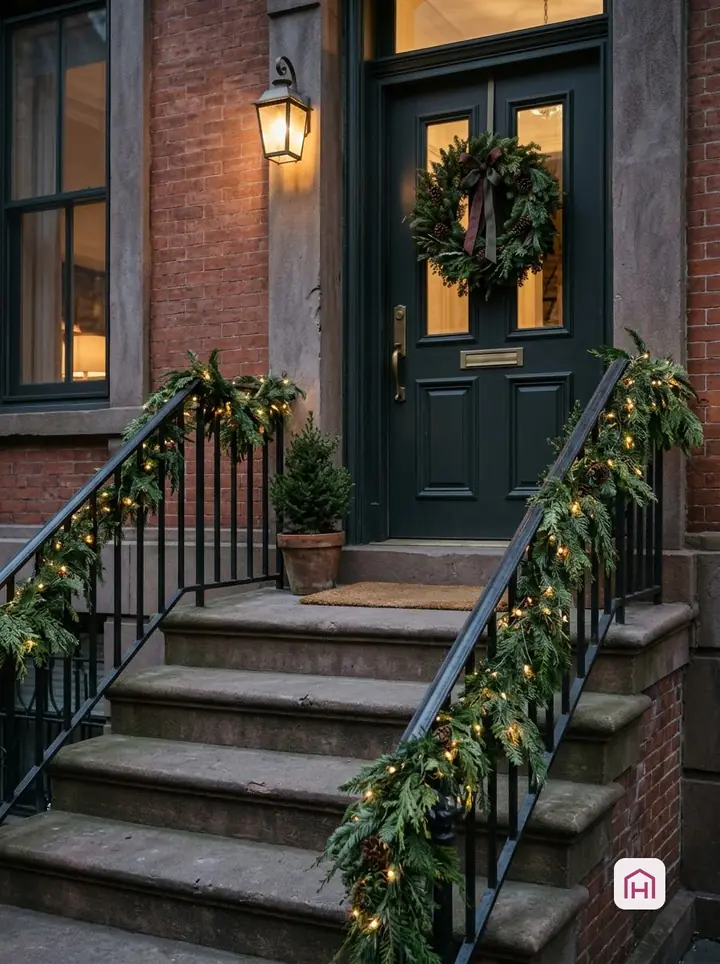
A garland along the stoop railing
Greenery goes on the railing, never on the treads.
Why it works
Winding a garland and a battery LED string along a railing decorates the stoop without putting anything on the steps. Christmas Central suggests holding garland with removable hooks, zip ties or banister ties, and using garland approved for outdoor use outside.
Materials and furniture
- Garland approved for outdoor use
- Zip ties or banister ties
- Battery lights labeled for outdoor use
- Wreath and hanger
Check first
- Keep the treads, the landing and the handrail grip clear.
- Use lights labeled for outdoor use, and no cord across the steps.
Steps, sizes and budget
How to set it up
- Run a piece of string along the railing to find the garland length you need.
- Fasten the garland to the rail with zip ties or banister ties, loosely, at regular points.
- Wind in the battery lights and keep the pack easy to reach.
- Hang the wreath on the door and set a small potted spruce beside it.
- Walk up and down: greenery must not hang over the treads or catch a sleeve.
- Sizes and clearances
- For a staircase, Christmas Central allows one and a half to two times the length of the banister, plus extra at the newel post; use string to test how deep it drapes. Keep it clear of the handrail's grip and the treads.
- Effort and budget
- Medium: a staircase needs more garland than a door. A shorter run on the top rail only keeps it low.
- For renters and smaller spaces
- With a shared stoop, decorate only your own side of the rail, and check the building's rules before fixing anything to it.
-
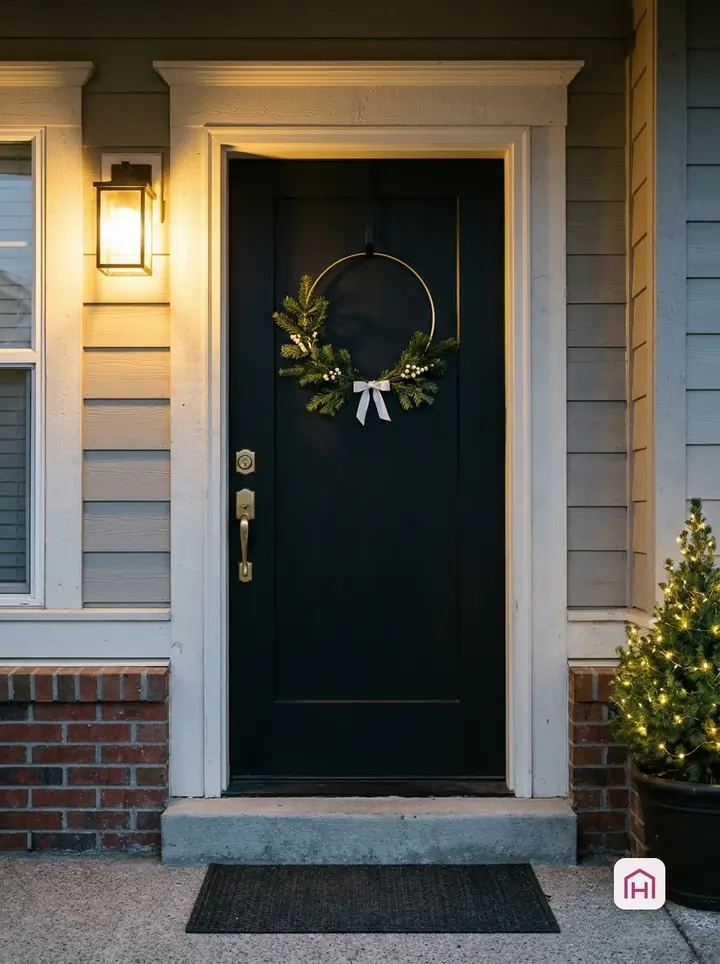
A brass ring wreath on a black door
One thin ring, a few sprigs and a small ribbon let the door stay the focus.
Why it works
A slim brass hoop with a few fir sprigs is lighter and quieter than a full wreath, and it shows off a dark door. The over-door hanger leaves no marks, and little greenery means little to replace.
Materials and furniture
- Brass hoop
- Fir sprigs and white berries
- Narrow over-door hanger
- Small ribbon
Check first
- Check the door closes and latches with the hanger fitted.
- Keep the hoop clear of the peephole, handle and latch.
Steps, sizes and budget
How to set it up
- Wire a few fir sprigs and berry stems to one side of the hoop, leaving most of the ring bare.
- Tie on a small ribbon where the greenery ends.
- Fit the empty hanger first and check that the door still latches.
- Hang the hoop centered at eye level and open and close the door a few times.
- Sizes and clearances
- Measure the hoop's full width, sprigs and ribbon included, and keep 4 to 6 in (10 to 15 cm) of bare door on each side, as Christmas Central advises for any wreath. A thin ring looks lighter than its width suggests.
- Effort and budget
- Low: a brass hoop is a one-off purchase and the sprigs and ribbon cost little. Swap the greenery each year.
- For renters and smaller spaces
- On a door where nothing may hang over the top, hang the hoop from a ribbon loop on the inside, or use a magnetic hook if the door is steel.
-
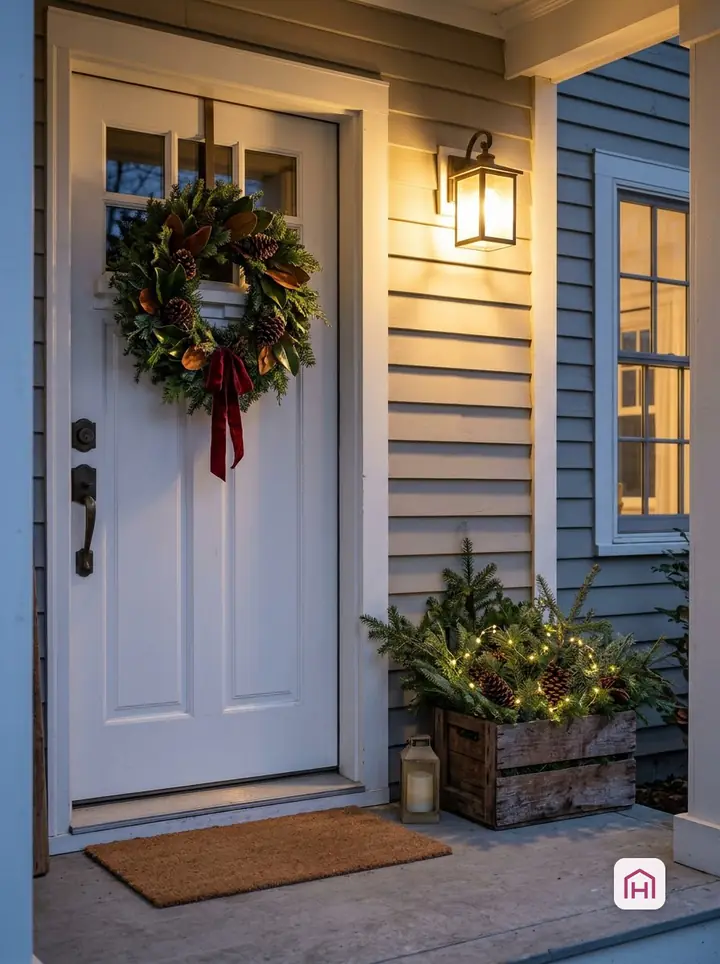
A farmhouse door with a crate of greenery
The crate stays against the wall, off the walking line and the door's swing.
Why it works
A crate of cut fir and cones adds volume at floor level without anything fixed to the door. Keep it against the wall, outside the swing of the door and any screen door, and off the walking line.
Materials and furniture
- Wooden crate
- Cut fir branches and pine cones
- Battery lights labeled for outdoor use
- Wreath and hanger
Check first
- Keep the crate outside the swing of the door and any screen or storm door.
- Cut greenery dries out; replace it as it sheds, and keep it away from heat.
Steps, sizes and budget
How to set it up
- Open the door fully, and any screen door, and mark where it swings.
- Set the crate against the wall outside that arc.
- Fill it with cut fir and pine cones and weave in battery lights labeled for outdoor use.
- Hang a mixed wreath on the door and keep the mat flat in front.
- Check the greenery weekly and replace the worst branches.
- Sizes and clearances
- Open the door and any screen door fully, and mark the arc they sweep: the crate, the lantern and the mat stay outside it. Leave the walking line to the door free.
- Effort and budget
- Low to medium: a crate and cut branches cost little, but fresh greenery is replaced during the season. Faux branches last for years.
- For renters and smaller spaces
- Without a porch, a small crate on a tray inside the entry gives the same layered look where you control the space.
-
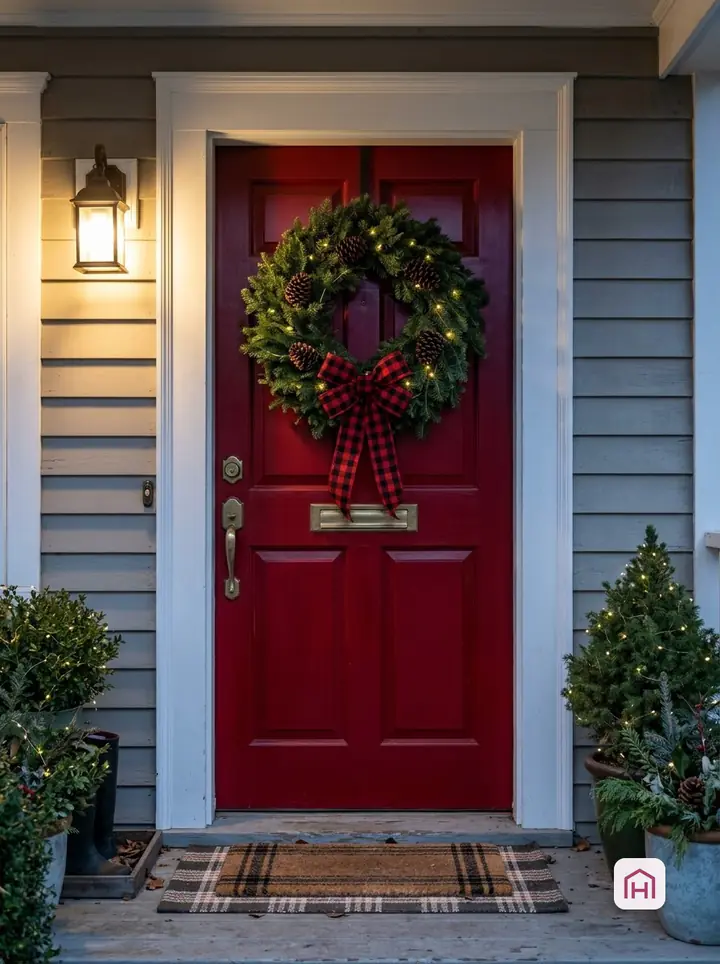
A plaid bow on a red door
One bold pattern in one place; the door color does the rest.
Why it works
A red door already carries color, so a full fir wreath with one large plaid bow is enough. A plaid mat repeats the pattern at the floor, where it is meant to be walked on.
Materials and furniture
- Full fir wreath
- Buffalo-check bow
- Outdoor-rated plaid doormat
- Over-door hanger
Check first
- Keep the bow tails clear of the handle, the latch and the mail slot.
- Use a flat mat that the door can pass over.
Steps, sizes and budget
How to set it up
- Measure the door width and choose a wreath 8 to 12 in (20 to 30 cm) narrower, bow included.
- Fit the empty hanger and check that the door still latches.
- Attach the bow at the bottom of the wreath and trim the tails so they end above the handle.
- Lay the mat, then open and close the door to check that it passes over it.
- Sizes and clearances
- On a 36 in (91 cm) door, Christmas Central suggests a 24 to 28 in (61 to 71 cm) wreath, measured with the bow. Door hardware sits about 34 to 48 in (865 to 1220 mm) above the floor in accessible buildings, so tails should end above that.
- Effort and budget
- Low: a plain wreath and one bow cost less than a fully decorated wreath, and the mat is a seasonal swap. Both store flat.
- For renters and smaller spaces
- On a door without a porch, put the plaid on a ribbon looped over the top and keep the mat inside the entry.
-
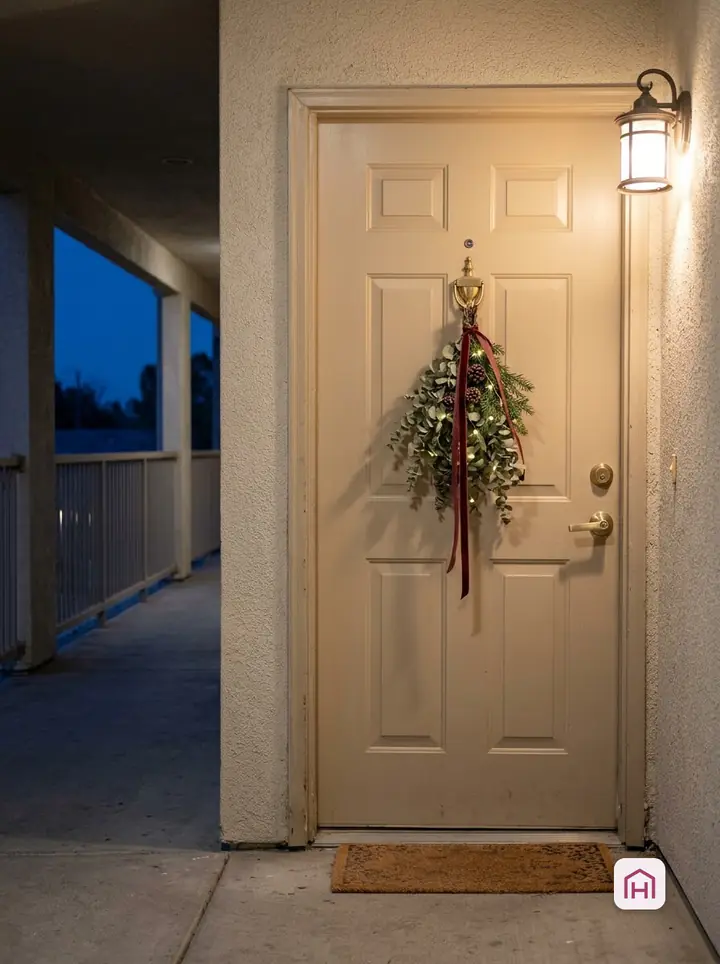
A swag on the door knocker and a flat mat
For a strict building: the door face stays free and the swag hangs from what is already there.
Why it works
If the building allows nothing on the door, hang a short swag from a fitting that is already there, such as a door knocker, and add a flat mat. Nothing is fixed to the door. Check the building's rules for mats on shared walkways.
Materials and furniture
- Short dried eucalyptus swag
- Ribbon
- Flat seasonal mat
- Battery LED string
Check first
- Check building rules for mats and decorations on a shared walkway.
- Keep the mat flat and within the doorway, so the walkway is not narrowed.
Steps, sizes and budget
How to set it up
- Check what the building allows on the door and the walkway before you start.
- Tie the swag to the knocker with ribbon and keep it above the handle.
- Weave in a battery LED string and keep the pack easy to reach.
- Lay a flat, non-slip mat in front of the door, then open and close the door to check it passes over.
- Sizes and clearances
- The swag must hang clear of the handle and latch, and within what the knocker can carry. The mat stays flat enough for the door to swing over it and no wider than your doorway, so the walkway is not narrowed.
- Effort and budget
- Low: a short swag, ribbon and a mat. Everything comes off in seconds and leaves no trace.
- For renters and smaller spaces
- Where mats are banned on the walkway, put the seasonal mat inside your own door and keep only the swag outside.
-
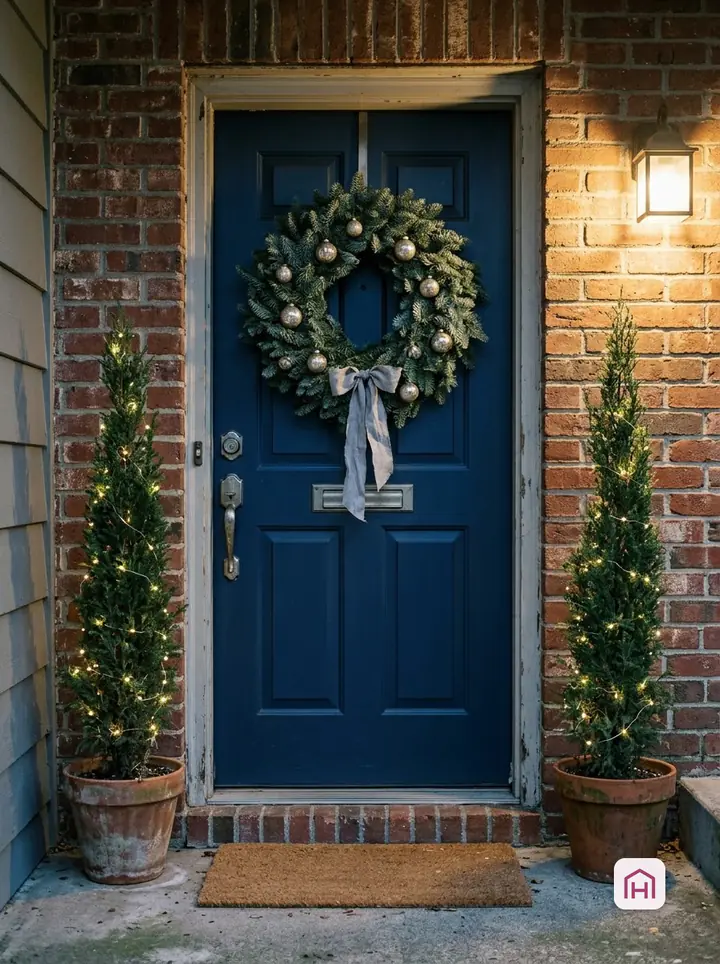
Silver and grey on a navy door
A cool palette: one metallic, one ribbon color and two slim trees.
Why it works
Metallic ornaments and a grey ribbon look crisp against navy. Two slim potted evergreens with warm white lights frame the door without taking space from the step.
Materials and furniture
- Fir wreath
- Shatter-resistant metallic ornaments
- Grey or silver ribbon
- Two slim potted evergreens
- Battery LED strings
Check first
- Wire the ornaments in so they cannot fall when the door closes.
- Keep the pots beside the step, off the walking line.
Steps, sizes and budget
How to set it up
- Choose a wreath 8 to 12 in (20 to 30 cm) narrower than the door.
- Wire shatter-resistant ornaments into the wreath, spaced evenly.
- Tie on the ribbon and hang the wreath from an over-door hanger.
- Wind battery lights around each potted evergreen and place them on each side of the door.
- Close the door and check that nothing knocks against the frame.
- Sizes and clearances
- Measure the wreath's full width, ornaments and bow included, against the door and keep 4 to 6 in (10 to 15 cm) bare on each side. Pots should be heavy enough not to tip and sit clear of the swing of the door.
- Effort and budget
- Medium: two slim evergreens and a set of metallic ornaments add up. Plastic ornaments and last year's wreath keep it low.
- For renters and smaller spaces
- On a narrow entry, use one slim evergreen on one side and keep the other side clear.
-
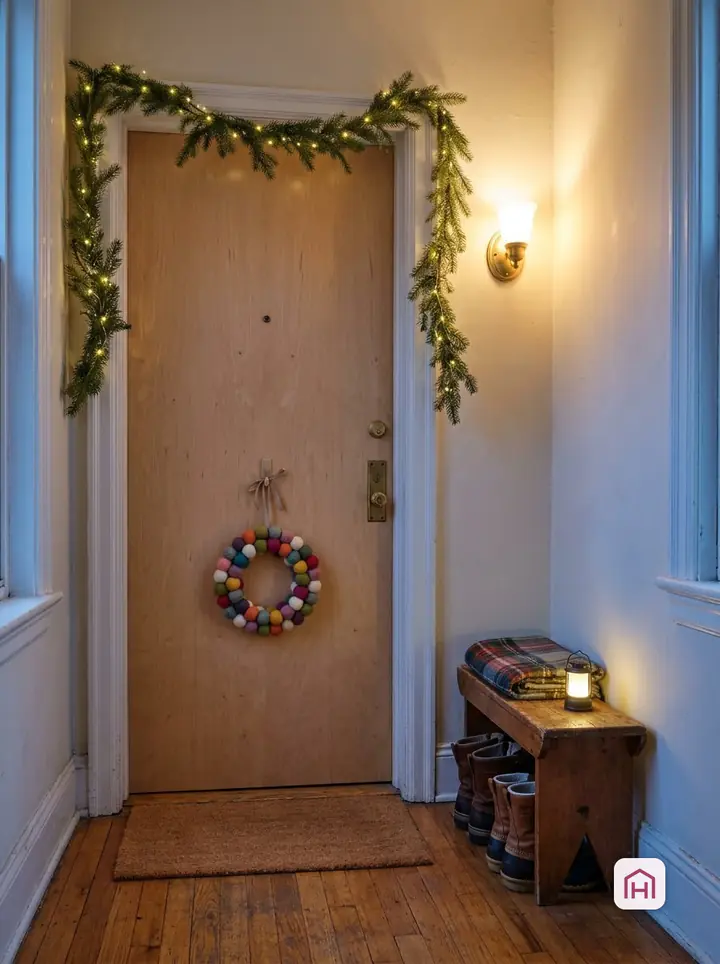
A soft felt wreath hung low on the door
Soft and light, and low enough to see without lifting a child.
Why it works
A felt-ball wreath is soft, light and unbreakable, so it can hang lower on the door where a child can see it. A small removable hook holds it, and it comes off without a mark.
Materials and furniture
- Felt-ball wreath
- Small removable hook
- Battery LED garland
Check first
- Keep battery packs and cords out of a child's reach.
- Use a hook within its stated load, and check that the door closes with the wreath on.
Steps, sizes and budget
How to set it up
- Pick a felt-ball wreath with firmly attached balls and no small loose parts.
- Fix a small removable hook below the peephole, on a clean and smooth part of the door.
- Wait the time stated on the pack, then hang the wreath on its ribbon loop.
- Close the door once firmly and check that the hook holds.
- Keep the bench and the floor clear so that the hallway stays open.
- Sizes and clearances
- Hang the wreath where the child can see it, below the peephole and clear of the handle and latch. Stay within the hook's stated load; felt weighs little, so a light hook is enough.
- Effort and budget
- Low: felt wreaths are cheap, last for years. One hook is the only fitting.
- For renters and smaller spaces
- Where nothing may be stuck to the door, hang the felt wreath on the inside of the door from an over-door hanger, at the same height.
-
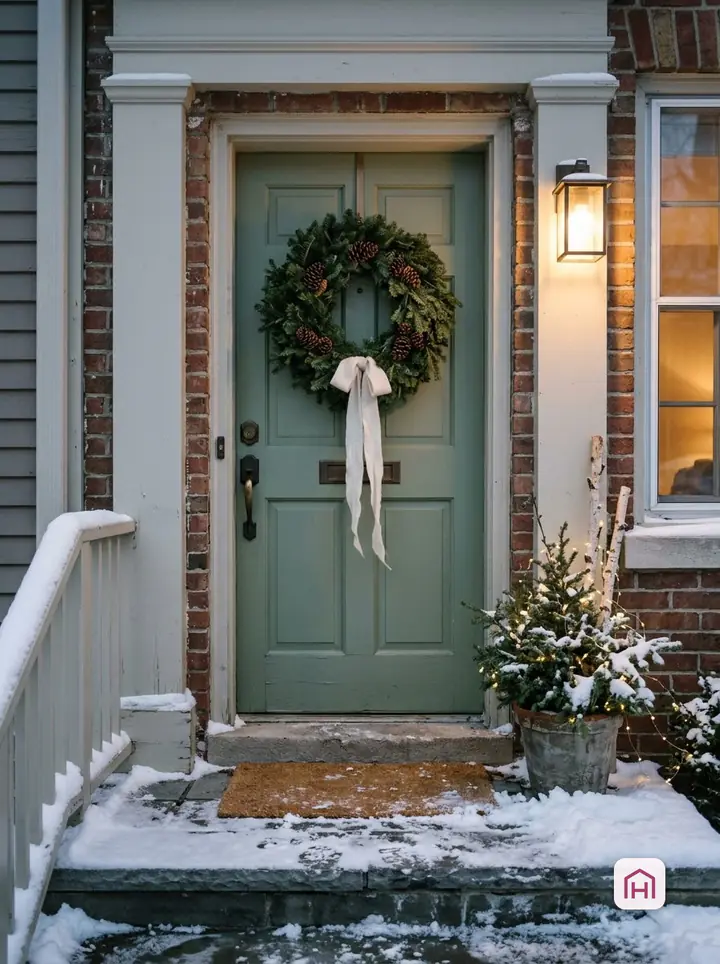
From Christmas to winter: swap the ribbon
Take off the red and keep the wreath: a cream ribbon makes it a winter one.
Why it works
A plain fir and pine-cone wreath carries on into January once the red ribbon is replaced with cream wool. One swap extends the season, and nothing needs to be taken down on 26 December.
Materials and furniture
- Fir and pine-cone wreath
- Cream wool ribbon
- Over-door hanger
Check first
- Choose pieces suited to a weather-exposed entrance.
- Keep the step and the path clear of snow and ice.
Steps, sizes and budget
How to set it up
- Untie the Christmas ribbon and any red or gold decorations.
- Tie a wide cream ribbon in a loose bow and leave the tails long.
- Keep the pine cones and plain greenery on the wreath.
- Check the wreath weekly; replace any worn greenery.
- In late winter, take it down before the hanger sits through weeks of damp.
- Sizes and clearances
- Change only the ribbon, so the wreath's width and the door's clearances stay as they were. Keep the tails above the handle and clear of the mail slot, and check that the door still closes.
- Effort and budget
- Low: one length of ribbon. The wreath you already own does the work.
- For renters and smaller spaces
- Without a porch, keep the wreath on the inside of the door and use the same swap there.
Your door, the shared corridor and the porch
An apartment door opens onto space that is shared with neighbors, and in many buildings that corridor is also an escape route. Decorate the door itself and the inside of your entrance, and check the house rules before putting anything on the floor outside. A house with a porch gives you more room, but the steps and the path still have to stay clear for everyone who arrives in the dark.
| Door | Best fit | Check first |
|---|---|---|
| Wooden apartment door | Over-door hanger, bow, swag | The door still closes and locks |
| Metal apartment door | Magnetic hook | Magnet strength and door surface |
| No decorations allowed outside | Wreath on the inside, frame garland | Spyhole and latch stay free |
| House with a porch | Pots, outdoor-rated lights, wreath | Steps and path stay clear |
Which idea fits your door?
| Your situation | Start with | Skip | Why |
|---|---|---|---|
| Apartment door in a shared hallway with building rules | Big bow or swag on an over-door hanger; seasonal mat only if mats are allowed | Porch pots, anything on the corridor floor | The corridor is shared and often an escape route; decoration that stays on the door leaf is easiest to justify |
| Front door with a porch | Wreath, two potted evergreens, outdoor-rated lights | Indoor lights, cords across the steps | You control the space, but it is outdoors and in the dark |
| Steel or metal-clad door | Magnetic hook with a light wreath or bow | Adhesive hooks on cold, painted metal outdoors | A magnet leaves no trace, if the door really is steel |
| Glass door or a door with a large glass panel | Wreath on a suction cup inside the glass, or a ribbon over the top | Heavy wreaths on adhesive hooks | Suction cups are made for glass; the glass must stay clear enough to see who is there |
| Door that must not be marked (rental, new paint, fire door) | Ribbon looped over the top and tied off inside, or a padded over-door hanger | Nails, tacks, strong adhesive | Nothing to remove but the ribbon; check the door still latches |
| Door with almost no clearance to a wall or second door | Flat swag or bow | Deep wreaths and full frame garlands | A wreath sticks out by its whole thickness |
Measure before you buy
A wreath that looks right in the shop can swallow a narrow apartment door. Measure the door's width and pick a wreath 8 to 12 inches (20 to 30 cm) narrower, so that 4 to 6 inches stay bare on each side; on a standard 36 inch (91 cm) door that means 24 to 28 inches [2]. Measure the full width, including picks, pine cones and ribbon tails, because those count too [2]. One manufacturer groups 21 to 24 inch wreaths for small doors and windows, 25 to 36 inches for standard doors and 37 to 60 inches for large or double doors [5]. The wreath size guide has the full table by door width and a cardboard test you can do before ordering.
Depth matters in a corridor as well. In accessible public buildings, objects between 27 and 80 inches above the floor may stick out at most 4 inches (100 mm) into a circulation path [7]. Your apartment door may not fall under those standards, but the number is a useful check for a narrow landing where neighbors walk past: a deep wreath on an outward-opening door sticks into the route twice, once flat and once when the door is open. How much width a hallway needs to stay comfortable is explained in hallway clear width.
For a garland around the frame, allow for the top and both sides plus a few extra inches to swag or hang lower; drape a piece of string around the door first and measure the string [9]. The garland length guide covers doors, stairs, mantels and trees.
Hanging without nails or damage
Most door decorations can go up without a single hole. Pick the method by your door surface and the weight of what you hang, and make sure the hook or hanger can carry the wreath's weight [5].
| Method | Suits | Watch out for |
|---|---|---|
| Over-door hanger | Most wooden and metal doors with a gap at the top [6] | The door must still close and latch; pad the metal if it rubs the paint |
| Ribbon over the top | Light wreaths, bows and swags; tie off inside with a small adhesive hook or a discreet tack [6] | A tack leaves a small hole |
| Removable adhesive hook | Light pieces on clean, smooth surfaces; comes off after the season [6] | Cold, damp or textured surfaces; follow the stated load and removal steps |
| Magnetic hook | Steel doors only | Many doors that look metal are not magnetic |
| Suction cup | Glass [5] | Clean the glass first; cold glass weakens suction |
Before the holidays, try the method with the empty fitting for a day. Then hang the decoration and work the door: open it fully, close it, lock it and turn the handle. A wreath that knocks against the frame every time the door shuts loses needles and ornaments within a week. For more ways to hang things without drilling, see the adhesive hook ideas and what renter-friendly really means for removing them.
Shared corridors and fire doors
Shared corridors need the building's rules and permitted escape routes checked before adding mats, pots or frame decorations. Keep the display on your permitted door area and avoid trailing leads. Many apartment entrance doors are fire doors. Fire doors must always be able to open, close and latch, and NFPA limits combustible signage on a door face to 5 percent of its area, about a 12 by 12 inch square on a common 36 by 80 inch door; the NFPA FAQ does not mention wreaths [8]. If your door has a closer at the top, keep anything you hang clear of it, and ask the building manager before hanging something larger than a bow.
Lights outdoors
Use only lights certified for outdoor use outside, plugged into a GFCI-protected outlet, with outdoor-rated extension cords, and check every set for cracked sockets, frayed or bare wires and loose connections before hanging it [1]. Inspect lights each year and throw away strands with frayed or pinched wires [3]. Do not run extension cords through doorways or under mats; they are meant for temporary use [4]. If a cord has to reach the porch, run it along the edge, not across the steps. Battery lights avoid the cord entirely; battery, plug-in and USB lights compared shows which suits a door, a railing or a wreath.
Test the door as a moving object
A wreath hanger must suit the door thickness and clearance. Open and close the door fully, turn the handle and operate the lock with the display attached. Do not force the door to shut over a hook or compress seals to make decoration fit. A magnetic hook requires a suitable magnetic surface and its own rated load; a painted metal-looking door is not evidence that it will hold.
The two porch examples belong to private entrances with suitable space, not to an apartment landing by default.
Plan removal with installation
Choose weather-suitable pieces for exposed entrances and use each attachment as instructed. Before mounting, decide how it comes off and where you will store the wreath without crushing it. One bow or swag can be easier to fit and keep than a full garland around every frame. The practical stopping point is a door that operates normally with the decor in place.
When the season ends, take wreaths down before the hooks have sat through weeks of cold and damp, pull adhesive strips slowly as their instructions say, and store the wreath flat or hung in a bag so it keeps its shape. The inside of your entrance can carry on into winter with the ideas for fall entryway decor or a slim entryway console; if guests are coming, the holiday hosting checklist plans the entrance along with everything else.
Before you hang anything
- Measure the door width and the wreath's full width, picks included.
- Fit the empty hanger or hook and close and lock the door.
- Keep the spyhole, handle, latch and any door closer free.
- Check your building's rules for corridors and fire doors.
- Use outdoor-rated lights and cords outside, and none across steps or doorways.
- Keep steps, mats and corridors flat and clear.
Common questions
How do you decorate an apartment door for Christmas without damaging it?
Use something that hangs from the door itself and comes off cleanly, an over-the-door wreath hanger, a ribbon looped over the top and tied off inside, a magnetic hook on a steel door, or a removable adhesive hook on a clean, smooth surface. Check that the door still closes and latches with it fitted.[6]
What size wreath should I buy for a 36 inch door?
A 24 to 28 inch wreath, which leaves 4 to 6 inches of bare door on each side. As a rule, choose a wreath 8 to 12 inches narrower than the door, and measure the wreath's full width including picks and ribbon.[2]
Will an over-the-door wreath hanger stop my door from closing?
It can. The hanger passes through the gap between the top of the door and the frame, and no standard sets that gap. Fit the empty hanger and close and lock the door before you buy a wreath; if it binds, hang the wreath on the inside or use ribbon instead.
Can I hang a wreath on a fire door in my apartment building?
Fire doors must always open, close and latch, and NFPA limits combustible signage on a door face to 5 percent of its area, about a 12 by 12 inch square on a 36 by 80 inch door. A wreath is not mentioned, so check your building's rules first and keep anything you hang small and clear of the closer and latch.[8]
How long a garland do I need around a front door?
Enough for the top and both sides of the frame plus a few inches to swag or hang lower. Drape a piece of string around the door first and measure the string.[9]
Are indoor Christmas lights safe to use on a porch?
No. Outdoors, use only lights labeled as certified for outdoor use, plugged into a GFCI-protected outlet, with an extension cord marked for outdoor use. Check each set for cracked sockets and bare wires before hanging it.[1]
Filter ideas by room and fixing
Sources
- Put Safety at the Top of Your List When Decorating this Holiday Season (December 6, 2017) , U.S. Consumer Product Safety Commission. checked
- Discover the Best Artificial Wreaths: Your Ultimate Buying Guide , Christmas Central (retailer). checked
- Holiday Fire Safety , U.S. Fire Administration (FEMA). checked
- Household Extension Cords Can Cause Fires (Publication 5032, April 2012) , U.S. Consumer Product Safety Commission. checked
- 48 in. Pre-Lit Norwood Fir Wreath with Warm White LED Lights, Plug-In , National Tree Company (manufacturer). checked
- How to Hang Wreaths and Garlands: 5 Damage-Free Ways to Decorate Beautifully , King of Christmas (retailer). checked
- ADA Accessibility Standards (sections 307 and 404) , U.S. Access Board. checked
- Fire Doors and NFPA 80 FAQs , National Fire Protection Association (NFPA). checked
- Deck the Halls: Your Ultimate Guide to Choosing and Using Christmas Garland , Christmas Central (retailer). checked